Introduction
First impressions are everything — especially in email marketing. The moment someone hands over their email address, they’re extending a form of trust. They’re saying, “I’m interested. Tell me more.” What you do next determines whether they become a loyal customer, a passive subscriber, or someone who hits “unsubscribe” before they’ve even opened your third message.
That’s where a well-crafted welcome email series comes in.
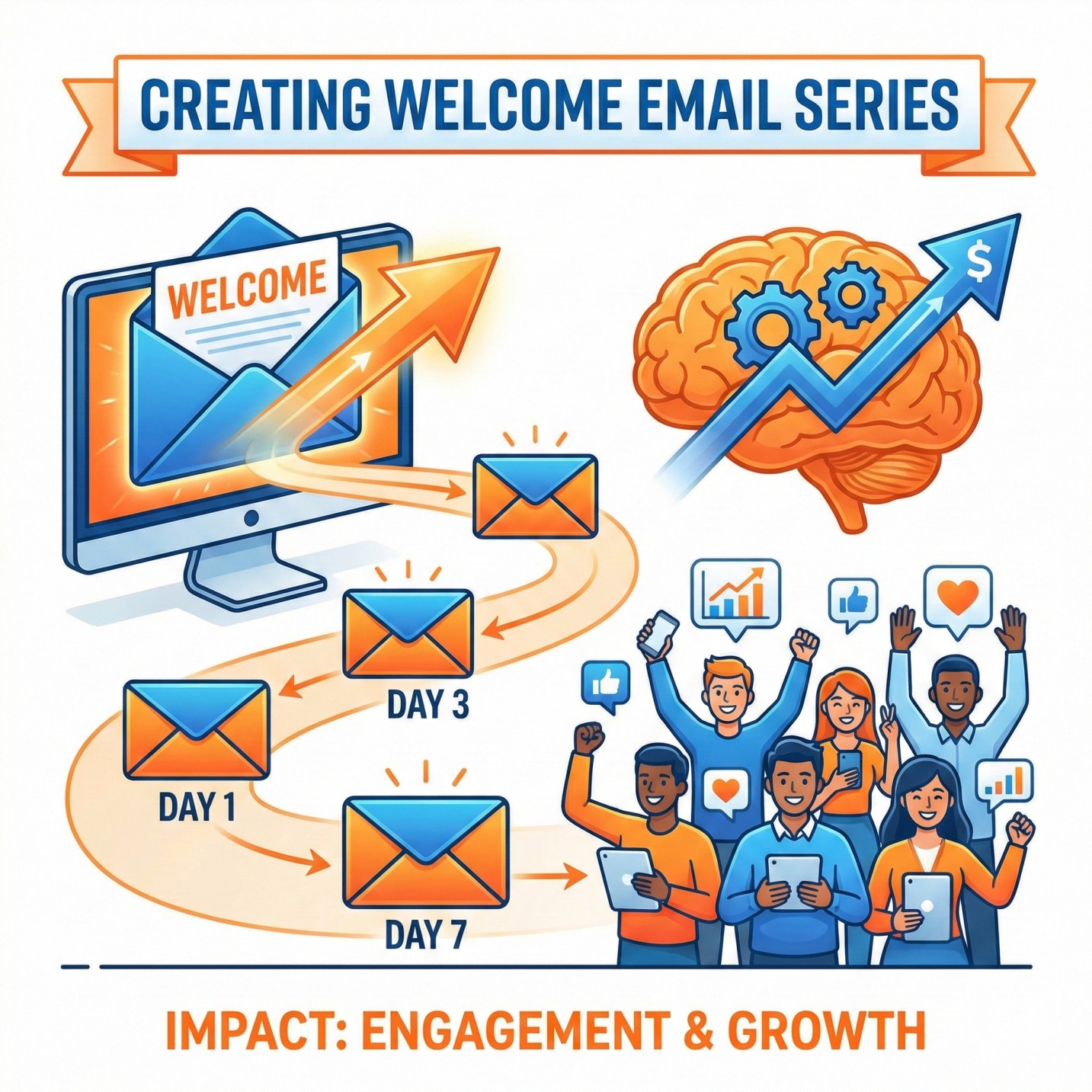
A welcome email series — sometimes called a welcome sequence or onboarding drip campaign — is an automated set of emails sent to new subscribers over a defined period of time. Unlike a single welcome email, a series allows you to tell your brand story, build trust, demonstrate value, and guide subscribers toward a meaningful action — all in a structured, intentional way.
In this guide, we’ll cover everything you need to know to build a welcome email series that works: from the psychology behind why it matters, to the anatomy of each email, to design, timing, personalization, and measurement. Whether you’re a solopreneur just starting your list or a marketing team scaling your automation, this article will give you the tools to create a sequence your new subscribers actually want to read.
Why a Welcome Email Series Matters
The Numbers Don’t Lie
Welcome emails consistently outperform regular marketing emails across every key metric. On average, welcome emails see open rates of 50–60%, compared to the industry average of around 20–25% for standard promotional emails. The click-through rate for welcome emails is also significantly higher — often three to five times that of regular campaigns.
Why? Because timing is everything. When someone subscribes to your list, they’re at peak interest. They’ve just discovered your brand, taken an intentional action, and they’re primed to engage. Capitalizing on that moment with a single email is good. Capitalizing on it with a thoughtful, multi-email sequence is even better.
A Single Email Isn’t Enough
Many businesses send one welcome email and call it done. While one email is far better than none, it presents a significant missed opportunity. A single email has to do too much — introduce your brand, set expectations, deliver a lead magnet (if applicable), build trust, and inspire action — all in one shot. The result is often an email that tries to do everything and accomplishes little.
A series, by contrast, lets you pace the conversation. You can introduce yourself in the first email, share your story in the second, offer value in the third, address objections in the fourth, and make your pitch in the fifth. Each email has a clear purpose and a single call to action, making it far more effective.
Building Relationships, Not Just Lists
The ultimate goal of a welcome series isn’t to sell — it’s to build a relationship. Subscribers who feel connected to your brand are more likely to open your emails consistently, engage with your content, buy your products, and refer their friends. A welcome series is the foundation of that relationship. It’s your chance to show new subscribers who you are, what you stand for, and why they made the right choice by joining your community.
Before You Write a Single Word: Strategic Groundwork
Define Your Goal
Before you open your email platform and start typing, get clear on what you want your welcome series to accomplish. Common goals include:
- Converting subscribers into first-time buyers
- Educating subscribers about your product or service
- Driving traffic to key content pieces (blog posts, videos, podcasts)
- Encouraging community participation (social media follows, group membership)
- Collecting data through surveys or preference centers
- Segmenting subscribers based on interests or behavior
Your goal shapes everything — the number of emails you send, the tone you use, the calls to action you include, and how you measure success. Don’t skip this step.
Know Your Audience
Who is your ideal subscriber? What problems are they trying to solve? What are their biggest fears and frustrations? What language do they use when they talk about those problems? The more intimately you understand your audience, the more personally and effectively you can speak to them.
If you have existing customer data, mine it. Survey your current subscribers. Review the comments and questions you get on social media. Read reviews of competing products. The language your audience uses is gold — use it in your emails.
Map the Customer Journey
Think about where your new subscriber is in their journey with you. Are they total strangers who found your brand through a paid ad? Or are they warm leads who’ve been following you on Instagram for months? The answer affects how much context-setting your first email needs and how quickly you can move toward a sales message.
Map out the path you want subscribers to take — from “just joined the list” to “ready to buy” — and let that map guide the structure of your series.
Choose Your Email Platform
Your welcome series will live inside an email automation platform. Popular options include Mailchimp, ConvertKit, ActiveCampaign, Klaviyo, Drip, HubSpot, and dozens of others. Each platform has different strengths — some are better for simple automation, others for complex behavioral segmentation. Choose the one that fits your current needs and budget, and make sure it supports automated sequences triggered by subscription.
The Anatomy of a Welcome Email Series
There’s no single “right” number of emails for a welcome sequence. Most effective sequences run between three and seven emails, spread over one to two weeks. Here’s a proven framework you can adapt to your brand.
Email 1: The Immediate Welcome (Send: Immediately Upon Signup)
This email should arrive within minutes of someone subscribing — ideally within five minutes. The subscriber’s inbox is still open. They’re expecting to hear from you. Strike while the iron is hot.
Purpose: Confirm the subscription, deliver what you promised (if anything), and make a warm first impression.
Key Elements:
Subject Line — Keep it simple and warm. Something like “Welcome! Here’s what happens next” or “You’re in — here’s your [lead magnet]” works well. Avoid being overly salesy. This email is a handshake, not a pitch.
The Opening — Welcome them warmly and personally. Use their first name if you have it. Express genuine gratitude that they’ve joined. This is not the place for corporate-speak — sound like a human being.
Deliver the Goods — If you offered a lead magnet (a free ebook, checklist, discount code, template, mini-course, etc.), deliver it here clearly and prominently. Make it easy to access. Don’t bury it.
Set Expectations — Briefly tell them what’s coming next. How often will you email them? What kind of content will they receive? This transparency builds trust and reduces future unsubscribes. Something like: “Over the next few days, I’ll share [X, Y, and Z] — things I wish I’d known when I was starting out” works beautifully.
One Simple CTA — If you want them to do one thing right now, make it clear and frictionless. Follow you on Instagram. Watch a welcome video. Reply to say hello. Whatever you choose, keep it to one action — not five.
Sample Subject Lines:
- “Welcome to [Brand Name]! Your [freebie] is inside 🎉”
- “You made it! Here’s what to expect”
- “Hi [First Name] — glad you’re here”
Email 2: Your Story (Send: 1–2 Days After Email 1)
Now that the subscriber has received their initial welcome and (hopefully) their freebie, it’s time to deepen the connection by sharing your story.
Purpose: Build trust and emotional connection by revealing the human behind the brand.
People buy from people they trust. And trust is built on authenticity. This email is where you let your guard down, share your origin story, and show subscribers why you do what you do.
Key Elements:
Your Origin Story — Where did you come from? What problem were you trying to solve when you started your business or began your journey? What failure, turning point, or “aha moment” led you here? Be specific and honest. Vague, polished success stories are forgettable. Raw, specific turning points are memorable.
The Problem You Solve — Tie your story to the subscriber’s reality. Show them that you understand their struggle because you’ve lived it (or something similar). This creates an “I get it” moment that transforms a stranger into a kindred spirit.
Your Mission — What do you stand for? What change do you want to see in the world, your industry, or your subscriber’s life? A clear sense of mission gives subscribers a reason to invest in you emotionally.
No Hard Sell Here — Email 2 is not the place to sell. It’s the place to connect. Resist the temptation to include a product pitch. Let the relationship breathe.
Sample Subject Lines:
- “Here’s why I started [Brand Name]”
- “The story I don’t tell very often…”
- “I almost gave up before I started — here’s what happened”
Email 3: Value Bomb (Send: 2–3 Days After Email 2)
By now, you’ve welcomed your subscriber and shared your story. It’s time to demonstrate your expertise by delivering pure, actionable value — no strings attached.
Purpose: Establish authority and goodwill by giving generously before you ask for anything.
Key Elements:
A High-Value Piece of Content — This could be your single best blog post, a practical how-to guide, a curated resource list, a case study, a video tutorial, or any piece of content that is genuinely useful and demonstrates your expertise. Think about what transformation or quick win you can offer your subscriber right now.
Make It Actionable — The best kind of value is the kind that moves someone forward. Don’t just share information — give your subscriber something they can implement today and see results from. Quick wins build momentum and cement your credibility.
Why You’re Sharing This — Briefly explain why you chose this specific piece of content for them. “I share this with every new subscriber because it’s the foundation of everything I teach” or “This is the post that changed how I think about X” gives context and importance to the resource.
Light Touch CTA — You can include a gentle call to action here — perhaps asking them to reply with their thoughts, share it with a friend, or explore a related piece of content.
Sample Subject Lines:
- “The [topic] guide I wish I’d had years ago”
- “My best advice for someone just starting out with [X]”
- “[First Name], this is the resource I share with everyone”
Email 4: Social Proof and Credibility (Send: 3–5 Days After Email 3)
Trust is cumulative. By Email 4, your subscriber has received value from you multiple times. Now it’s time to let others speak on your behalf.
Purpose: Reinforce trust and credibility through testimonials, success stories, and social proof.
Key Elements:
Customer Stories or Testimonials — Share real stories from real customers. Specific, results-oriented testimonials are dramatically more powerful than vague praise. “This program helped me lose 20 pounds in three months” is infinitely more compelling than “I really liked this program!” Include names, photos, and details whenever possible.
Case Studies or Transformations — Walk the subscriber through a before-and-after journey. Where was someone before they worked with you or used your product? Where are they now? This narrative format is persuasive and humanizing.
Numbers and Credentials — If you have impressive numbers (clients served, years in business, articles published, podcast downloads, certifications), share them here. Numbers add credibility. Just don’t lead with them — lead with stories, support with data.
A Bridge to Your Offer — You can begin to mention your product or service here, but frame it in the context of how it helped the people you’ve featured. “Sarah got these results using my [Program Name]…” This plants the seed for the pitch without being pushy.
Sample Subject Lines:
- “How [Name] went from [problem] to [result] in [timeframe]”
- “Real results from real people”
- “What [X] people are saying about [Brand Name]”
Email 5: The Pitch (Send: 5–7 Days After Email 4)
You’ve welcomed, connected, delivered value, and built credibility. Now it’s time to make your offer.
Purpose: Convert interested subscribers into buyers with a clear, compelling call to action.
Key Elements:
Lead With the Transformation — Don’t open with “I’m selling a course.” Open with the transformation your product or service enables. Paint a picture of where the subscriber could be if they take action. Make the dream vivid and specific.
Clearly Describe Your Offer — What exactly are you offering? What does it include? How does it work? Be clear, concise, and benefit-focused. For every feature you mention, explain the benefit it provides. “You’ll get 12 video lessons” becomes “You’ll get 12 video lessons that walk you step by step through [specific outcome].”
Address Objections — What are the most common reasons someone might hesitate to buy? Price? Time? Skepticism that it will work for them? Proactively address these objections in your email. This shows empathy and reduces friction.
Create Urgency (Honestly) — If there’s a legitimate reason to act now — a limited-time discount, a bonus that expires, an enrollment deadline, limited spots — communicate it clearly. Manufactured urgency damages trust; real urgency drives action.
A Clear, Prominent CTA — Include your call to action multiple times in the email (at the top, middle, and bottom for longer emails). Make the link stand out visually. Use action-oriented button text like “Get Instant Access,” “Join the Program,” or “Claim Your Discount.”
Sample Subject Lines:
- “Here’s how I can help you [achieve result]”
- “Ready to [transformation]? Here’s what I’ve got for you”
- “[First Name], this is what I’ve been building toward”
Email 6: The Follow-Up / Objection Crusher (Send: 1–2 Days After Email 5)
Many subscribers won’t buy the first time they see your offer. That’s normal. Email 6 gives you another opportunity to reach people who are interested but not yet committed.
Purpose: Re-engage undecided subscribers by addressing hesitations and reinforcing the offer’s value.
Key Elements:
Acknowledge That They’ve Seen It — A brief, honest acknowledgment that you’ve shared your offer before keeps things transparent. “I know I mentioned [Product] the other day…”
Address the Top Objection — What’s the number one reason someone doesn’t buy? Dedicate this email to dismantling that objection with evidence, logic, and empathy. Common objections include: “Is this really for me?”, “I can’t afford it right now,” “I’m too busy,” or “I’ve tried things like this before and they didn’t work.”
FAQ Format — If you have multiple objections to address, a simple Q&A format works well. “I keep getting questions about [Program Name], so let me answer the most common ones…”
Reiterate the Key Benefits — Remind subscribers of the transformation your offer enables without rewriting your entire pitch email. Keep it focused.
Reinforce Any Urgency — If your offer has a deadline or limited availability, remind them. If it doesn’t, consider adding a legitimate time-limited bonus to create momentum.
Sample Subject Lines:
- “Still thinking about it? Let me help”
- “The question I keep getting about [Product]”
- “Last chance to [benefit] before [deadline/bonus expires]”
Email 7: The “What’s Next” Email (Send: After the Sales Push)
Whether or not a subscriber bought, they need to know what their ongoing relationship with you looks like.
Purpose: Set expectations for the long-term, keep non-buyers engaged, and welcome buyers into the next phase.
Key Elements:
For Everyone — Thank them for being part of your community. Share what they can expect from your regular emails going forward. Reiterate the value you’ll continue to provide.
For Buyers (via segmentation) — Congratulate them, explain next steps, and transition them into a customer onboarding sequence.
For Non-Buyers — Don’t write them off. Let them know the door is always open, continue delivering value, and trust that when the time is right, they’ll be ready.
An Invitation to Connect — Encourage subscribers to follow you on social media, join your Facebook group, or listen to your podcast. Give them more ways to engage with your world.
Sample Subject Lines:
- “What to expect going forward”
- “You’re officially part of the family 🙌”
- “Here’s what comes next”
Timing and Frequency: Getting the Cadence Right
How Often Should You Send?
The ideal sending frequency for a welcome series depends on your audience and content, but a general rule is to strike while engagement is high. Most successful sequences send emails every one to two days during the active period. Sending too infrequently (e.g., once a week) allows interest to cool between emails. Sending too frequently (e.g., multiple times per day) can feel overwhelming and trigger unsubscribes.
A practical cadence for a six-email sequence might look like this:
- Email 1: Immediately upon signup
- Email 2: Day 1–2
- Email 3: Day 3–4
- Email 4: Day 5–6
- Email 5: Day 7–8
- Email 6: Day 9
- Email 7: Day 11–12
Time of Day
Research consistently shows that emails sent mid-morning on weekdays (around 9–11 AM in the subscriber’s timezone) see the highest open rates. However, your specific audience may behave differently. Once you have enough data, test different send times and let your analytics guide you.
Adjust for Your Audience
B2B audiences often respond better to emails sent during business hours on weekdays. B2C audiences, particularly in lifestyle, fashion, or entertainment niches, may be more receptive on evenings or weekends. Know your audience and test accordingly.
Writing Tips for High-Performing Welcome Emails
Write Like a Human Being
The biggest mistake brands make in welcome emails is sounding like a corporation. Subscribers don’t want a press release — they want a conversation. Write the way you’d talk to a friend who’s just discovered your work. Use contractions. Start sentences with “I” or “You.” Let your personality shine.
Subject Lines Are Everything
An email with a brilliant body copy and a boring subject line will never be opened. Subject lines should be intriguing, personal, or benefit-driven. Test different approaches: questions, curiosity gaps, personal statements, numbers, and emojis. A/B test your subject lines whenever possible and double down on what works.
Keep Paragraphs Short
Long, dense blocks of text are email killers. Keep paragraphs to two to four lines. Use white space generously. Make your emails scannable — many readers skim before they decide whether to read fully. Use bold text to highlight key phrases or sentences, but don’t overdo it.
One Email, One CTA
Every email in your welcome series should have a single, clear call to action. Giving subscribers multiple options creates decision paralysis and dilutes your results. Decide what the ONE thing you want them to do is, and design the entire email around getting them to do it.
Use the Preview Text Strategically
The preview text (also called pre-header text) is the snippet of text that appears after the subject line in most email clients. It’s prime real estate. Use it to extend your subject line, add intrigue, or reinforce your message. Don’t waste it by letting it default to “View this email in your browser.”
Personalization Goes Beyond the First Name
Using a subscriber’s first name is a start, but true personalization goes deeper. Segment your list based on how people subscribed (which opt-in form, which lead magnet, which landing page) and tailor your welcome series accordingly. If someone subscribed to get a beginner’s guide, don’t send them advanced content in Email 3. Meet them where they are.
Tell Stories
Stories are the most powerful tool in a copywriter’s arsenal. They engage, they entertain, and they persuade — without feeling like persuasion. Weave stories throughout your welcome series: your origin story, customer transformation stories, even short anecdotes that illustrate a point. Stories make your emails memorable in a way that bullet points never will.
Design Best Practices
Keep It Clean
Overwhelming email designs with too many images, colors, and fonts work against you. Clean, simple designs with clear visual hierarchy outperform busy, cluttered ones. Use your brand colors and fonts consistently, but don’t sacrifice readability for aesthetics.
Mobile First
More than 60% of emails are now opened on mobile devices. Design your welcome emails with a mobile-first mindset: single-column layouts, large fonts (minimum 16px body text), large clickable buttons (minimum 44px height), and images that load quickly. Always preview your emails on mobile before sending.
Plain Text vs. HTML
Surprisingly, plain text emails — or emails that look like plain text — often outperform elaborate HTML designs in terms of open and reply rates. They feel more personal and less promotional. For your welcome series, consider using a simple, lightly branded template rather than a highly designed newsletter format. Save the fancy design for your promotional campaigns.
Images: Use Thoughtfully
Images can enhance your emails, but they can also slow load times and get blocked by email clients. Use images purposefully — a headshot in your story email, a product photo in your pitch email, a testimonial screenshot in your social proof email. Don’t include images just for the sake of having them.
Accessible Design
Make your emails accessible to subscribers with visual impairments: use sufficient color contrast, include alt text for all images, and ensure your emails can be read without images enabled. Accessibility is both the right thing to do and good for deliverability.
Segmentation and Personalization at Scale
Why Segmentation Matters
Not all subscribers are the same. Someone who signed up for a beginner’s checklist has different needs than someone who downloaded an advanced guide. Sending the same welcome series to everyone leaves performance on the table.
Segmentation allows you to create different welcome sequences for different subscriber groups and tailor your messaging accordingly. Even simple segmentation — based on which opt-in form someone used — can significantly improve engagement.
Common Segmentation Variables
- The lead magnet or opt-in source (which piece of content or form they used to subscribe)
- Interests or preferences (gathered via a survey or preference center in your welcome series)
- Demographics (location, industry, job title for B2B)
- Behavior (emails opened, links clicked, pages visited)
- Purchase history (for e-commerce)
Dynamic Content
Many email platforms allow you to use dynamic content blocks that change based on subscriber data. This means you can send a single email that displays different content to different segments — a powerful way to personalize at scale without creating dozens of separate campaigns.
The Preference Center
One clever tactic is to include a link to a “preference center” in one of your early welcome emails. Ask subscribers what they’re most interested in, how often they want to hear from you, or what their biggest challenge is. Use their answers to tailor subsequent emails and set appropriate sending frequency. This not only improves relevance but also reduces unsubscribes.
Testing and Optimization
A/B Testing
Never assume your first draft is your best. A/B testing — sending two versions of an email to different segments of your list and measuring which performs better — is one of the most powerful tools for improving your welcome series over time.
Variables worth testing include subject lines, preview text, from names, send times, email length, CTA button text and color, the number of emails in the series, and the spacing between emails. Test one variable at a time for clean results.
Key Metrics to Track
For each email in your welcome series, monitor:
Open Rate — What percentage of recipients opened the email? This reflects your subject line effectiveness and sender reputation.
Click-Through Rate (CTR) — What percentage of openers clicked a link? This reflects the quality and relevance of your content and the strength of your CTA.
Conversion Rate — What percentage of subscribers completed the desired action (purchased, registered, downloaded, etc.)?
Unsubscribe Rate — What percentage unsubscribed after receiving this email? A spike in unsubscribes after a specific email signals a problem with that email.
Revenue Per Subscriber — If your welcome series has a sales component, this is the most important metric of all. Divide total revenue generated by the sequence by the number of subscribers who entered it.
Iterate Continuously
Your welcome series is never “done.” Revisit it regularly — at minimum quarterly — to update references, improve copy, add new social proof, and incorporate learnings from your A/B tests. The best welcome sequences are living documents that get better over time.
Technical Setup: Making It All Work
Trigger Configuration
Your welcome series should trigger automatically the moment someone subscribes. In your email platform, set up an automation or workflow that begins with the trigger “subscribes to list” or “submits form X.” This ensures every subscriber enters the sequence immediately, with no manual intervention from you.
Avoid Overlap With Regular Campaigns
Consider whether subscribers in your welcome sequence should simultaneously receive your regular email campaigns. In most cases, the answer is no — at least not during the active welcome period. Too many emails from you at once increases unsubscribes and dilutes the welcome experience. Most platforms allow you to exclude subscribers in active workflows from your regular campaigns.
Deliverability Best Practices
Even the best welcome email series fails if emails land in the spam folder. To maximize deliverability, use a reputable email service provider, authenticate your domain with SPF, DKIM, and DMARC records, maintain a clean list by removing invalid addresses regularly, avoid spam trigger words in subject lines, and warm up new domains gradually.
Double Opt-In vs. Single Opt-In
Double opt-in requires subscribers to confirm their email address before entering your sequence. It results in a smaller but higher-quality list with better engagement rates and fewer bounces. Single opt-in removes that friction and results in higher signup volume but potentially more invalid addresses and lower engagement. The right choice depends on your goals and audience. Many marketers use single opt-in for lower-friction growth and manage list quality through regular cleaning.
Common Mistakes to Avoid
Sending only one welcome email. As we’ve discussed, a single email can’t do justice to the relationship you’re trying to build. Invest in a sequence.
Making it all about you. Your subscribers care about their own problems, goals, and aspirations — not your company history or product features. Frame everything in terms of how it benefits them.
Being too salesy too soon. If your first email is a pitch, you’ve broken trust before it was ever built. Earn the right to sell by delivering value first.
Ignoring mobile optimization. More than half your subscribers will open your emails on a phone. If your emails are hard to read on mobile, you’re losing people.
Using a generic “noreply” sender address. Emails from “noreply@yourcompany.com” are cold and impersonal. Use a real person’s name and email address (“Sarah from BrandName” or “hello@brandname.com“) to encourage replies and build connection.
Sending inconsistently. If you promise weekly emails and then disappear for a month, you’ve eroded trust. Stick to the cadence you set in Email 1.
Never updating your sequence. Evergreen doesn’t mean eternal. Testimonials get stale, offers change, cultural references date themselves. Revisit your sequence regularly and keep it fresh.
Not segmenting. Sending the same welcome series to every subscriber regardless of how they joined or what they’re interested in is a missed opportunity. Even basic segmentation dramatically improves relevance and results.
Welcome Email Series for Different Business Types
E-Commerce Brands
For e-commerce, the welcome series typically revolves around a discount offer in Email 1, brand story and values in Email 2, bestseller highlights or social proof in Email 3, and a final nudge with urgency around the discount expiry in Email 4. The goal is a first purchase, and the series should be designed with that specific conversion in mind.
SaaS and Software
For SaaS businesses, the welcome series is often an onboarding sequence that helps new users get value from the product quickly. The first email welcomes the user and directs them to complete a key setup step. Subsequent emails walk them through core features, share use cases and success stories, and encourage upgrade from free to paid if applicable.
Coaches, Consultants, and Service Providers
For service businesses built on personal relationships, the welcome series should be deeply personal and story-driven. The focus is on building connection, establishing authority, and moving interested subscribers toward booking a discovery call or attending a webinar.
Content Creators and Media Brands
For bloggers, podcasters, and newsletter writers, the welcome series is about showing new subscribers the best of what you’ve created. Share your most popular pieces of content, tell your story, and give them a reason to look forward to every email you send.
Non-Profits and Mission-Driven Organizations
For non-profits, the welcome series centers on mission, impact, and community. Show new subscribers the change their support makes possible. Share beneficiary stories. Invite them to take a meaningful first action — a donation, a share, a volunteer signup.
Advanced Strategies
Behavioral Triggers
Beyond simple time-based sequences, advanced welcome series use behavioral triggers to personalize the subscriber experience in real time. If a subscriber clicks the link to your sales page in Email 5 but doesn’t buy, trigger a follow-up email specifically for people who showed that intent. If they click a specific type of content, tag them accordingly and adjust subsequent emails. Behavioral automation makes your sequence feel uncannily relevant.
SMS Integration
Many brands are now complementing their email welcome series with SMS messages. A text message confirming the subscription immediately (even before the first email arrives) can boost engagement and make new subscribers feel instantly seen. Just make sure you have explicit consent for SMS and that your messages add value, not noise.
Video Emails
Embedding a short personal video — even a 60-second webcam recording — in your welcome email can dramatically increase engagement and connection. Video shows subscribers that there’s a real human behind the brand. Even a simple “Hey, I’m Sarah, welcome to my community” video in Email 2 can transform the relationship.
Re-Engagement Sequences
If a subscriber goes through your welcome series without engaging (no opens, no clicks), don’t write them off. Build a re-engagement sequence that fires after a defined period of inactivity: “Hey, I noticed you haven’t opened any of my emails. Are you still interested in [topic]? No worries if not — just let me know and I’ll stop sending.” This wins back some subscribers and helps you clean your list of truly uninterested contacts.
Conclusion: The Welcome Series as Your Most Valuable Marketing Asset
A well-crafted welcome email series is arguably the highest-leverage marketing asset you can build. Unlike social media posts that disappear into the algorithm or ads that stop working when you stop paying, your welcome series works around the clock, 365 days a year, automatically converting new subscribers into engaged community members and loyal customers.
The investment required to build a strong welcome sequence — whether it’s a few hours of writing time or a few days of careful planning and testing — pays dividends indefinitely. Every new subscriber who joins your list from this moment forward will experience the best of your brand in a structured, intentional, relationship-building way.

Author