A/B Testing vs Split Testing: When & How to Use Each
A comprehensive guide for marketers, CRO specialists, and growth teams
Optimization is no longer optional in digital marketing. Whether you run paid ads, landing pages, SaaS funnels, or eCommerce stores, testing is the foundation of improving performance. However, one of the most misunderstood topics in Conversion Rate Optimization (CRO) is the difference between A/B testing and split testing.
Many marketers use the terms interchangeably — but they are not always the same. Understanding the difference helps you choose the right method, avoid invalid results, and maximize ROI.
This in-depth guide explains:
What A/B testing is
What split testing is
Key differences between them
When to use each method
Step-by-step implementation
Statistical significance & traffic requirements
Tools & best practices
Common mistakes to avoid
Real-world examples
Advanced optimization strategies
Understanding Testing in Conversion Optimization
Testing allows marketers to:
✔ Improve conversion rates
✔ Reduce acquisition costs
✔ Increase engagement & retention
✔ Improve UX and customer journey
✔ Make data-driven decisions
✔ Scale winning strategies
Instead of guessing what works, testing lets users decide.
What is A/B Testing?
Definition
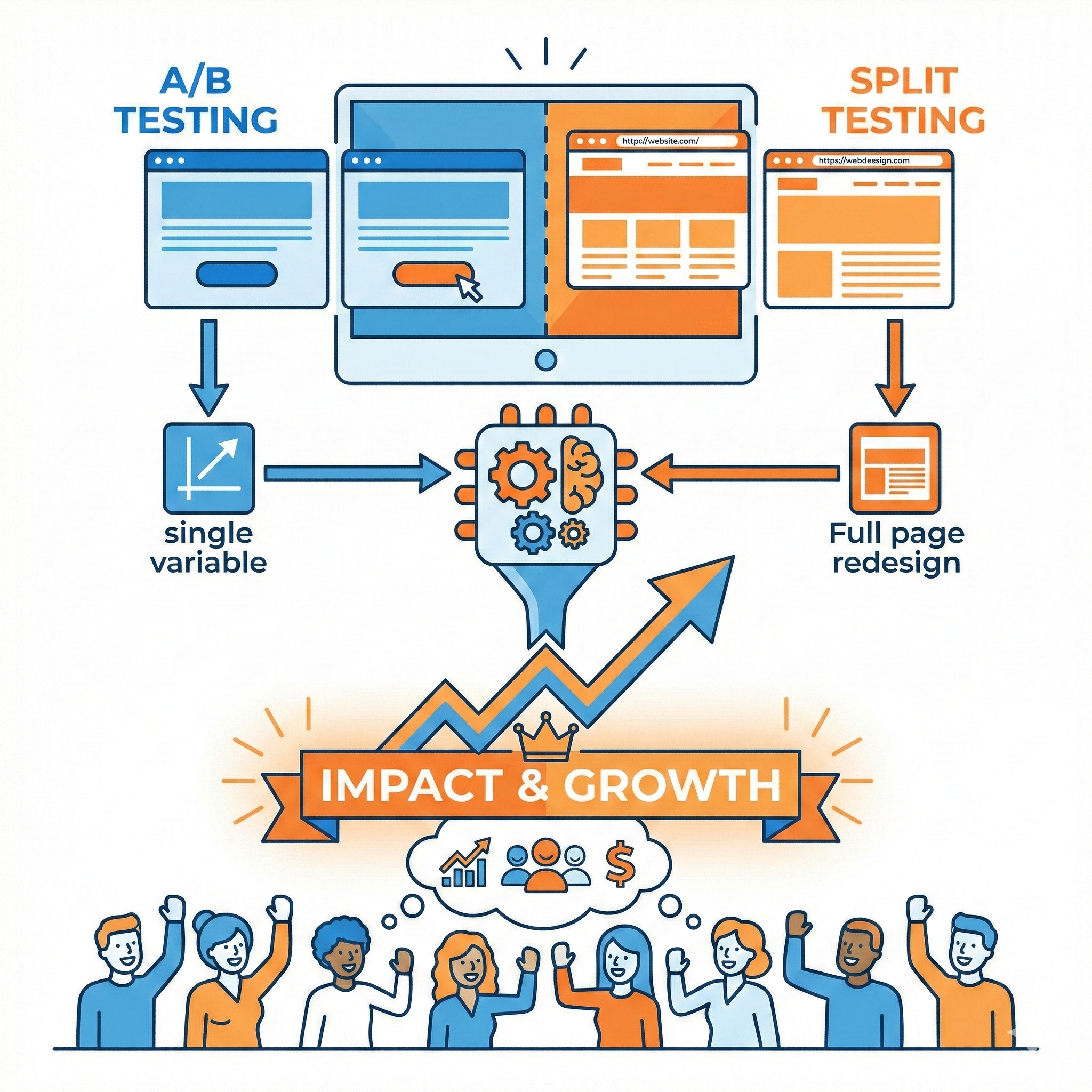
A/B testing (also called bucket testing) compares two versions of a single variable to determine which performs better.
Visitors are randomly shown Version A or Version B, and performance metrics are measured.
Example
You test:
Version A → Blue CTA button
Version B → Orange CTA button
Everything else remains identical.
How A/B Testing Works
Identify a variable to test
Create Version A (control)
Create Version B (variation)
Split traffic randomly
Measure performance
Determine statistical significance
Implement winner
What Can You Test with A/B Testing?
1. Headlines
Emotional vs direct
Benefit-driven vs curiosity-based
2. Call-to-Action (CTA)
Color
Placement
Text (“Buy Now” vs “Get Started”)
3. Images
Product vs lifestyle imagery
Human faces vs graphics
4. Form Fields
3 fields vs 6 fields
Email first vs phone first
5. Pricing Display
Monthly vs yearly emphasis
Discount messaging
6. Email Subject Lines
Personalized vs generic
Urgency vs curiosity
When A/B Testing Works Best
Use A/B testing when:
✅ You want to test one specific change
✅ Traffic is moderate or limited
✅ You want quick insights
✅ You are optimizing micro-elements
✅ You need clear cause-and-effect results
Advantages of A/B Testing
✔ Easy to implement
✔ Clear results
✔ Low risk
✔ Ideal for continuous optimization
✔ Requires less traffic
✔ Precise insights
Limitations
✖ Tests only one change at a time
✖ Can be slow for large improvements
✖ May miss interaction effects
What is Split Testing?
Definition
Split testing compares two completely different versions of a page, design, or experience.
Instead of changing one element, you test entire variations.
Example
Version A → Long-form landing page
Version B → Minimalist short page
OR
Version A → Traditional layout
Version B → Video-first design
How Split Testing Works
Create two distinct page versions
Host on separate URLs or variants
Divide traffic between versions
Track performance metrics
Analyze conversion differences
What Can You Test with Split Testing?
1. Landing Page Designs
Long-form vs short-form
Single column vs multi-column
2. Funnel Structure
One-step checkout vs multi-step checkout
Lead magnet vs direct sale
3. Page Layout
Video hero vs static image
Minimal design vs detailed content
4. Messaging Strategy
Emotional storytelling vs logical benefits
Problem-focused vs aspiration-focused
5. Navigation Experience
With navigation vs distraction-free
Scroll page vs multi-page journey
When Split Testing Works Best
Use split testing when:
✅ You want to test major design differences
✅ You are redesigning a page
✅ You want to compare UX strategies
✅ You suspect layout impacts conversion
✅ You are launching a new funnel approach
Advantages of Split Testing
✔ Tests major improvements
✔ Reveals user experience preferences
✔ Faster large-scale insights
✔ Useful for redesign validation
Limitations
✖ Requires more traffic
✖ Harder to identify exact cause of improvement
✖ More development effort
✖ Higher risk of performance drop
A/B Testing vs Split Testing: Key Differences
| Factor | A/B Testing | Split Testing |
|---|---|---|
| Scope | Single element | Entire design/page |
| Complexity | Low | Medium to high |
| Traffic needed | Low–moderate | Moderate–high |
| Insight type | Micro optimization | Macro experience |
| Implementation | Simple | More technical |
| Risk | Low | Medium |
| Use case | Continuous improvement | Redesign & strategy testing |
| Speed of insight | Gradual | Faster for major changes |
| Root cause clarity | Clear | Less precise |
When to Use A/B Testing vs Split Testing
Use A/B Testing When:
✔ Optimizing landing page elements
✔ Improving CTR in ads
✔ Increasing email open rates
✔ Reducing form friction
✔ Enhancing button performance
✔ Testing micro-copy
Use Split Testing When:
✔ Launching a new website design
✔ Comparing funnel strategies
✔ Testing conversion architecture
✔ Validating UX redesign
✔ Evaluating messaging approach
Step-by-Step Process for Effective Testing
Step 1: Define Objective
Examples:
Increase signups by 20%
Improve checkout completion
Reduce bounce rate
Step 2: Identify KPI Metrics
Primary metrics:
Conversion rate
Revenue per visitor
CPA
CTR
Secondary metrics:
Bounce rate
Time on page
Scroll depth
Step 3: Develop Hypothesis
Weak hypothesis:
“Changing color might improve conversions.”
Strong hypothesis:
“Changing CTA color to orange will increase conversions because it creates visual contrast and draws attention.”
Step 4: Calculate Sample Size
Avoid stopping tests early. Statistical significance ensures reliable results.
Key factors:
Traffic volume
Baseline conversion rate
Minimum detectable effect
Confidence level (usually 95%)
Step 5: Run the Test
Best practices:
✔ Random traffic distribution
✔ Run for full business cycles
✔ Avoid mid-test changes
✔ Test one hypothesis at a time
Step 6: Analyze Results
Evaluate:
Conversion lift
Statistical significance
Revenue impact
User behavior changes
Step 7: Implement & Iterate
Optimization is continuous.
Test → Learn → Improve → Repeat
Traffic Requirements & Statistical Significance
Why Traffic Matters
Low traffic can produce misleading results.
General Guidelines
A/B Testing
Minimum: 1,000 conversions per variation ideal
Smaller sites can test longer
Split Testing
Requires higher traffic due to larger differences
Recommended for high-volume pages
Statistical Confidence
Aim for:
✔ 95% confidence level
✔ Minimum 2 full business cycles
✔ Avoid weekend-only testing
Tools for A/B and Split Testing
Website & Landing Page Testing
Google Optimize alternatives (VWO, Convert)
Optimizely
VWO
Unbounce
Instapage
Email Testing
Mailchimp
HubSpot
ActiveCampaign
Ad Testing
Meta Ads Experiments
Google Ads Experments
Heatmaps & Behavior Tools
Hotjar
Microsoft Clarity
Crazy Egg
Real-World Examples
Example 1: CTA Optimization (A/B Test)
A SaaS company tested:
A: “Start Free Trial”
B: “Get Started Free”
Result: 18% conversion increase.
Example 2: Landing Page Redesign (Split Test)
An eCommerce brand tested:
A: Traditional product page
B: Storytelling + video-first page
Result: 32% higher conversions.
Example 3: Checkout Flow (Split Test)
One-page checkout
Multi-step checkout
Result: Multi-step improved completion rate.
Common Testing Mistakes to Avoid
1. Testing Too Many Variables
Leads to unclear results.
2. Ending Tests Early
False winners are common.
3. Ignoring Statistical Significance
Small samples mislead decisions.
4. Testing Without Hypothesis
Leads to random experimentation.
5. Not Segmenting Results
Different audiences behave differently.
6. Running Tests During Traffic Spikes
Seasonality can skew results.
7. Copying Competitor Changes Blindly
What works for them may not work for you.
Advanced Optimization Strategies
Multivariate Testing
Tests multiple variables simultaneously.
Best for:
High traffic sites
Complex optimization
Sequential Testing
Continuous testing cycles to refine results.
Personalization Testing
Show variations based on:
device
location
behavior
traffic source
AI-Driven Testing
Modern tools auto-optimize variations using machine learning.
A/B Testing & Split Testing in Performance Marketing
As a digital marketer, testing impacts:
Paid Ads
creatives
copy
landing pages
SEO & CRO
content layout
CTA placement
engagement elements
Email Funnels
subject lines
timing
personalization
Conversion Funnels
checkout flow
lead forms
upsell structure
How to Decide Which Testing Method to Use
Ask yourself:
✔ Am I testing a small element? → A/B test
✔ Am I testing the entire experience? → Split test
✔ Do I want micro improvements? → A/B test
✔ Am I redesigning strategy? → Split test
✔ Do I have low traffic? → A/B test
✔ Do I want big conversion jumps? → Split test
Final Thoughts
Both A/B testing and split testing are powerful tools in a growth marketer’s toolkit. The key is understanding when to use each method and how to interpret results correctly.
Remember:
✔ A/B testing = micro improvements
✔ Split testing = macro experience comparison
✔ Data beats assumptions
✔ Continuous testing drives growth
✔ Optimization is an ongoing process
Organizations that build a culture of experimentation consistently outperform competitors — not because they guess better, but because they learn faster.

Author