

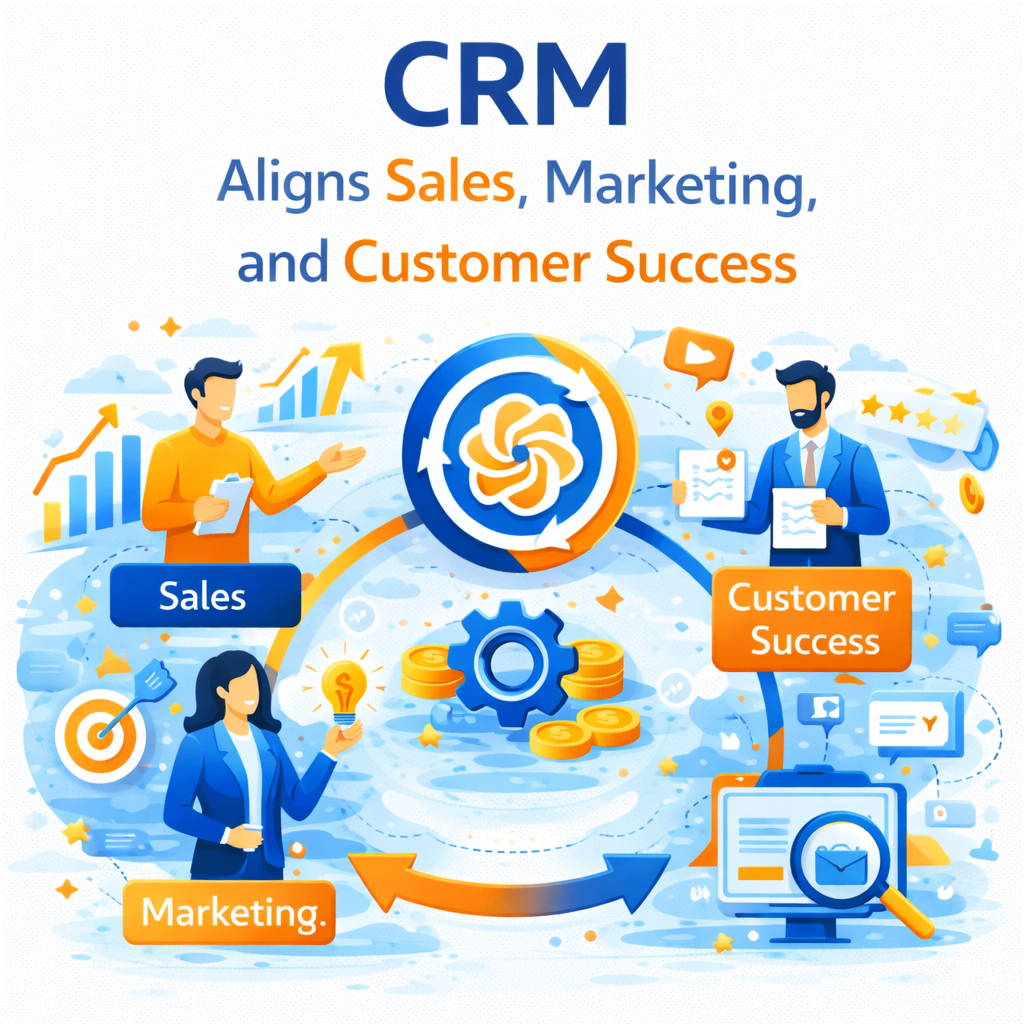
How CRM Aligns Sales, Marketing, and Customer Success
Turning Silos into a Single Revenue Engine
Introduction: Why Alignment Is a Growth Imperative
In many organizations, Sales, Marketing, and Customer Success are expected to work toward a common objective: sustainable revenue growth and long-term customer value. However, in practice, these teams often operate in silos. Marketing focuses on lead generation, Sales prioritizes deal closures, and Customer Success concentrates on retention and support. Each team uses different tools, tracks different metrics, and interprets success differently.
This lack of alignment leads to predictable problems:
-
Poor lead quality disputes between Sales and Marketing
-
Broken handoffs after deals close
-
Customers repeating the same information to multiple teams
-
Missed upsell and renewal opportunities
-
Increased churn and higher acquisition costs
Customer Relationship Management (CRM) systems exist to solve exactly this problem. When implemented strategically, a CRM becomes the central operating system that connects teams, aligns incentives, and ensures a consistent customer experience from first touch to long-term retention.
This article explains how CRM aligns Sales, Marketing, and Customer Success at a strategic, operational, and executional level.
Understanding CRM Beyond Software
CRM is often misunderstood as a contact database or sales tracking tool. In reality, a modern CRM is a business framework supported by technology. It connects people, processes, and data across the entire customer lifecycle.
A well-implemented CRM:
-
Centralizes all customer interactions and history
-
Creates a single source of truth for all teams
-
Automates workflows and handoffs
-
Enables lifecycle-based engagement
-
Aligns performance metrics across departments
CRM does not replace teams or relationships. It standardizes how teams collaborate around the customer.
The Customer Lifecycle as the Alignment Foundation
True alignment starts when Sales, Marketing, and Customer Success operate on a shared understanding of the customer lifecycle.
A typical lifecycle includes:
-
Visitor
-
Lead
-
Marketing Qualified Lead
-
Sales Qualified Lead
-
Opportunity
-
Customer
-
Active User
-
Renewal or Expansion
CRM enforces consistency by defining:
-
Clear entry and exit criteria for each stage
-
Ownership at every point in the journey
-
Automated transitions between stages
This removes ambiguity and ensures every team understands where a customer stands and what actions are required next.
How CRM Aligns Marketing and Sales
Data-Driven Lead Qualification
Without CRM alignment, Marketing often measures success by lead volume, while Sales measures success by deal quality. This misalignment creates tension and inefficiency.
CRM resolves this by introducing structured lead scoring based on:
-
Behavioral engagement such as website visits and content consumption
-
Demographic and firmographic attributes
-
Historical conversion patterns
Leads are qualified using shared criteria, not opinions. Marketing delivers sales-ready leads, and Sales trusts the pipeline.
Seamless Lead Handoffs
CRM automates lead routing based on predefined rules such as geography, industry, or deal size. This ensures:
-
Faster response times
-
Reduced manual effort
-
Clear accountability
Sales representatives receive full context, including previous interactions, content viewed, and campaign sources. This allows more relevant and personalized outreach, improving conversion rates.
Closed-Loop Reporting
CRM connects marketing campaigns directly to revenue outcomes. Marketing teams can see which channels, campaigns, and messages drive actual sales, not just engagement.
This enables:
-
Better budget allocation
-
Campaign optimization based on revenue impact
-
Improved collaboration between Sales and Marketing
Marketing becomes accountable for revenue contribution, and Sales benefits from higher-quality demand generation.
How CRM Aligns Sales and Customer Success
Structured Post-Sales Handoffs
One of the most common points of failure in customer experience is the transition from Sales to Customer Success. Without CRM, critical information is often lost.
CRM ensures:
-
Deal expectations are documented
-
Customer goals and success criteria are recorded
-
Contract terms and deliverables are visible
Customer Success begins onboarding with full visibility, reducing friction and building trust with the customer from day one.
Proactive Retention Management
CRM allows Customer Success teams to track:
-
Product usage
-
Engagement levels
-
Support interactions
-
Renewal timelines
This data enables proactive intervention before issues escalate. Sales benefits from higher renewal rates and better timing for expansion conversations.
Expansion and Upsell Collaboration
CRM highlights signals that indicate expansion readiness, such as increased usage, feature adoption, or engagement with advanced content.
Sales and Customer Success can collaborate on:
-
Account growth strategies
-
Timing of upsell conversations
-
Long-term account planning
Revenue growth becomes lifecycle-driven rather than dependent solely on new customer acquisition.
How CRM Aligns Marketing and Customer Success
Personalized Onboarding and Education
CRM integrates customer data into onboarding and lifecycle campaigns. Customers receive targeted communication based on:
-
Industry
-
Role
-
Product usage stage
This ensures consistent messaging across Marketing and Customer Success and reduces dependency on manual follow-ups.
Advocacy and Referral Programs
CRM helps identify satisfied customers based on engagement, usage, and feedback. These customers can be systematically engaged for:
-
Reviews and testimonials
-
Case studies
-
Referral programs
Marketing gains authentic social proof, while Customer Success sees tangible outcomes from customer satisfaction efforts.
CRM as a Single Source of Truth
Alignment breaks down when teams rely on disconnected systems, spreadsheets, or personal notes. CRM eliminates this fragmentation by centralizing customer data.
All teams access:
-
The same customer history
-
The same lifecycle stage
-
The same performance metrics
This transparency reduces internal conflict and improves decision-making.
Aligning KPIs Across Teams
CRM enables organizations to move from isolated metrics to shared performance indicators.
Examples include:
-
Marketing measured by revenue influence, not just lead volume
-
Sales measured by pipeline velocity and deal quality
-
Customer Success measured by retention and expansion revenue
When KPIs align, behaviors align naturally.
Automation as the Alignment Engine
CRM automation ensures consistency and scalability by:
-
Triggering tasks based on lifecycle events
-
Enforcing service-level agreements
-
Automating renewals and follow-ups
-
Reducing manual dependency
Automation supports teams without replacing human judgment, ensuring alignment even as the organization scales.
Common CRM Pitfalls That Undermine Alignment
CRM fails to align teams when:
-
Lifecycle definitions are unclear
-
Data quality is neglected
-
CRM is treated as a sales-only tool
-
Leadership does not enforce adoption
-
Customization overrides strategy
CRM success depends more on governance and culture than on features.
Best Practices for CRM-Driven Alignment
-
Define lifecycle stages collaboratively
-
Standardize data fields and ownership
-
Align KPIs before building dashboards
-
Automate handoffs, not relationships
-
Train teams on purpose, not just processes
-
Use CRM data in leadership decisions
-
Treat CRM as a revenue infrastructure
Conclusion: CRM as a Growth Enabler, Not Just a Tool
CRM aligns Sales, Marketing, and Customer Success by creating a shared view of the customer, standardizing collaboration, and enabling data-driven decisions.
Organizations that treat CRM as a strategic asset achieve:
-
Better customer experiences
-
Predictable revenue growth
-
Stronger inter-team trust
-
Higher lifetime customer value
CRM does not just organize data—it aligns people, processes, and purpose around the customer.

Author