
Key Pillars of Performance Marketing: Targeting, Measurement, and Optimization
Performance marketing has fundamentally changed how brands approach growth. Unlike traditional advertising—where success is often judged by reach, impressions, or brand recall—performance marketing is built on measurable actions. Every campaign is accountable. Every rupee spent is expected to deliver a visible, trackable outcome such as leads, installs, purchases, or subscriptions.
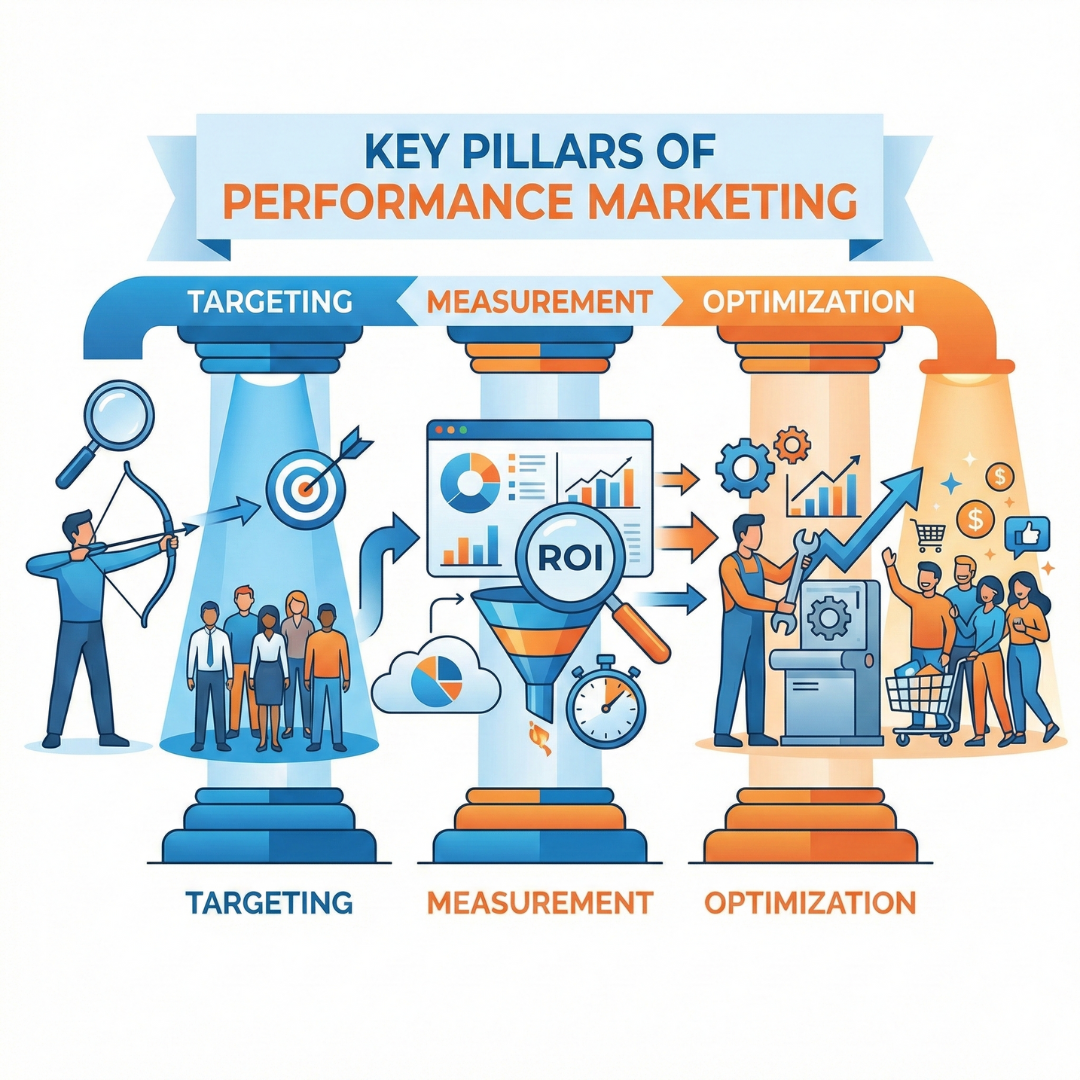
At the heart of this results-driven ecosystem lie three foundational pillars: Targeting, Measurement, and Optimization. These pillars are not isolated tactics; they form a continuous loop. Targeting defines who you reach, measurement determines what is working, and optimization decides how to improve outcomes over time. When executed together, they turn marketing into a predictable revenue engine rather than a cost center.
This article breaks down each pillar in depth—conceptually, strategically, and practically—so you can understand not just what to do, but why it works and how to scale it.
Pillar 1: Targeting — Reaching the Right Audience with Precision
Targeting is the foundation of performance marketing. No matter how strong the offer or how large the budget, results will suffer if ads are shown to the wrong audience. Performance marketing prioritizes relevance over reach, focusing on connecting with users who are most likely to take action.
Intent-Driven Targeting
Modern targeting is built around user intent rather than just demographics. Intent signals come from search behavior, browsing activity, content engagement, app usage, and previous purchases. These signals help marketers identify users who are actively researching, comparing, or preparing to buy.
High-intent users convert at significantly higher rates because they already have a problem and are looking for a solution. Performance marketing strategies aim to intercept these users at the exact moment of need, reducing friction and improving conversion efficiency.
Audience Segmentation and Funnel Stages
Effective targeting relies on detailed audience segmentation. Instead of treating all users the same, performance marketers divide audiences based on where they are in the funnel. New visitors, engaged users, abandoned prospects, repeat buyers, and loyal customers all require different messaging and offers.
Segmentation allows marketers to allocate budgets strategically. High-intent, bottom-of-funnel audiences can justify higher bids, while awareness-stage audiences require lower costs and longer nurturing cycles. This structured approach ensures budgets are spent where they generate the highest return.
First-Party Data and Targeting Resilience
As privacy regulations evolve and third-party data becomes less reliable, first-party data has become central to targeting strategies. Email lists, CRM data, app users, website visitors, and purchase history provide accurate and consent-based signals that improve targeting precision.
First-party data also allows brands to create stronger lookalike audiences, retargeting strategies, and lifecycle campaigns. This not only improves performance but also makes marketing systems more resilient to platform and algorithm changes.
In performance marketing, targeting determines the quality of traffic entering the funnel. Poor targeting increases costs and reduces conversion potential, while strong targeting amplifies every downstream effort.
Pillar 2: Measurement — Converting Data into Actionable Insights
Measurement is the backbone of performance marketing. It enables marketers to understand what is working, what is failing, and where improvements are needed. Without accurate measurement, performance marketing becomes reactive and inefficient.
Choosing the Right Performance Metrics
Performance marketing focuses on metrics that directly reflect business impact. Cost Per Acquisition, Return on Ad Spend, Customer Acquisition Cost, Lifetime Value, and conversion rates across the funnel are far more meaningful than surface-level metrics such as impressions or clicks.
A common mistake is optimizing for vanity metrics. High click-through rates or low CPCs may look impressive but offer little value if they do not translate into revenue or long-term customers. Mature performance strategies evaluate success based on profitability and scalability rather than engagement alone.
Conversion Tracking and Funnel Visibility
Accurate measurement requires precise conversion tracking. Every meaningful user action—from page visits and form submissions to purchases and renewals—should be tracked and mapped to the funnel.
Tracking both micro-conversions and macro-conversions provides visibility into user behavior and helps identify friction points. This allows marketers to diagnose problems early and improve performance without waiting for revenue losses to appear.
Attribution and Performance Clarity
Attribution is one of the most complex elements of measurement. Users often interact with multiple ads, platforms, and touchpoints before converting. Attribution models help assign value across these interactions to understand which channels influence conversions and which ones close them.
While no attribution model is perfect, the goal is directional accuracy rather than absolute precision. Better attribution leads to smarter budget allocation, more effective channel strategies, and improved long-term performance.
Measurement transforms performance marketing from guesswork into a decision-making framework. It provides clarity, accountability, and confidence when scaling campaigns.
Pillar 3: Optimization — Continuous Improvement for Sustainable Growth
Optimization is the engine that drives performance marketing forward. It is the ongoing process of refining campaigns based on measured data to improve efficiency, conversion rates, and return on investment.
Creative and Messaging Optimization
Creatives play a critical role in performance outcomes. Messaging, visuals, formats, and calls-to-action directly influence how users respond to ads. Even small changes can produce significant performance shifts.
Optimization involves structured testing rather than assumptions. By continuously testing creative variations, marketers learn which emotional triggers, value propositions, and formats resonate most with different audience segments. Over time, this knowledge compounds, making campaigns more predictable and scalable.
Landing Page and Funnel Optimization
Driving traffic is only effective if the post-click experience supports conversion. Landing pages, forms, onboarding flows, and checkout processes must be optimized to reduce friction and reinforce intent.
Performance marketers analyze page speed, clarity, trust signals, navigation, and content alignment to improve conversion rates. Incremental improvements at each stage of the funnel can significantly increase overall performance when scaled across large traffic volumes.
Budget Allocation and Bidding Optimization
Optimization also applies to how budgets are distributed across campaigns, channels, and audiences. High-performing segments receive increased investment, while underperforming areas are refined or reduced.
Automation and machine learning assist with bidding, but strategic oversight remains essential. Marketers must know when to scale, when to stabilize, and when to pause campaigns to protect efficiency and data quality.
Optimization as a Continuous Cycle
Performance marketing optimization never stops. Markets evolve, consumer behavior shifts, competitors adapt, and platforms change algorithms. Continuous testing, learning, and refinement are essential to maintain performance over time.
Optimization feeds directly back into targeting and measurement, strengthening the entire system.
How Targeting, Measurement, and Optimization Work Together
These three pillars are interconnected. Targeting brings in the right users, measurement reveals how they behave, and optimization improves outcomes based on those insights. Weakness in any pillar reduces the effectiveness of the others.
When all three pillars are aligned, performance marketing becomes a scalable growth engine rather than a series of isolated campaigns.
Conclusion: Building a High-Performance Marketing System
Performance marketing is not about running ads—it is about building a system that consistently converts intent into revenue. Targeting ensures relevance, measurement ensures accountability, and optimization ensures continuous improvement.
Brands that master these pillars gain a competitive advantage by learning faster, adapting quicker, and scaling smarter. Even as platforms and technologies evolve, these fundamentals remain constant.
When targeting, measurement, and optimization are executed together, performance marketing becomes predictable, profitable, and sustainable.

Author