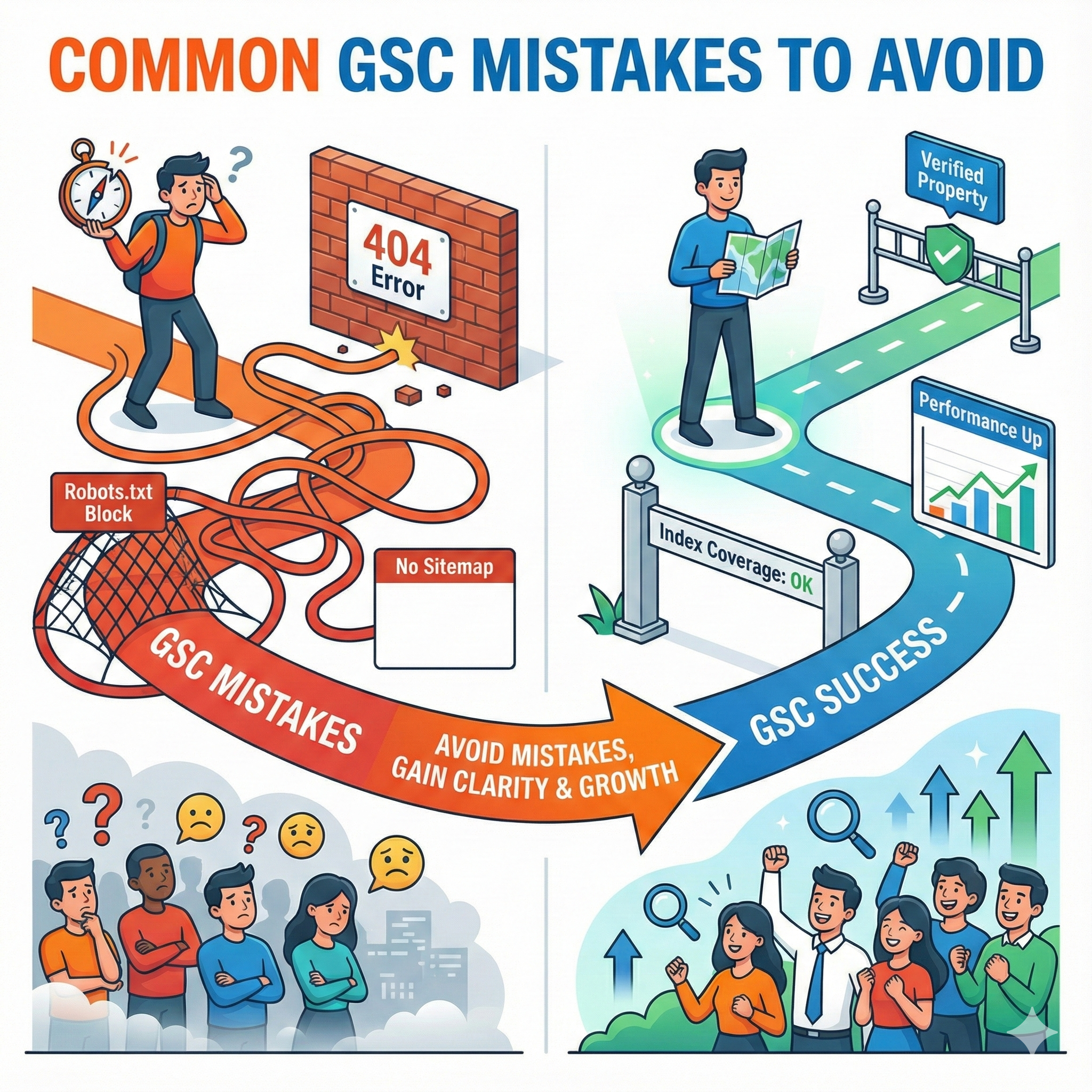
Common GSC Mistakes to Avoid: A Very Detailed & Informative Guide
Google Search Console (GSC) is one of the most powerful free SEO tools available. Yet, many website owners, marketers, and even experienced SEOs misuse it, misinterpret it, or completely ignore its most valuable insights.
This article is a deep, practical, mistake-focused guide that explains:
If you want accurate SEO decisions, clean indexing, and sustainable organic growth, this guide is for you.
1. Not Setting Up GSC Correctly
❌ The Mistake
Many users:
Never verify their website properly
Verify only one version of the site
Skip domain-level property setup
Why This Is Dangerous
Google treats the following as separate properties:
HTTP vs HTTPS
WWW vs non-WWW
Subdomains
Tracking only one version leads to incomplete and misleading data.
✅ Best Practice
Always set up a Domain Property
Redirect all versions to one canonical version
Ensure sitemap and internal links reflect the preferred version
2. Checking GSC Only When Traffic Drops
❌ The Mistake
Opening GSC only after rankings or traffic decline.
Why This Is a Problem
GSC is not just for damage control. It is a preventive SEO intelligence tool.
By the time traffic drops, the root issue may already be weeks old.
✅ Best Practice
Review GSC weekly
Monitor:
Indexing trends
CTR changes
Query position movement
Coverage warnings
Think of GSC as SEO health monitoring, not emergency treatment.
3. Misunderstanding Performance Report Data
❌ The Mistake
Why This Happens
Pages rank for hundreds of queries
Average position is a blended metric
Search demand fluctuates seasonally
✅ Best Practice
Analyze by:
Pro insight:
High impressions + low CTR = snippet or search intent mismatch.
4. Ignoring Index Coverage Issues
❌ The Mistake
Assuming “Excluded” or “Not indexed” pages are always fine.
Why This Is Risky
Some exclusions hide serious technical or content-quality problems.
High-Risk Coverage Statuses
Crawled – currently not indexed
Discovered – currently not indexed
Duplicate without user-selected canonical
Soft 404
✅ Best Practice
Audit important excluded pages manually
Improve content depth and uniqueness
Strengthen internal linking
Fix canonical and technical signals
Indexing is a combined outcome of quality + technical SEO.
5. Assuming Indexed Pages Will Rank
❌ The Mistake
Believing:
“If the page is indexed, it will rank.”
Reality
Indexing means Google can show the page—not that it will.
✅ Best Practice
Evaluate:
Indexing is permission, ranking is earned.
6. Ignoring Mobile Usability & Core Web Vitals
❌ The Mistake
Treating page experience issues as “developer problems.”
Why This Hurts SEO
Google prioritizes mobile-first indexing and user experience signals.
Common Issues
✅ Best Practice
Fix template-level issues
Optimize images and scripts
Balance CRO tools with performance
SEO, UX, and CRO must work together.
7. Misusing the URL Inspection Tool
❌ The Mistake
Repeatedly clicking “Request Indexing” expecting instant results.
Why This Doesn’t Work
Indexing requests do not override quality signals.
What URL Inspection Is Actually For
✅ Best Practice
Use it as a diagnostic and validation tool, not a shortcut.
8. Ignoring Manual Actions & Security Issues
❌ The Mistake
Never checking:
Manual Actions
Security Issues
Why This Is Critical
Manual actions can:
Common Causes
✅ Best Practice
9. Misinterpreting Keyword Cannibalization
❌ The Mistake
Assuming multiple pages ranking for the same keyword is a good thing.
Reality
Cannibalization can:
Confuse Google
Split authority
Reduce overall rankings
✅ Best Practice
Filter performance by query
Identify competing URLs
Merge, redirect, or differentiate intent
One keyword intent = one primary page.
10. Ignoring Internal Linking Reports
❌ The Mistake
Never reviewing internal links in GSC.
Why This Matters
Internal links:
Signal importance
Distribute authority
Improve crawl efficiency
Common Issues
✅ Best Practice
Strengthen links to money and conversion pages
Use contextual, descriptive anchor text
Align internal links with search intent
11. Not Using GSC for Content Optimization
❌ The Mistake
Treating GSC as purely a technical SEO tool.
What Most People Miss
GSC reveals exactly how users search for your content.
Content Opportunities in GSC
Keywords ranking on page 2
Pages with impressions but low CTR
Emerging queries over time
✅ Best Practice
Refresh content using real query data
Improve titles and descriptions
Add missing subtopics and FAQs
12. Comparing the Wrong Time Periods
❌ The Mistake
Comparing:
Why This Misleads
Search demand is:
Seasonal
Event-driven
Trend-based
✅ Best Practice
13. Ignoring Crawl Stats & Server Signals
❌ The Mistake
Never checking crawl stats.
Why It Matters
Crawl behavior reflects:
Server performance
Crawl budget efficiency
Technical bottlenecks
✅ Best Practice
Monitor crawl frequency trends
Fix 5xx and timeout errors
Remove crawl waste (duplicate URLs, filters)
14. Expecting GSC to Be Real-Time
❌ The Mistake
Panicking over daily data fluctuations.
Reality
GSC data:
✅ Best Practice
Focus on patterns, not daily noise
Combine with analytics tools
Make decisions based on time ranges
15. Tracking Vanity Metrics Instead of Business Impact
❌ The Mistake
Focusing only on:
Total clicks
Total impressions
What Actually Matters
Leads
Revenue
Conversions
Qualified traffic
✅ Best Practice
Map GSC pages to funnel stages
Prioritize pages that drive business outcomes
Align SEO KPIs with CRO and revenue goals
Final Thoughts
Most SEO failures don’t happen due to lack of tools—but due to misreading or ignoring the right signals.
Google Search Console is not:
It is a strategic SEO decision-making system.
Master GSC by:
Understanding user intent behind metrics
Connecting technical, content, and UX insights
Thinking long-term instead of reacting emotionally
Used correctly, GSC can outperform many paid SEO tools.