



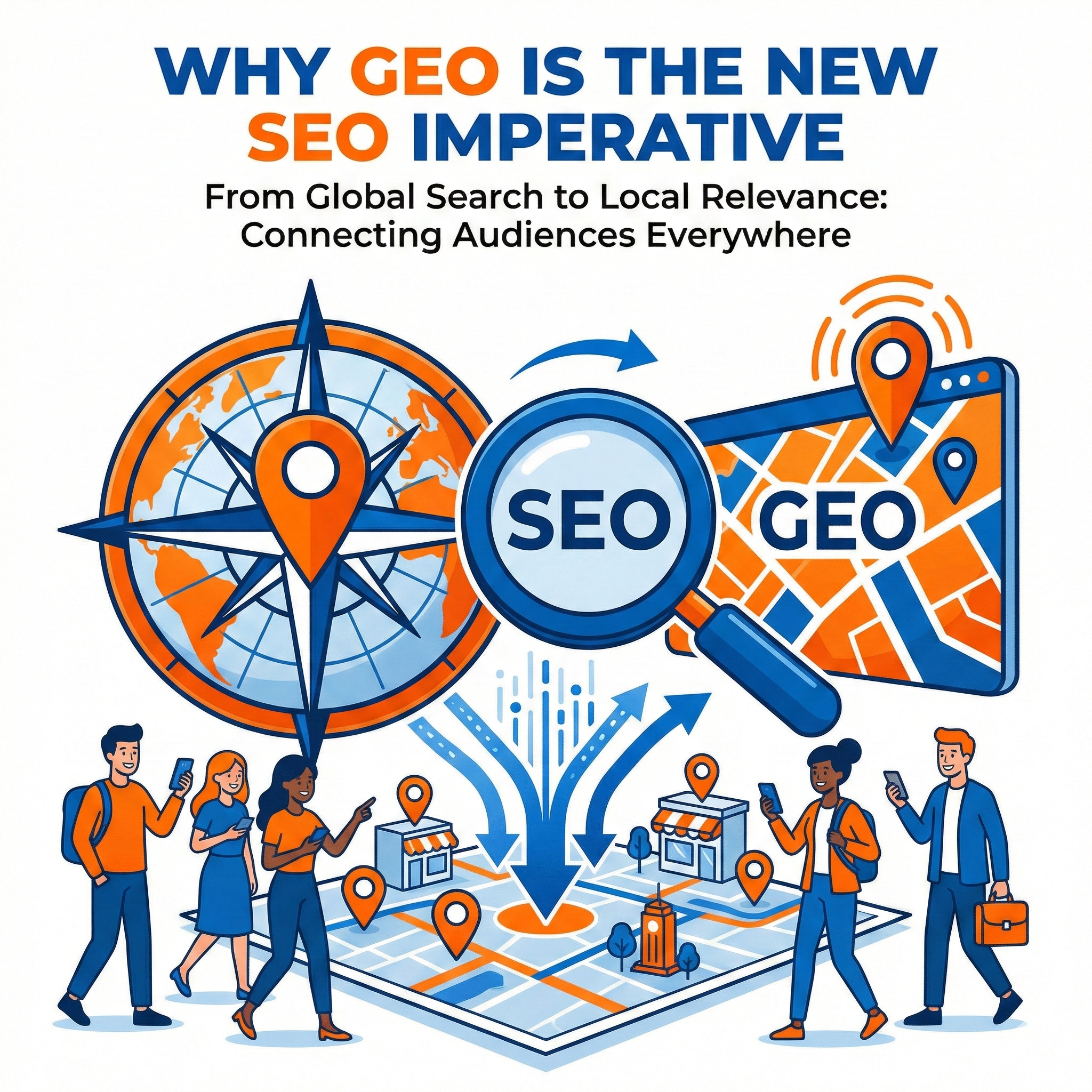
Introduction: Why GEO Is the New SEO Imperative
Search is undergoing the biggest transformation since the introduction of mobile-first indexing. Traditional search engines no longer operate solely as link-based retrieval systems. They are rapidly evolving into answer engines powered by large language models, capable of synthesizing information, summarizing sources, and directly responding to user intent without requiring a click.
This shift has given rise to Generative Engine Optimization (GEO), a new discipline focused on making websites visible, trusted, and cited within AI-generated answers across platforms such as Google’s AI-powered search experiences, Bing Copilot, ChatGPT-style interfaces, and other LLM-driven discovery systems.
Ranking in GEO does not mean ranking at position one on a traditional SERP. It means being understood, trusted, and reused by generative models when they construct answers. Websites that adapt early to GEO principles will dominate visibility, while those relying purely on legacy SEO tactics will see declining organic impact despite maintaining rankings.
This article explains in deep detail how GEO works, how it differs from traditional SEO, and how to systematically optimize a website to rank, surface, and influence AI-generated search results.
Understanding How Generative Search Engines Actually Work
To rank in GEO, it is essential to understand how generative engines retrieve and construct answers. Unlike traditional search engines that rank individual pages based on keyword relevance and backlinks, generative engines operate through a retrieve–understand–synthesize model.
First, the system retrieves information from trusted sources across the web, including indexed pages, structured data, authoritative publications, and historical training signals. Second, it interprets the information semantically, identifying entities, relationships, concepts, and intent rather than exact keyword matches. Finally, it synthesizes a response by combining insights from multiple sources into a coherent answer.
This means GEO ranking is not about “blue links.” It is about being selected as a source of truth during the synthesis phase. If your content is unclear, shallow, contradictory, or lacks authority, it may be crawled but never used. If your content is structured, contextual, and demonstrably expert, it becomes a candidate for inclusion in AI-generated answers.
GEO vs Traditional SEO: A Fundamental Shift in Thinking
Traditional SEO is largely competitive and positional. You optimize to outrank others for a keyword. GEO is contributive and contextual. Your content competes to be included, referenced, or summarized by the model.
In SEO, keyword density, backlinks, and page-level optimization play a dominant role. In GEO, semantic clarity, topical depth, factual consistency, and trustworthiness are far more important. Generative engines prefer content that explains concepts holistically rather than pages optimized for a single keyword variation.
Another major difference is traffic expectation. GEO success may not always result in a direct click. Your brand, insights, or data may be surfaced directly in answers. This makes brand authority and recall more important than raw traffic numbers.
Building Topical Authority for GEO Visibility
Generative engines strongly favor websites that demonstrate deep topical authority rather than scattered content coverage. Ranking in GEO requires your website to be perceived as a reliable knowledge hub for a specific subject area.
This means creating interconnected, in-depth content that covers a topic from foundational concepts to advanced applications, edge cases, and real-world use scenarios. Thin articles, surface-level explanations, and generic rewrites are unlikely to be trusted by AI systems.
Topical authority in GEO is built through consistency, depth, and internal coherence. When multiple pages on your website reinforce each other semantically, generative engines gain confidence in your expertise and are more likely to draw from your content during answer generation.
Writing Content That Generative Engines Can Understand and Reuse
One of the biggest GEO mistakes is writing content exclusively for human persuasion while ignoring machine comprehension. GEO content must serve both.
Generative engines favor content that is logically structured, clearly segmented, and semantically explicit. This does not mean robotic writing, but it does mean avoiding ambiguity, fluff, and unnecessary jargon. Concepts should be explained clearly, definitions should be precise, and claims should be supported by reasoning or evidence.
Long-form content performs exceptionally well in GEO because it provides sufficient context for models to understand not just what something is, but why it matters, how it works, and when it should be used. Content that answers follow-up questions implicitly is far more likely to be reused in AI-generated responses.
Optimizing for Search Intent in a Generative World
Generative engines are far more intent-sensitive than traditional search algorithms. They aim to resolve the user’s underlying problem, not just match keywords.
To rank in GEO, content must align tightly with informational, comparative, procedural, or strategic intent, depending on the query. Pages that mix multiple intents without clarity often get ignored because they confuse the synthesis process.
For example, a page that claims to explain “what GEO is” but quickly turns into a sales pitch lacks intent purity. Generative engines prefer content that fulfills its stated purpose comprehensively before attempting persuasion.
Intent clarity is achieved through narrative flow rather than bullet-point optimization. When content reads like a structured explanation rather than a keyword-stuffed page, it becomes more compatible with generative retrieval.
Structured Data and Semantic Markup for GEO
While GEO relies heavily on natural language understanding, structured data still plays an important role in reinforcing meaning and credibility.
Schema markup helps clarify what your content represents, whether it is an article, guide, organization, product, or educational resource. This structured context reduces ambiguity and increases the likelihood that your content is correctly interpreted and reused.
Internal linking also functions as a semantic signal. When related concepts are linked logically, generative engines gain a clearer picture of your topical ecosystem. This internal semantic reinforcement strengthens GEO authority far more effectively than random backlink acquisition.
Trust, Expertise, and E-E-A-T in Generative Ranking
Trust is a cornerstone of GEO. Generative engines are extremely cautious about misinformation, especially in domains such as finance, health, technology, and marketing strategy.
To rank in GEO, your website must consistently demonstrate Experience, Expertise, Authoritativeness, and Trustworthiness. This is achieved through transparent authorship, accurate information, consistent publishing quality, and alignment with known industry consensus where applicable.
Content that includes original insights, real-world examples, data-backed explanations, and clear reasoning is far more likely to be trusted than content that simply rewrites existing articles. Over time, trust signals compound, making future content easier to rank in generative systems.
Optimizing for Conversational and Follow-Up Queries
Generative search is conversational by nature. Users ask follow-up questions, refine intent, and explore topics dynamically.
Websites that rank in GEO anticipate these conversational patterns. Instead of answering a single question in isolation, content should naturally lead into related explanations, comparisons, and implications. This allows generative engines to reuse multiple sections of the same content across different query variations.
When your content can support a conversation rather than a single answer, it becomes far more valuable in an AI-driven search environment.
GEO Measurement: How to Track Success Without Traditional Rankings
One of the biggest challenges in GEO is measurement. Traditional ranking positions and organic traffic metrics do not fully capture GEO performance.
Success in GEO is reflected through brand mentions in AI answers, increased branded search demand, higher trust-driven conversions, and content being referenced across multiple generative platforms. While attribution is less direct, the long-term impact on authority and influence is significant.
Websites that invest in GEO often see improved performance across all channels, including SEO, paid media, and direct traffic, because trust and clarity improve the entire digital presence.
Future of GEO and Long-Term Competitive Advantage
Generative Engine Optimization is not a trend; it is the future foundation of search visibility. As AI-generated answers become the default interface for discovery, only websites that are structurally sound, semantically rich, and genuinely valuable will remain visible.
Ranking in GEO requires a mindset shift from “how do I rank higher?” to “how do I become the best source of understanding?” Businesses and publishers that embrace this shift early will build defensible authority that competitors will struggle to replicate.
Conclusion: How to Win GEO Rankings Sustainably
Ranking a website in GEO is not about exploiting algorithms or chasing loopholes. It is about clarity, depth, trust, and usefulness at scale.
By building strong topical authority, writing content that educates deeply, structuring information for semantic understanding, and aligning tightly with user intent, websites can position themselves as primary sources for generative engines.

Author