Introduction: Understanding Funnel Leakage in Modern Businesses
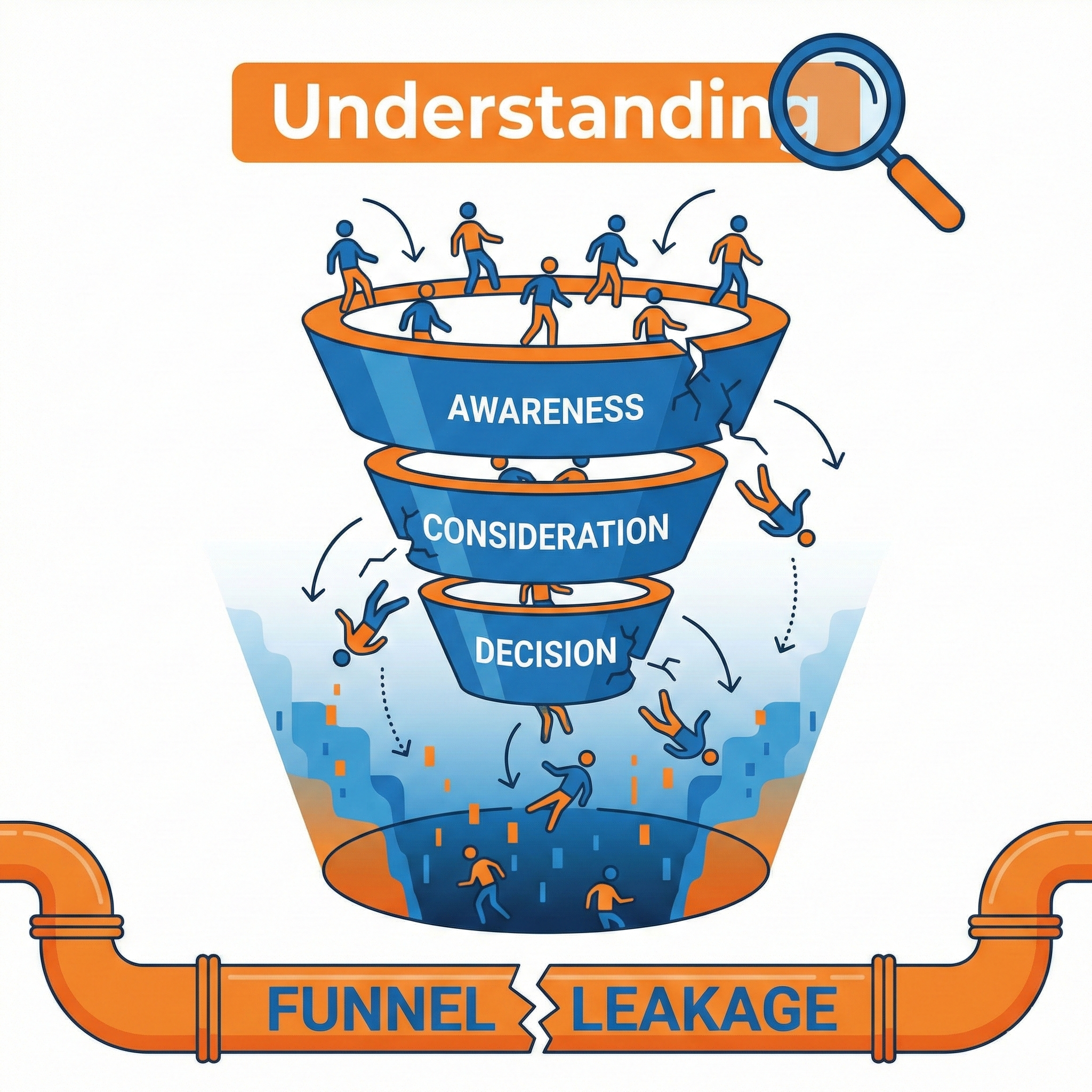
Funnel leakage is one of the most expensive and least visible problems in marketing and sales operations. Businesses invest heavily in acquiring traffic, generating leads, and nurturing prospects, yet a significant percentage of potential customers drop off at different stages of the funnel without converting. These losses often go unnoticed because teams focus more on top-line acquisition numbers than on what happens between each stage.
Funnel leakage does not occur due to a single failure. It is usually the result of fragmented data, delayed follow-ups, inconsistent messaging, lack of personalization, poor handoffs between teams, and an absence of real-time visibility into customer behavior. This is precisely where a well-implemented Customer Relationship Management system becomes transformative.
A CRM is not just a database of contacts. It is a behavioral intelligence system that captures every interaction, aligns teams around a single source of truth, and orchestrates communication across the entire customer journey. When used strategically, CRM becomes the most powerful tool for identifying, preventing, and systematically reducing funnel leakage.
What Funnel Leakage Really Means Beyond Drop-Off Numbers
Most organizations define funnel leakage simply as users or leads dropping off between stages such as awareness, consideration, conversion, and retention. However, this definition is incomplete and often misleading. Funnel leakage is not just about people leaving; it is about lost intent, broken continuity, and unmet expectations.
A prospect who fills out a lead form but never receives a follow-up is not just a lost lead; it is a failure of process and timing. A user who signs up for a product but never activates key features is not uninterested; they are under-guided. A customer who churns after the first purchase may not be dissatisfied; they may simply feel ignored.
CRM helps businesses move from reactive analysis to proactive prevention by making these invisible leaks visible and actionable.
CRM as the Single Source of Truth Across the Funnel
One of the primary reasons funnel leakage occurs is data fragmentation. Marketing teams operate in one system, sales teams in another, and customer success teams in yet another. This separation creates blind spots where prospects fall through gaps without accountability.
A CRM centralizes customer data across acquisition, engagement, conversion, and retention. Every lead, interaction, email, call, website visit, app event, and purchase is recorded and connected to a single customer profile. This unified view ensures that no prospect is lost simply because one team lacks context about what another team has already done.
When every stakeholder sees the same data, decisions become faster, follow-ups become timely, and customer experiences become consistent. This alignment alone eliminates a significant portion of funnel leakage caused by internal silos.
Identifying Leakage Points with CRM Funnel Visibility
Without a CRM, funnel analysis is often limited to surface-level metrics such as conversion rates between stages. CRM enables a much deeper level of diagnosis by tracking not just where users drop off, but why they drop off.
By analyzing stage-wise movement, time spent in each stage, interaction history, and engagement signals, CRM helps identify specific friction points. For example, if leads are converting from marketing-qualified to sales-qualified but not closing, the issue may lie in sales follow-up speed or messaging. If users activate but do not retain, the problem may be onboarding or value communication.
CRM dashboards allow teams to visualize funnel health in real time, making leakage patterns impossible to ignore and easier to prioritize.
Reducing Leakage Through Speed and Timely Follow-Ups
Speed is one of the most underestimated factors in funnel conversion. The longer a lead waits for a response, the more their intent decays. CRM systems drastically reduce response time by automating lead routing, notifications, and task assignments.
When a lead enters the funnel, CRM can instantly assign it to the right representative, trigger follow-up reminders, and even initiate automated communication. This ensures that no lead is forgotten, delayed, or mishandled due to human error or workload pressure.
Timely follow-ups do more than improve conversion rates. They signal professionalism, reliability, and respect for the prospect’s time, which directly impacts trust and engagement.
CRM-Driven Personalization to Prevent Mid-Funnel Drop-Off
One-size-fits-all communication is a major contributor to funnel leakage. Prospects disengage when messages feel generic, irrelevant, or disconnected from their needs.
CRM enables deep personalization by leveraging behavioral, demographic, and contextual data. Communication can be tailored based on industry, role, past interactions, product interest, content consumption, and engagement history. This level of relevance keeps prospects engaged and moving forward rather than stalling or dropping out.
Personalization through CRM is not limited to email. It extends to sales conversations, support interactions, onboarding flows, and retention campaigns, creating a cohesive experience across every touchpoint.
Automating Nurturing to Keep Prospects Warm
Not every prospect is ready to convert immediately. Without structured nurturing, these leads often go cold and leak out of the funnel silently.
CRM-driven automation allows businesses to design intelligent nurturing journeys that educate, reassure, and guide prospects over time. These journeys adapt based on engagement, ensuring that prospects receive the right information at the right moment without manual intervention.
By maintaining consistent, value-driven communication, CRM keeps prospects engaged even during long consideration cycles, significantly reducing drop-off due to neglect or forgetfulness.
Improving Sales Handoffs and Accountability
One of the most critical leakage points occurs during the transition from marketing to sales. Leads are often passed without sufficient context, leading to repetitive conversations, misaligned expectations, and lost momentum.
CRM eliminates this friction by preserving the entire interaction history. Sales teams can see what content the lead consumed, what pain points they expressed, and what triggered their interest. This continuity allows sales conversations to feel informed and relevant rather than intrusive or redundant.
CRM also introduces accountability through task tracking, pipeline ownership, and performance visibility. When every stage has a clear owner and timeline, leads are far less likely to be ignored or abandoned.
Reducing Post-Conversion Leakage with CRM
Funnel leakage does not end at conversion. Many businesses lose customers shortly after the first purchase due to poor onboarding, lack of engagement, or unmet expectations.
CRM extends funnel management into post-conversion stages by tracking onboarding progress, usage behavior, support interactions, and satisfaction signals. This allows businesses to intervene early when customers show signs of disengagement.
Proactive outreach, guided onboarding, and personalized follow-ups driven by CRM help transform first-time customers into long-term users, reducing churn and increasing lifetime value.
Using CRM Insights to Continuously Optimize the Funnel
CRM is not just a tool for execution; it is a system for learning. Every interaction captured becomes a data point that can be analyzed to improve future performance.
By studying historical funnel data, businesses can identify patterns that lead to success or failure. These insights inform better targeting, messaging, timing, and product decisions. Over time, this creates a feedback loop where the funnel becomes progressively more efficient and resilient.
Continuous optimization powered by CRM ensures that funnel leakage is not just patched temporarily but structurally reduced.
CRM as a Strategic Growth Engine, Not Just a Tool
Organizations that view CRM as a contact management tool miss its true potential. CRM is a strategic growth engine that aligns people, processes, and data around customer success.
By providing visibility, automation, personalization, and accountability, CRM addresses the root causes of funnel leakage rather than treating symptoms. It transforms fragmented journeys into cohesive experiences and reactive teams into proactive operators.
In competitive markets where acquisition costs continue to rise, reducing funnel leakage is often more impactful than increasing traffic. CRM enables businesses to extract maximum value from every lead and customer by ensuring that no opportunity is lost due to preventable gaps.
Conclusion: Why CRM Is Essential for Funnel Integrity
Funnel leakage is inevitable in poorly connected systems, but it is largely preventable with the right CRM strategy. CRM brings structure to chaos, clarity to complexity, and intelligence to execution.
By centralizing data, enabling real-time action, personalizing communication, and enforcing accountability, CRM turns leaky funnels into optimized growth pipelines. Businesses that master CRM-driven funnel management not only improve conversions but also build stronger, more durable customer relationships.

Author