
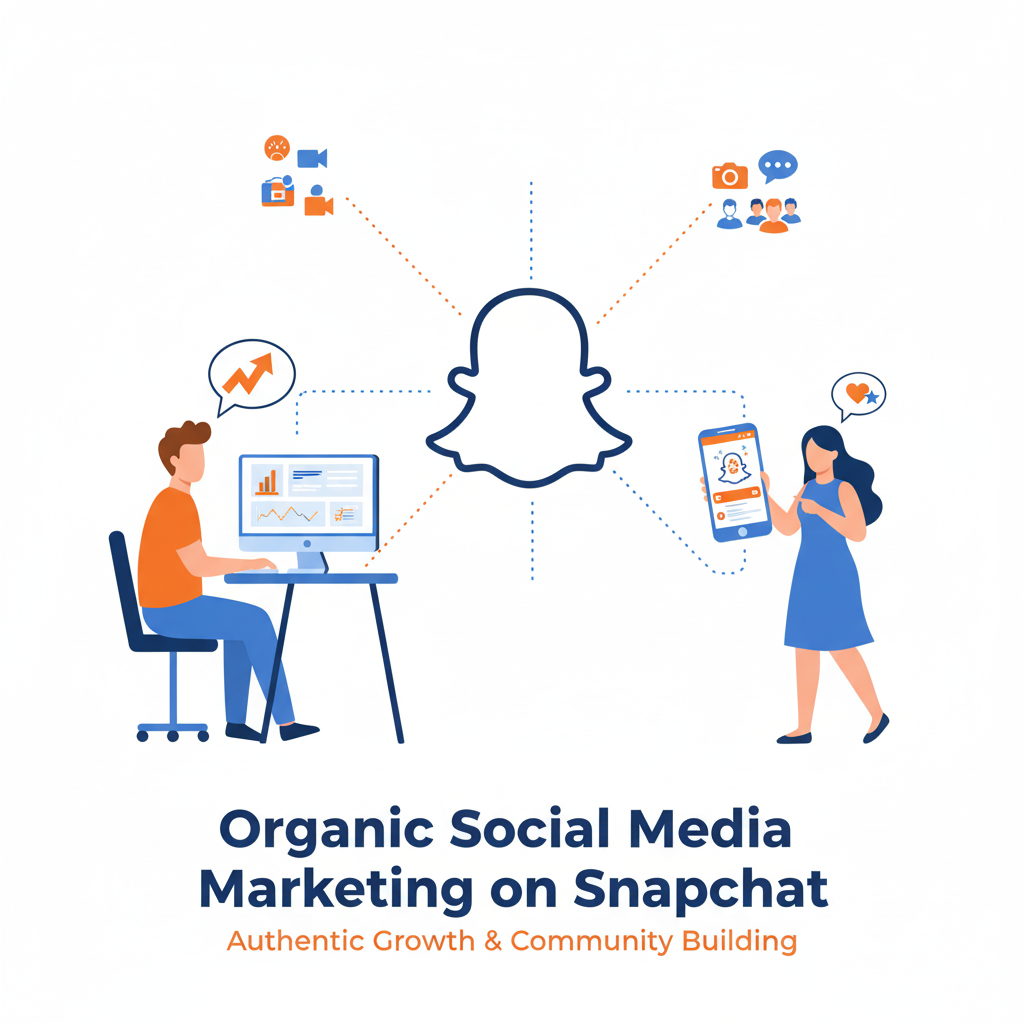
Snapchat’s Organic Marketing
1. Understanding Snapchat’s Organic Ecosystem (expanded)
Communication-first platform — what that means and how to act
Snapchat’s core UX is private messaging and ephemeral stories; people go there to talk to friends, not to endlessly scroll public feeds.
Implication for brands: your content must feel like a snap to a friend — casual, authentic, conversational. Avoid polished, broadcast-only content that reads like an ad.
Tactics: use first-person voice, short direct-speaking captions, behind-the-scenes POV angles, and creator-led narratives. Keep content intimate, not corporate.
Algorithm & relationship signals — deeper
Snapchat’s reach is influenced by the quality of interactions between user and creator. The platform tracks if people reply, save, screenshot, or replay your snaps.
Implication: encourage micro-actions (reply, screenshot) rather than vanity metrics (likes). Responses and repeat views directly expand reach.
Tactics: add direct questions, “reply for part 2,” shareable checklists, and content that invites DMs.
Native, low-production content works best — execution tips
Users reward raw, human-scale content. You don’t need a studio: phone POV, quick captions, natural lighting, and on-the-ground sound work very well.
Production checklist: shoot vertical, record clean audio, keep shots <8–12s for story slides, add on-screen captions for sound-off viewers, use quick cuts and text overlays.
2. Why Snapchat Still Matters for Organic Marketing (expanded)
Reach & demographics — the reality
Snapchat is disproportionately used by Gen Z and younger Millennials, so if your target is under 30, Snapchat is often higher-engagement than other platforms.
Action: map your buyer personas to Snapchat segments (age, interests, location) before investing heavily.
Authenticity & trust — how to leverage it
Snapchat users expect honesty. Brands that adopt humility and humor often outperform polished messaging.
Actionable tactic: run “no-edit” days where the brand posts only authentic, unscripted moments.
Lower competition = high impact
Because fewer legacy brands invest heavily in organic Snapchat, well-run organic programs get outsized reach.
Action: early experiments with frequent posting and creator partnerships can yield strong subscriber growth.
High frequency & session behaviour
Snapchat is opened frequently throughout the day — multiple brief exposures add up.
Action: plan micro-moments (morning hook, midday update, evening CTA) to match typical usage patterns.
3. Snapchat Organic Marketing Funnel (expanded: detailed tactics per stage)
Snapchat organic funnels differ from typical social funnels because of the platform’s intimacy and ephemeral nature. Here’s a granular expansion for each stage.
Stage 1 — Discoverability
Goal: get discovered by people who aren’t your followers.
Where you can appear:
Snap Map (public stories pinned to locations)
Spotlight (short viral videos)
Public Profiles & Subscriptions
My AI recommendations (if content is optimized to be helpful)
Cross-promoted Snapcodes
Tactics to increase discoverability:
Geo-posting: film content in high-traffic public locations (cafes, events, malls) or create event-specific public stories so you appear on Snap Map to those nearby.
Spotlight optimization: make 5–10s, high-energy vertical clips with a strong hook and payoff in the first 1–2 seconds. Avoid heavy branding; focus on entertainment or a surprising reveal.
Create AR Lenses: Lenses show up in discovery and can be shared virally. A well-designed try-on lens or funny filter can bring large organic reach.
Leverage creators: creators expose your profile to new cohorts; use micro-creators for niche audiences and macro creators for spikes.
Promote Snapcode everywhere: physical packaging, email, other social platforms.
Measurement: new public profile subscribers, Spotlight views, Snap Map impressions.
Stage 2 — Engagement
Goal: get viewers to engage with your story (replay, screenshot, reply).
Key signals & tactics:
Cliffhanger storytelling: break a story into multiple parts and use “to be continued” to push completion rate and replays.
Interactive content: add polls, question stickers, sliders, and direct prompts (“reply with your fav…”).
Value-first content: lists, checklists, and tips are screenshot-prone. Add short, save-worthy content like “3 hacks in 10s.”
MicroCTA mechanics: “Screenshot this coupon”, “Reply for link” — direct CTAs that generate replies or screenshots.
Measurement: screenshot counts, replies volume, completion rate, average time per story.
Stage 3 — Relationship Building
Goal: convert viewers into engaged followers who open your content daily and reply often.
Tactics:
Personal replies: reply to messages by referencing the user’s response; treat them like a friend. Use Short Voice Notes for high-impact personalization.
Serial content: run recurring series (e.g., “Mondays with [Founder]”) so users expect content at a cadence.
Community features: share user submissions, callouts, and Q&As to build two-way engagement.
Exclusive content for subscribers: early access or subscriber-only stories increase retention.
Measurement: repeat viewers, DM volume, subscriber retention week-over-week.
Stage 4 — Conversion
Goal: drive a measurable action (website click, shop, signup).
Organic Snapchat conversion mechanics:
Link sticker / swipe-up: place them in stories with matching message-match landing pages.
Promo codes & Snap-specific offers: short-run coupon codes encourage purchase and are easy to track.
AR commerce: try-on lenses that include product tags/links to buy.
Micro-conversions: email capture via a one-screen landing page optimized for mobile.
Optimization tips:
Landing pages must be mobile-first and fast. Match the story’s message and creative to the landing page hero.
Use single-step forms (email only) or deep link to in-app experiences for frictionless conversion.
Measurement: CTA clicks, conversion rate from click to purchase, promo code redemptions, shop sales attributed to Snap.
Stage 5 — Retention
Goal: keep users coming back (subscribe, reopen, respond).
Retention levers:
Daily content cadence: 5–15 snaps/day for brands that can sustain it.
Serial content & anticipation: “Drop” content at same time daily to build habit.
Personalized content: shoutouts, replies, and localized content for city-specific audiences.
Push integration: remind users via cross-platform (email, SMS) when important content drops.
Measurement: retention cohorts, weekly active followers, lifetime engagement per follower.
4. Snapchat Content Strategy — Fully detailed execution
This section shows exact formats, examples, production tips, and content calendars.
A. Daily content strategy (expanded and practical)
Aim for 5–15 snaps per day depending on resources and audience expectation. Example day:
Morning hook (Snap 1) — 5–8s: “This is the #1 thing you must do today to [benefit].” Use text overlays + CTA to stay tuned.
Why: morning starts get high open rates.
Mid-morning micro-tutorial (Snap 2–3) — 8–12s steps or 2–3 slides with a bite-sized tip.
Why: snackable learning content is screenshot-friendly.
BTS / culture snap (Snap 4–6) — show people/company vibe (coffee, office banter, staff shoutouts).
Why: builds friendships and authenticity.
Product proof snap (Snap 7–8) — quick testimonial or social proof. Include user-generated content if available.
Value story (Snap 9–11) — checklist, mini-infographic, or before/after that people can screenshot.
Evening CTA (Snap 12–15) — offer, link, or “reply for freebies” with urgency (limited time).
Why: evening mirroring leisure browsing increases conversion.
Production tips: batch-shoot 2–3 days of stories in a single 60–90 minute session; use a simple shot list; edit natively in Snapchat when possible; save raw files for reuse.
B. Weekly content strategy
Spotlight post (1–2x/week): short 5–15s viral clip—hook in 1–2s, payoff, no heavy branding. Experiment with fast beats and trends.
Public story series: Pick a theme and produce 5–10 parts across a week (e.g., “How we launch a product”).
Highlights refresh: choose top-performing snaps and add to Highlights to create evergreen discovery.
AR lens drop: schedule a lens release every 1–2 weeks (even a small seasonal lens drives shares).
Creator collab: partner with a creator to swap shoutouts or co-create content.
C. Monthly strategy
UGC campaign / challenge: craft an incentive and clear prompt. Include a unique Snapcode or hashtag (on other platforms) for increased cross-platform tracking.
Creator program: structured collaborations, performance-based payments, and repurposing rights.
Location-based push: coordinate real-world events or pop-ups to take advantage of Snap Map local discovery.
Content audit: monthly review of top-performing snaps and update content calendar accordingly.
5. Snapchat Content Types That Go Viral — practical recipes
For each content type, I’ll give the “why it works” and a short recipe.
‘Day in My Life’
Why: personal, relatable, builds empathy.
Recipe: 8–12 snaps showing morning routine, work highlight, lunch, small win, evening. Foster continuity with the same opener and closer for brand recognition.
Raw product demos
Why: trust-building, shows real use.
Recipe: single-take POV of product in use, quick “before / after,” end with “screenshot for code.”
Advice carousel stories
Why: saveable & screenshotable.
Recipe: 5 slides — hook, 3 actionable tips, CTA. Use consistent visual template for brand recall.
Unboxing POV
Why: high curiosity, authenticity.
Recipe: first-person hand-held unboxing, close-ups of packaging, quick on-product demo.
Reaction-style stories
Why: emotional, entertaining.
Recipe: watch or sample something, film facial reaction, overlay short caption like “Wait for it…”
Challenges & Giveaways
Why: user participation scales reach.
Recipe (giveaway): ask users to reply with a snap, tag friend on other platform, and include a Snap-specific code for winners.
AR lens experiences
Why: highly viral when fun/useful.
Recipe: create a 3–5 element lens with a single memorable interaction (try-on, face filter, voice-reactive animation).
6. Snapchat Algorithm — Deep breakdown & optimization playbook
Snapchat uses several explicit signals. For each, I’ll explain why it matters and how to optimize.
1. Story Completion Rate (SCR)
Why: shows your story holds attention.
How to improve: keep stories short; design narrative flow; use bold captions; open with a hook in slide 1; avoid long single slides.
2. Screenshots
Why: signals content is worth saving; high intent.
How to improve: include checklists, short recipes, codes, and visual memes that people want to save.
3. Replays
Why: indicates high value or entertainment.
How to improve: reveal a payoff only on later slides, use suspense, or multi-step tutorials.
4. Chat replies
Why: one of the strongest signals.
How to improve: ask a personal question, ask for choices, use “reply for link” mechanics with frictionless follow-up.
5. Time spent on stories
Why: longer view time suggests deeper engagement.
How to improve: add a mix of short & slightly longer segments (10–20s) for educational clips; use text overlays to increase dwell time.
6. Friend interactions
Why: the platform values interactions that look like real social relationships.
How to improve: encourage DMs, use interactive stickers, respond with personalized messages.
7. Geo-activity signals
Why: Snap Map boosts local, timely content.
How to improve: film at events, use geo-filters, run pop-up experiences.
7. Building a Snapchat Organic Growth Engine — systems & SOPs
A growth engine is not a set of one-offs. It’s a repeatable system across content, community, and measurement. Here’s the step-by-step system:
A. Optimize Public Profile (SOP)
Profile image: clear face or product close-up.
Bio: short, conversational, with a 1-line value promise and a CTA (e.g., “DM for behind-the-scenes”).
Highlights: curate evergreen content into 4–6 highlights.
Snapcode: create graphic assets for cross-promotion.
Lens Library: publish at least 1 branded lens.
Ops: update profile every month with top-performing highlight.
B. Daily publishing rhythm (SOP)
Morning hook posted between 7–9am local time.
Midday value content posted 12–2pm.
Evening CTA posted 7–10pm.
Use a content calendar and batch production to ensure consistency.
Ops: assign roles — Creator, Editor (for in-app editing), Community Manager (replies), Analytics (tracking).
C. Encourage replies (playbook)
Always end at least 1 story with a question.
Track top message types and reuse successful prompts.
Build a response library: templates for common replies and escalation path for sales/inquiries.
D. Snap Map activation (playbook)
Schedule one location-based live story per week.
Partner with local businesses or events for cross-promo.
Use geofilters for physical events and hand out Snapcodes.
E. Spotlight mastery
Create 10–20 short clips with different hooks and test 2x/week.
Keep branding subtle but include a unique style (sound, opening move) so users recognize you.
F. Cross-promotion & Snapcode distribution
Export Snapcode into email footer, Instagram story highlight, website hero, print collateral.
Run paid+organic experiments where you boost a Spotlight clip to jumpstart virality.
8. Industry-Specific Snapchat Strategies (detailed tactics)
E-commerce brands
Product funnels: Spotlight for discovery → Story for demo → Swipe-up for product page → Promo code for conversion.
UGC harvesting: ask customers to snap with product and tag your Snapcode; repurpose best UGC for Spotlight and paid ads.
Influencer micro-campaign: 10 micro-influencers each creating a 3-snap mini-series about product usage.
Restaurants & cafes
Menu teasers: post daily “special of the day” stories with behind-the-scenes prep.
Snap Map location posts: show dining atmosphere and crowd—appears to nearby users.
Loyalty via Snap: provide a Snap-exclusive discount for followers who show a saved snap at checkout.
Fitness trainers
Quick workouts: 60s POV workouts with modifications.
Challenge series: 7-day mini-challenges with daily snaps and user replies.
Nutritional tips: share short recipes or meal under 15 snaps with screenshotable macros.
Personal brands / influencers
Consistent persona: define the voice & “content pillars” (education, lifestyle, humor).
Direct selling: use swipe-ups for merch and early-bird drops.
Community building: host weekly AMAs and save selected replies to highlights.
Education brands
Micro-lessons: 3–5 minute micro-lessons as serialized content.
Exam tips: “10-day exam booster” with daily actionable tips.
Student takeover: invite current students to takeover the account for a week.
9. Snapchat Organic Analytics — what to track & how to read it
Core metrics & their meaning
Views per story: top-of-funnel reach. Segment by public vs subscriber.
Story Completion Rate (SCR): content stickiness — higher is better.
Average time per story: indicates attention and value.
Screenshots & replays: proxies for saving & sharing intent.
Chat replies: community engagement — predictive of retention.
Spotlight views: virality metric; translate to follower growth.
Subscription growth: weekly & monthly new subs and churn.
CTA clicks / swipe-ups: direct conversion metric.
Dashboard suggestions
Week-over-week trend for each metric.
Top-performing stories (by SCR & screenshots).
Best-performing posting times and formats.
Conversion funnel: views → CTA clicks → purchases (UTM tracked).
Creator performance table: impressions, conversions, cost (if paid).
Attribution & experiments
Use UTM parameters on swipe-ups and product links to tie conversions to specific snaps.
For true lift tests, run holdout experiments (e.g., geo holdout where certain cities don’t receive any Snap-specific promo and compare conversion lift).
10. Organic Snapchat Marketing Checklist (50 Points) — actionable
Profile & setup
Public Profile created
Clear profile photo (face or product)
Short, benefit-led bio + CTA
Highlights set up (4–6)
Snapcode exported across channels
AR lens published (basic)
Creator partnerships roster prepared
Daily content & production
Morning hook scheduled
Midday tutorial scheduled
BTS snap scheduled
Value story scheduled
Evening CTA scheduled
5–15 snaps/day production target set
Batch-production SOP in place
Content templates created (advice, BTS, proof)
Engagement & community
Reply templates library created
Auto-alert for DMs set (team response time <12 hours)
At least one interactive sticker used daily
Weekly custom Q&A planned
System to feature user-generated snaps in stories
Growth & discoverability
Snap Map event scheduled weekly
Spotlight content calendar created (2 posts/week)
Cross-promotion plan for Snapcode (IG, email, site)
Creator collaboration pipeline (micro + macro)
Geo-filters for events or locations ready
Conversion & commerce
Swipe-up links / link stickers created with UTMs
Snap-specific promo codes prepared
Mobile-first landing pages optimized
AR commerce lens with product tag created (if applicable)
CRM integration for Snap leads in place
Measurement & optimization
Analytics dashboard with core metrics live
Weekly content performance review process
Monthly content audit & optimization plan
A/B test plan for landing pages and CTAs
Holdout test blueprint for measuring lift
Ops & governance
Roles & responsibilities defined (creator, editor, community mgr)
Content approval SLA (24–48 hours)
Legal check for contests & promotions
Budget for creator payments & lens dev allocated
Repurpose plan to convert best snaps into ads
Creative & assets
Brand voice & visual guidelines created for Snap
Quick-edit mobile template pack ready (fonts, colors, overlays)
Music & sound assets library licensed for Snap
Batch raw files archive organized by date/topic
Best-performing UGC permission agreements stored
Long-term & scale
Monthly creator reviews & retention incentives planned
Quarterly AR lens releases scheduled
Annual UGC campaign calendar planned
Snap-led events & tie-ins defined (pop-ups, collabs)
Growth KPIs and LTV tracking for Snapchat customers implemented
Final conclusion & next steps (practical)
Quick implementation roadmap (first 30 / 60 / 90 days)
First 30 days: Set up public profile, plan and execute first 30 days of daily snaps (use the day template), publish one Spotlight video, and set up analytics.
First 60 days: Launch a creator pilot (5 micro-creators), publish first AR lens, run a small UGC challenge, and optimize top landing pages.
First 90 days: Run a localized Snap Map activation, analyze metrics, scale top creators, and create repurposable asset library.
Hire / roles you’ll need
Creator (in-house or agency) — daily snaps and lens concepts.
Community Manager — replies and DM handling.
Analytics lead — tracking UTMs, conversion attribution.
AR developer (freelance) — lenses and Snap tools.
Creator partnerships manager — outreach & negotiation

Author