Keyword Match Types: Broad, Phrase, and Exact
Keyword match types are one of the most critical foundations of paid search advertising, especially when running campaigns on Google Ads. The way you choose match types directly impacts traffic quality, cost, scalability, relevance, and ROI.
Many advertisers struggle not because of poor ads or landing pages—but because they misuse keyword match types.
This guide will explain Broad, Phrase, and Exact match types in extreme depth, with:
Table of Contents
-
What Are Keyword Match Types?
-
How Google Matches Search Queries to Keywords
-
Broad Match: Deep Dive
-
Phrase Match: Deep Dive
-
Exact Match: Deep Dive
-
Broad vs Phrase vs Exact (Comparison Table)
-
How Match Types Affect CPC, Quality Score & ROI
-
Match Types + Search Intent
-
Match Types & Negative Keywords
-
Smart Match Type Strategy (Beginner → Advanced)
-
Common Mistakes to Avoid
-
Final Recommendations
1. What Are Keyword Match Types?
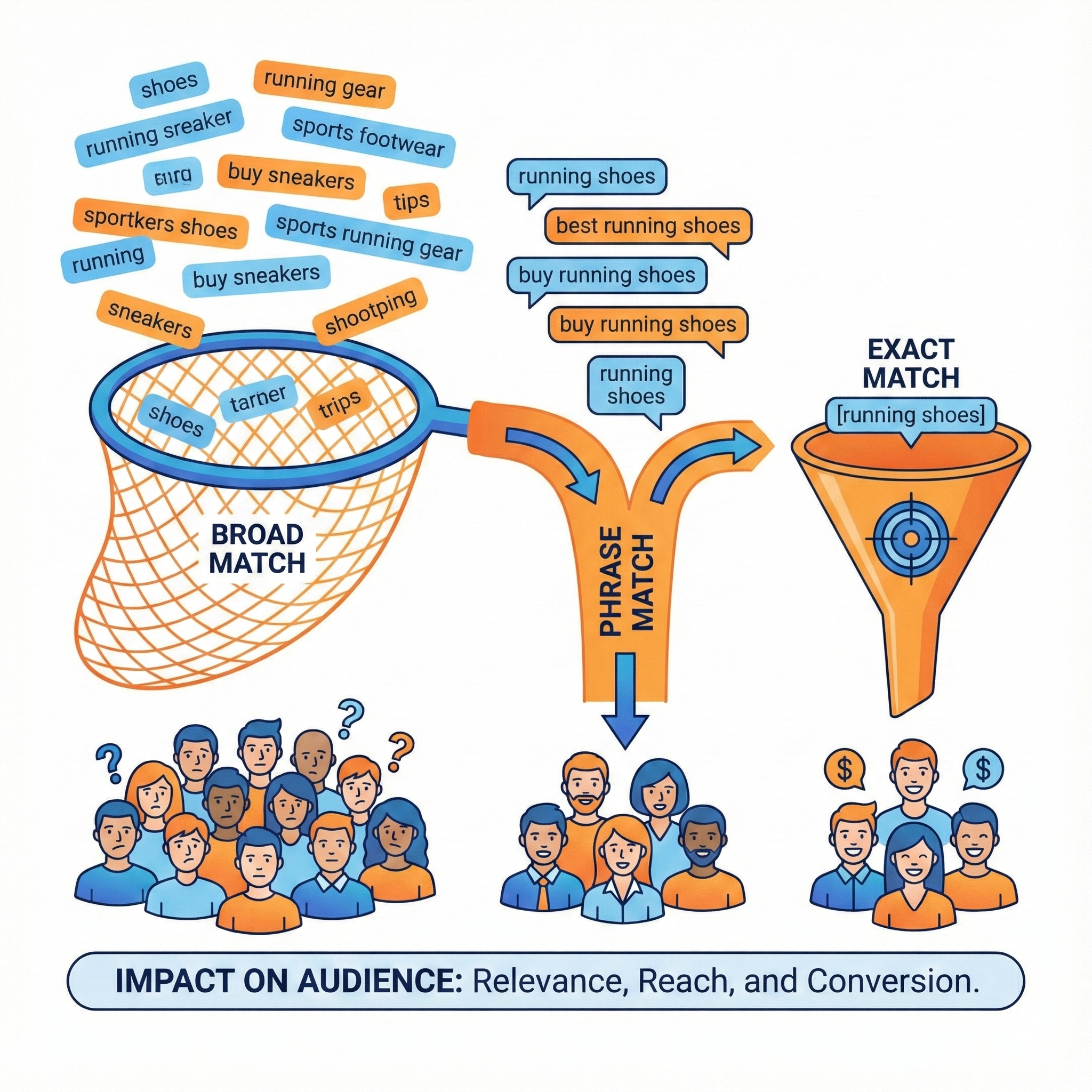
Keyword match types define how closely a user’s search query must match your chosen keyword for your ad to appear.
In simple words:
Match types control who sees your ads.
When you select a keyword, you’re not buying that keyword alone—you’re buying a range of search queries, and match types decide how wide or narrow that range is.
2. How Google Matches Search Queries to Keywords
Google Ads does not match keywords literally anymore.
Instead, Google uses:
This means:
-
A keyword does not need to contain the exact words
-
Meaning matters more than wording
-
Match types act as guidelines, not strict rules
3. Broad Match – Complete Breakdown
What Is Broad Match?
Broad match is the default match type in Google Ads.
It allows your ad to show for:
📌 Syntax:
How Broad Match Works (Modern Google Ads)
Google uses:
-
Machine learning
-
Conversion data
-
Smart bidding signals
Broad match focuses on intent, not words.
Keyword: running shoes
Can trigger ads for:
-
best shoes for jogging
-
sports footwear for men
-
gym shoes
-
marathon sneakers
Advantages of Broad Match
✅ Massive reach
✅ Discover new converting keywords
✅ Best for scaling campaigns
✅ Works well with Smart Bidding
✅ Ideal for high-volume goals
Disadvantages of Broad Match
❌ High risk of irrelevant traffic
❌ Expensive if unmanaged
❌ Requires strong negative keywords
❌ Poor for small budgets
❌ Can attract low-intent users
When to Use Broad Match
✔ Large budgets
✔ Conversion tracking is accurate
✔ Smart bidding enabled (tCPA / tROAS)
✔ Mature accounts with strong data
✔ Discovery & expansion phase
When NOT to Use Broad Match
✘ New accounts
✘ Limited budgets
✘ No conversion tracking
✘ Manual CPC bidding
✘ Highly niche or regulated industries
4. Phrase Match – Complete Breakdown
What Is Phrase Match?
Phrase match shows ads when the meaning of the keyword is included in the search query, even if additional words appear before or after.
📌 Syntax:
How Phrase Match Works Today
Phrase match is intent-based, not word-order dependent.
Keyword: "running shoes"
Can trigger ads for:
Won’t trigger ads for:
-
casual shoes
-
sandals for men
Advantages of Phrase Match
✅ Better control than broad
✅ Captures high-intent searches
✅ Balanced reach and relevance
✅ Easier to manage
✅ Good for scaling safely
Disadvantages of Phrase Match
❌ Less reach than broad
❌ Still needs negative keywords
❌ Misses some long-tail opportunities
When to Use Phrase Match
✔ Most search campaigns
✔ Mid-level budgets
✔ Lead generation
✔ E-commerce product categories
✔ Testing new keyword themes
5. Exact Match – Complete Breakdown
What Is Exact Match?
Exact match shows ads for searches with the same intent or meaning as your keyword.
📌 Syntax:
How Exact Match Works Now
Exact match is no longer exact.
It includes:
-
Close variants
-
Plurals
-
Misspellings
-
Same-intent queries
Keyword: [running shoes]
Can trigger ads for:
-
running shoe
-
shoes for running
Advantages of Exact Match
✅ Highest relevance
✅ Best Quality Score
✅ Lower CPC
✅ Predictable performance
✅ Strong ROI
Disadvantages of Exact Match
❌ Lowest reach
❌ Limited scaling
❌ Slower data collection
❌ Misses discovery keywords
When to Use Exact Match
✔ High-converting keywords
✔ Brand campaigns
✔ Competitor campaigns
✔ Limited budgets
✔ ROI-focused advertisers
6. Broad vs Phrase vs Exact (Comparison Table)
| Factor |
Broad |
Phrase |
Exact |
| Reach |
Very High |
Medium |
Low |
| Control |
Low |
Medium |
High |
| CPC |
High |
Medium |
Low |
| Intent Accuracy |
Low–Medium |
Medium–High |
Very High |
| Scaling |
Excellent |
Good |
Limited |
| Best For |
Discovery |
Balanced Growth |
Profitability |
7. Impact on CPC, Quality Score & ROI
Broad Match
Phrase Match
-
CPC: Moderate
-
Quality Score: Good
-
ROI: Consistent
Exact Match
-
CPC: Lowest
-
Quality Score: Best
-
ROI: Highest
8. Match Types & Search Intent
| Intent Type |
Best Match Type |
| Informational |
Broad |
| Commercial Research |
Phrase |
| Transactional |
Exact |
| Brand Searches |
Exact |
| New Market Testing |
Broad |
| High-Intent Leads |
Phrase + Exact |
9. Match Types & Negative Keywords
Negative keywords are non-negotiable, especially for Broad and Phrase match.
Examples:
-
free
-
jobs
-
meaning
-
images
-
cheap (if premium brand)
💡 Pro Tip:
Exact match keywords often require fewer negatives, while broad match requires constant mining.
10. Smart Match Type Strategy (Pro Framework)
Beginner Strategy
-
70% Phrase
-
30% Exact
-
Avoid Broad initially
Intermediate Strategy
Advanced Strategy
11. Common Mistakes to Avoid
❌ Using only Broad match
❌ Avoiding Exact match entirely
❌ No negative keywords
❌ Same keyword in all match types in one ad group
❌ Judging match types without enough data
12. Final Recommendations
-
Exact match = precision & ROI
-
Phrase match = balance & scalability
-
Broad match = growth & discovery
The best advertisers don’t choose one match type—they combine all three strategically, based on:
-
Budget
-
Funnel stage
-
Data maturity
-
Business goals
Final Thought
Keyword match types are not settings.
They are strategic levers that control profitability, growth, and risk.