
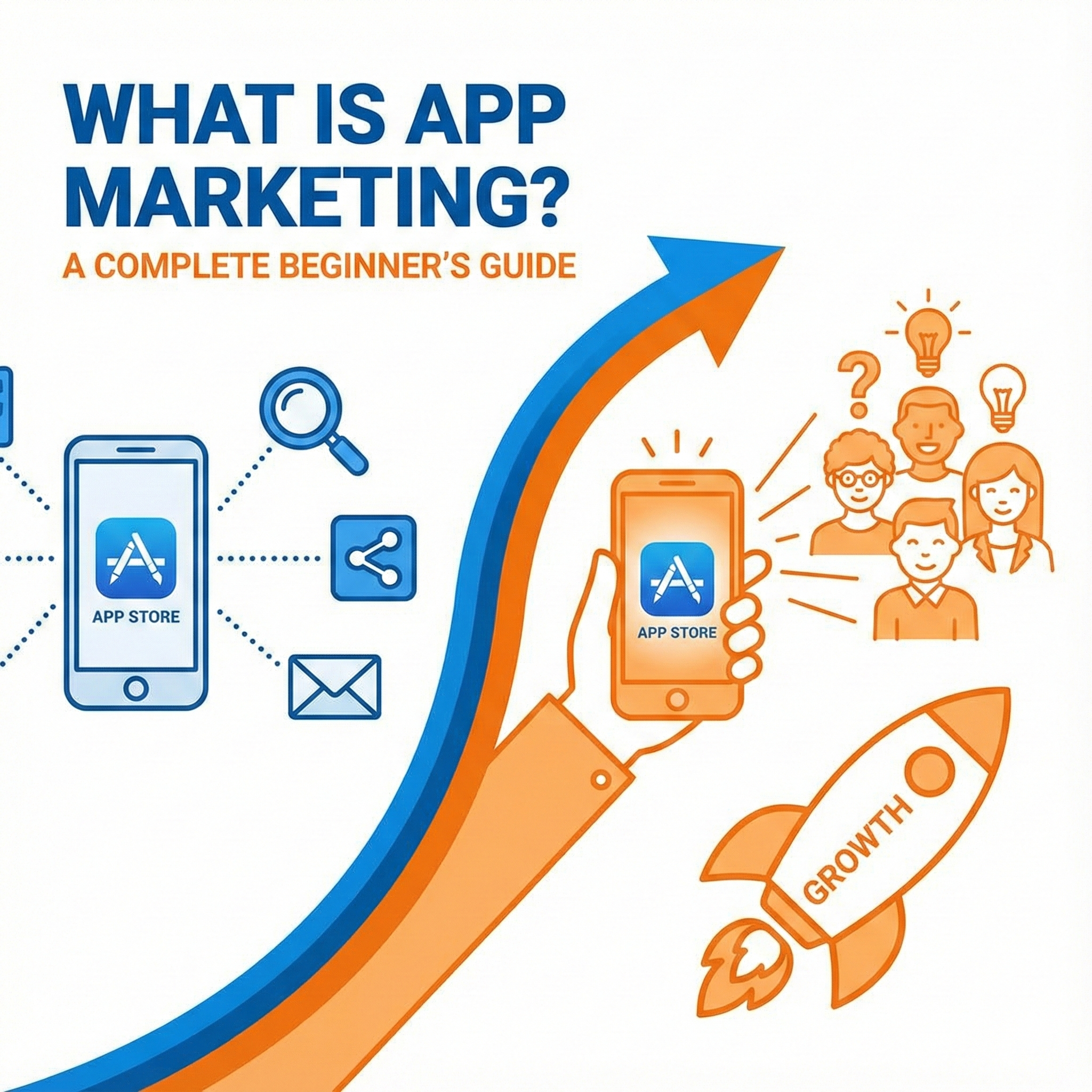
What Is App Marketing? A Complete Beginner’s Guide
Mobile apps have become an inseparable part of everyday life—from ordering food and booking cabs to managing finances, fitness, and entertainment. But with millions of apps competing for attention, simply building an app is not enough. This is where App Marketing comes in.
This complete beginner’s guide explains what app marketing is, why it matters, how it works, key strategies, channels, metrics, and common mistakes—in clear, simple language.
1. What Is App Marketing?
App marketing is the process of promoting a mobile application throughout its entire lifecycle—from pre-launch awareness to post-install engagement, retention, and monetization.
Unlike traditional digital marketing, app marketing focuses on:
Driving app installs
Encouraging in-app actions
Increasing long-term usage
Generating revenue from users
App marketing does not end after downloads. In reality, effective app marketing starts after the install.
2. Why App Marketing Is Important
2.1 App Stores Are Overcrowded
There are millions of apps available today. Without proper marketing, even a great app can remain invisible.
2.2 Downloads Don’t Equal Success
Many users install an app and never open it again. App marketing ensures users stay, engage, and return.
2.3 Rising User Acquisition Costs
Acquiring new users is expensive. Retaining existing users is more cost-effective and profitable.
2.4 Revenue Depends on Engagement
Subscriptions, ads, and in-app purchases only work when users actively use the app.
3. How App Marketing Is Different from Website Marketing
| Aspect | App Marketing | Website Marketing |
|---|---|---|
| Platform | Mobile apps | Websites |
| Primary Goal | Installs + Engagement | Traffic + Conversions |
| Tracking | SDK-based analytics | Cookies & pixels |
| Retention | Push, in-app, CRM | Email & remarketing |
| User Experience | App UI & flows | Page design & speed |
App marketing is behavior-focused, while website marketing is intent-focused.
4. The App Marketing Funnel (Lifecycle Model)
App marketing follows a lifecycle funnel, not a one-time conversion funnel.
4.1 Awareness
Users discover your app via ads, content, social media, influencers, or word-of-mouth.
4.2 Acquisition
Users visit the app store and install the app.
4.3 Activation
Users open the app and experience the first meaningful value (often called the “Aha moment”).
4.4 Engagement
Users repeatedly use the app, explore features, and complete actions.
4.5 Retention
Users return on Day 1, Day 7, Day 30, and beyond.
4.6 Monetization
Users generate revenue through subscriptions, purchases, or ads.
4.7 Advocacy
Satisfied users leave reviews, recommend the app, and refer others.
5. Types of App Marketing
5.1 Organic App Marketing
Does not require direct ad spend.
Includes:
App Store Optimization (ASO)
Content marketing
SEO for app landing pages
Social media presence
Community building
5.2 Paid App Marketing
Involves paid user acquisition.
Includes:
App install ads
Search ads
Display and video ads
Influencer collaborations
Retargeting campaigns
5.3 Lifecycle and CRM-Based App Marketing
Focuses on engaging existing users.
Includes:
Push notifications
In-app messages
Email marketing
SMS and WhatsApp communication
6. App Store Optimization (ASO)
App Store Optimization (ASO) is the process of improving your app listing to increase visibility and conversion.
Key ASO elements include:
App title and keywords
App description
App icon
Screenshots and preview videos
Ratings and reviews
Update frequency
Think of ASO as SEO for mobile apps.
7. Paid App Advertising Channels
7.1 Search-Based Ads
High-intent users searching for solutions are more likely to install and engage.
7.2 Social Media Advertising
Effective for discovery, brand building, and scaling installs.
7.3 Video Advertising
Short-form videos help demonstrate app value quickly and emotionally.
7.4 Influencer Marketing
Trusted creators showcasing real app usage drive high-quality installs.
8. App Engagement and Retention Strategies
8.1 Push Notifications
Used for reminders, offers, updates, and re-engagement. Overuse can cause uninstalls.
8.2 In-App Messaging
Contextual messages inside the app for education, feature discovery, and upselling.
8.3 App Onboarding
A strong onboarding experience helps users understand value quickly and reduces drop-offs.
8.4 Personalization
Customized experiences based on user behavior significantly improve engagement and retention.
9. Important App Marketing Metrics
Acquisition Metrics
Impressions
Click-through rate (CTR)
Cost per install (CPI)
Engagement Metrics
Daily active users (DAU)
Monthly active users (MAU)
Session duration
Retention Metrics
Day 1, Day 7, Day 30 retention
Churn rate
Monetization Metrics
Average revenue per user (ARPU)
Customer lifetime value (LTV)
Paid user conversion rate
A profitable app usually has LTV greater than CPI.
10. App Analytics and Measurement
App marketers rely on analytics tools to understand:
User behavior
Funnel drop-offs
Attribution sources
ROI by channel
Data-driven decisions are critical for scaling app growth.
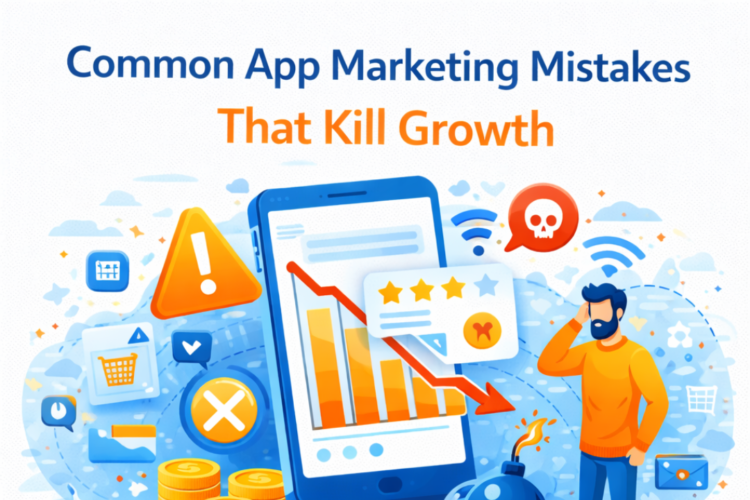
11. Common App Marketing Mistakes Beginners Make
Focusing only on installs
Ignoring onboarding experience
Skipping ASO optimization
Sending excessive push notifications
Not tracking retention or lifetime value
Scaling ads without product-market fit
12. The Future of App Marketing
Key trends shaping app marketing:
AI-driven personalization
Privacy-first measurement
Predictive churn and retention modeling
Omnichannel app experiences
Stronger focus on retention over acquisition
13. Simple App Marketing Strategy for Beginners
Clearly define your app’s core value
Optimize your app store listing
Test small paid acquisition campaigns
Improve onboarding and activation
Focus on retention before scaling
Track lifetime value vs acquisition cost
Build engagement and referral loops
Final Thoughts
App marketing is not about getting users—it’s about keeping them.
Successful app marketers think like:
Product managers (UX and value)
Data analysts (metrics and insights)
Marketers (growth and distribution)
Psychologists (user behavior and motivation)
If you master the entire app lifecycle, app marketing becomes one of the most powerful and scalable growth engines in digital marketing.

Author