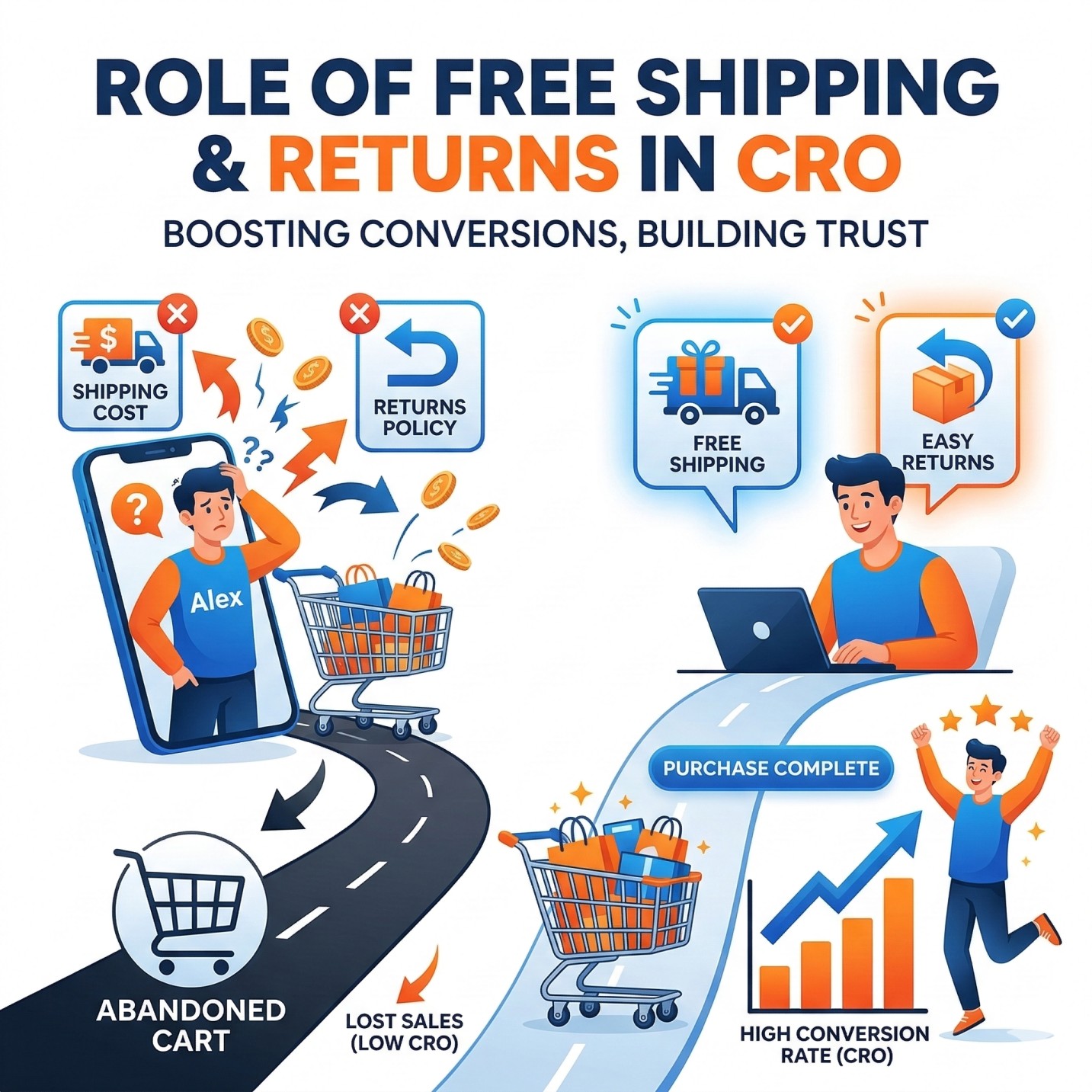
Role of Free Shipping and Returns in Conversion Rate Optimization
How removing financial risk at checkout can be one of your highest-leverage CRO moves
Conversion rate optimization is, at its core, about removing friction. Every hesitation a shopper feels — every moment of “but what if…” — chips away at the likelihood they’ll complete a purchase. Among all the barriers that stand between a visitor and a completed order, two have proven especially powerful: the fear of paying for shipping, and the fear of being stuck with something they don’t want.
Free shipping and free returns aren’t just perks. When implemented and communicated well, they are CRO instruments that directly influence purchase intent, average order value, and long-term customer lifetime value.
Why Shipping Costs Kill Conversions
Cart abandonment sits stubbornly between 65–80% across most e-commerce categories. The number-one reason shoppers abandon? Unexpected costs at checkout — and shipping fees are the most common culprit.
The psychology here is well-documented. Customers respond disproportionately to the addition of a shipping fee — even a small one — because it reframes the transaction. A product listed at $45 feels like a different purchase when checkout reveals a $7.99 shipping charge. The customer suddenly isn’t paying $45 for something they want; they’re paying $52.99, and the math feels different.
This isn’t irrational. It’s a well-understood cognitive response: people are more sensitive to losses (paying more than expected) than to equivalent gains. Shipping costs aren’t experienced as “paying for a service” — they’re experienced as a penalty.
The “Something for Nothing” Effect
Free shipping, by contrast, activates a powerful positive signal. Research from the National Retail Federation consistently shows that free shipping is the single most influential factor in purchase decisions for online shoppers — ranking above discounts, loyalty programs, and even product availability.
There’s a reason Amazon built its entire Prime membership around free shipping as the core value proposition. The membership fee is a psychological trade — pay once, eliminate the shipping pain forever. Customers adopted it in the hundreds of millions.
Free Returns: Reducing the Risk of Buying Blind
Returns are the second major anxiety point, particularly for categories where fit, feel, or quality can only be assessed in person — apparel, footwear, furniture, electronics, and beauty, to name a few.
When a customer lands on a product page, they’re making a decision with incomplete information. They can’t try it on. They can’t feel the fabric. They can’t see how it looks in their living room. Free returns collapse that uncertainty. The implicit message is: if this isn’t right, you’re not punished for trusting us.
This shifts the conversion equation significantly. Instead of asking “Am I sure enough to risk my money?”, the customer is effectively asking “Do I want to try this?” — a far lower bar.
The Zappos Blueprint
Zappos built an entire brand identity around free returns (365 days, no questions asked) at a time when this was almost unheard of in e-commerce. The result wasn’t a return-rate disaster — it was a loyalty engine. Customers who had returned items were among Zappos’ highest-value repeat buyers. They trusted the brand and came back more often, spent more per order, and referred others.
This counterintuitive pattern holds across the industry: generous return policies don’t just reduce purchase hesitation — they build the kind of trust that compounds into repeat business.
The CRO Mechanics: Where These Policies Actually Move Numbers
Free shipping and returns aren’t just feel-good brand decisions. They operate on specific, measurable levers.
1. Checkout Abandonment Rate
This is the most direct impact. Displaying “Free Shipping” prominently — in banners, on product pages, in the cart, and at checkout — reduces the surprise factor that causes late-stage abandonment. A/B tests routinely show meaningful lifts in checkout completion rates when shipping costs are removed or when free shipping thresholds are clearly communicated early in the funnel.
2. Average Order Value (AOV)
Free shipping thresholds are a classic AOV lever. “Free shipping on orders over $50” nudges customers who are at $35 or $40 to add another item. The key is placing the threshold communication at the right moment — in the cart, close to the threshold, with a specific prompt (“You’re $12 away from free shipping”). This turns a cost-saving policy into an upsell mechanism.
3. Product Page Conversion
Many shoppers make their buy/no-buy decision on the product page, before ever adding to cart. Surfacing free shipping and free return information on product pages — not just at checkout — means it factors into that initial decision. This is often under-optimized: brands bury these policies in footers and FAQ pages instead of putting them where the decision is being made.
4. Return Visitor Rate and Customer Lifetime Value
One of the most underappreciated CRO metrics is the return rate of customers who experienced a smooth return. A customer who returned an item and found the process painless is statistically more likely to purchase again than a customer who never returned anything. The friction-free experience — paid for by the returns policy — effectively buys future revenue.
Making It Work: Implementation Principles
Offering free shipping and returns is only half the job. The other half is making sure customers know about it at every relevant point in their journey.
Be specific and early. Don’t wait until checkout to reveal shipping policy. Display it on homepages, category pages, product pages, and in the cart. Shoppers shouldn’t have to hunt for this information.
Use threshold messaging dynamically. If you’re offering free shipping above a certain order value, inject real-time messaging in the cart that tells customers exactly how much more they need to add. Generic “Free shipping on orders over $X” banners are less effective than “Add $13.40 more to get free shipping” in the cart.
Make returns frictionless in practice, not just in policy. A generous written policy undercut by a confusing returns process creates a trust deficit that’s worse than no policy at all. Pre-printed return labels, self-service portals, and clear timelines matter enormously.
Test placement and messaging. CRO is ultimately empirical. “Free shipping” versus “Free delivery” versus “We pay for shipping” can yield meaningfully different results depending on your audience. Run tests, not assumptions.
Be transparent about exceptions. If free shipping applies only above a threshold or only to certain product categories, say so clearly. Hidden exceptions discovered at checkout damage trust and spike abandonment.
The Cost Question: Is It Worth It?
The honest answer: it depends on your margins, your category, and your customer acquisition costs — but for most e-commerce businesses, the math tilts toward offering it.
Consider the full picture:
- Higher conversion rate → more revenue from the same traffic
- Higher AOV (from threshold incentives) → better margin per order
- Lower return anxiety → higher product satisfaction and fewer returns
- Repeat purchase rate → customer lifetime value compounds
For businesses with thin margins where absorbing shipping costs isn’t viable, the options are: build shipping into product pricing, use a threshold strategy, or offer free shipping as a loyalty program benefit. The goal isn’t necessarily to offer free shipping universally — it’s to remove or reframe the shipping cost anxiety at the moment it would otherwise cause abandonment.
The Bottom Line
Conversion rate optimization often gets framed as a discipline of clever copy, button colors, and checkout flow tweaks. Those things matter. But the highest-leverage CRO work is often structural: redesigning the risk profile of a purchase so that the customer’s hesitation has nowhere to live.
Free shipping removes the “unexpected cost” surprise. Free returns remove the “what if I’m wrong” fear. Together, they don’t just improve conversion metrics — they build the kind of customer trust that makes those metrics better permanently.
In an era where customer acquisition costs are high and attention is scarce, giving shoppers one fewer reason to leave is one of the most defensible investments an e-commerce brand can make.
The best CRO strategy isn’t always about optimizing what’s there — sometimes it’s about eliminating what shouldn’t be.

Author