Silent Transformation of Search Behavior
Search has always been about discovery. Users typed a query, scanned a list of links, clicked a result, and explored content across the web. For nearly two decades, this click-based model shaped how websites were built, how SEO was practiced, and how digital success was measured. Today, that model is quietly but fundamentally changing.
The rise of zero-click searches represents one of the most disruptive shifts in the history of search engines. A zero-click search occurs when a user’s query is answered directly on the search results page itself, eliminating the need to click through to any external website. What once felt like an edge case has now become a dominant behavior pattern across informational, navigational, and even commercial queries.
This change is not accidental. It is driven by advances in artificial intelligence, changes in user expectations, mobile-first consumption, and platform incentives that prioritize speed and convenience. Understanding the rise of zero-click searches is no longer optional for marketers, publishers, and businesses. It defines how visibility, authority, and growth will work in the next era of search.
What Zero-Click Searches Really Are (Beyond the Simple Definition)
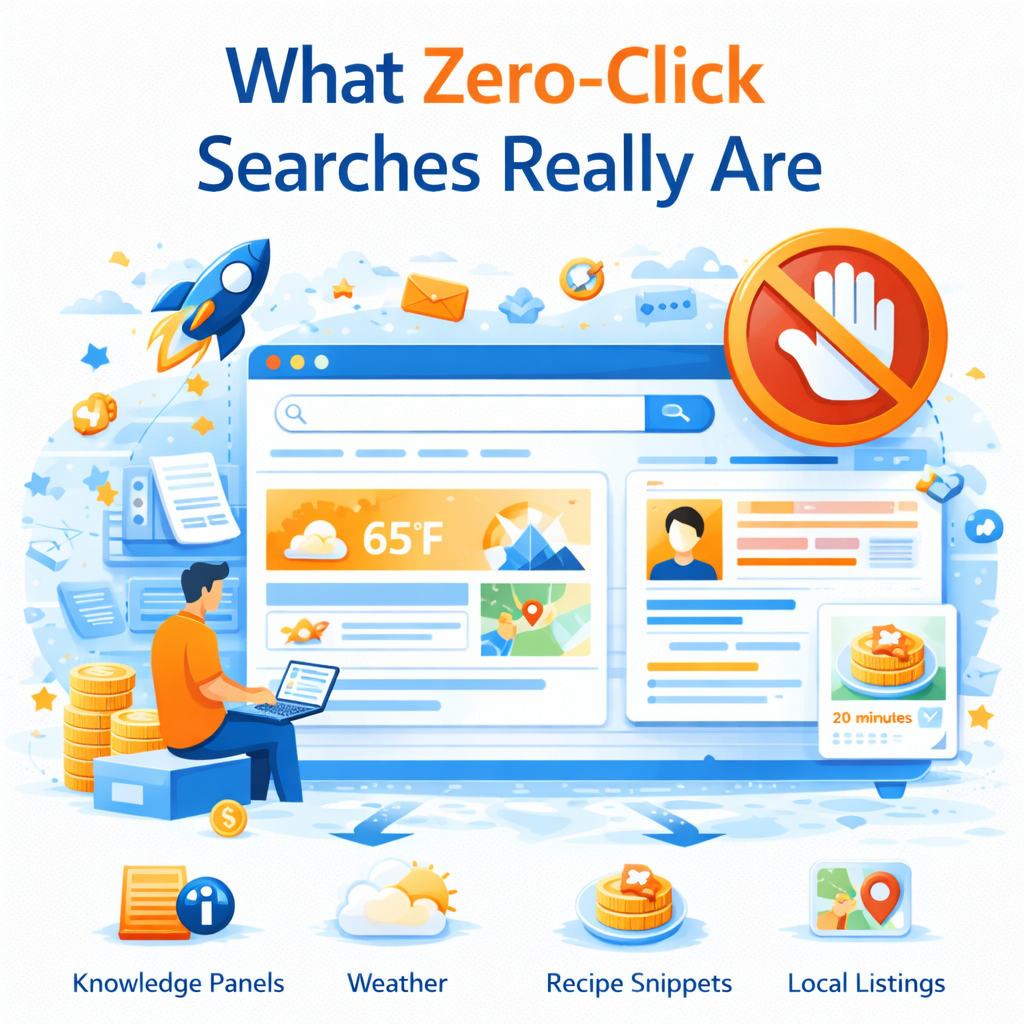
Zero-click searches are often described narrowly as searches where users do not click on any organic result. However, this definition understates their significance. Zero-click searches represent a deeper evolution in how search engines function.
Instead of acting purely as directories that point users to external content, modern search engines increasingly act as answer engines. They extract, synthesize, and present information directly within the interface. Users still search, but the destination has shifted from websites to the search results page itself.
These answers appear in many forms, including featured snippets, knowledge panels, People Also Ask boxes, local packs, calculators, definitions, summaries, and AI-generated overviews. In each case, the user’s intent is resolved instantly without requiring a visit to a publisher’s website.
Why Zero-Click Searches Are Increasing So Rapidly
The explosive growth of zero-click searches is driven by a combination of technological progress and behavioral change. Users increasingly expect immediate answers, not exploration. On mobile devices especially, clicking through multiple pages feels slow and unnecessary when the answer is already visible.
Search engines, particularly Google, have strong incentives to satisfy this expectation. The faster users get answers, the more they trust the platform and continue using it. This reinforces Google’s dominance and keeps users within its ecosystem longer.
Artificial intelligence has accelerated this trend dramatically. With advances in natural language processing and large language models, search engines can now interpret intent, summarize complex topics, and present cohesive responses rather than isolated facts. This makes zero-click answers viable for queries that previously required multiple clicks and deep reading.
The Role of SERP Features in Zero-Click Searches
Search engine results pages are no longer simple lists of blue links. They have evolved into rich, interactive environments designed to resolve intent directly.
Featured snippets extract a concise answer from a webpage and place it at the top of the results. Knowledge panels aggregate structured information about entities such as people, brands, and concepts. People Also Ask boxes guide users through related questions without leaving the page. Local packs provide directions, hours, and reviews instantly. AI-powered summaries now combine insights from multiple sources into a single response.
Each of these elements reduces the likelihood of a click, even when the content originates from third-party websites. The paradox is that while publishers supply the information, the engagement increasingly happens on the platform itself.
How Zero-Click Searches Change User Intent Fulfillment
Traditional SEO assumed that satisfying user intent required a click. Zero-click search challenges this assumption by fulfilling intent at the search layer itself.
For simple informational queries such as definitions, conversions, weather, or quick explanations, zero-click results are often genuinely helpful. Users save time, and friction disappears. However, this convenience changes how intent is expressed and measured.
Users may still be influenced by a brand or source they see in a snippet, even if they do not click. Awareness and trust can be built without traffic. This makes visibility and authority more important than raw visits.
The Impact on Organic Traffic and Publisher Economics
One of the most profound consequences of zero-click searches is the decline in organic traffic for many types of content. Informational publishers, bloggers, and reference websites are particularly affected because their content is most easily summarized.
This shift challenges the traditional content-for-traffic business model. When search engines answer questions directly, fewer users reach the original source, reducing ad impressions, subscriptions, and monetization opportunities.
However, this does not mean all traffic is disappearing. It is becoming more polarized. Simple queries generate fewer clicks, while complex, high-intent queries still drive engagement. Websites that offer depth, nuance, tools, or experiences that cannot be fully summarized remain essential.
Zero-Click Searches and the Evolution of SEO
Zero-click searches do not signal the death of SEO, but they do redefine it. Optimization is no longer solely about ranking to earn clicks. It is about earning presence, authority, and influence within search results themselves.
Modern SEO must account for how content is extracted, summarized, and represented. Clear structure, semantic clarity, strong topical authority, and trustworthiness determine whether content is chosen as a source for snippets or AI answers.
In this environment, visibility can exist without traffic, and success must be measured differently. Brand recall, assisted conversions, and downstream demand become more meaningful indicators than pageviews alone.
Brand Authority in a Zero-Click World
As clicks decline, brands that consistently appear in zero-click results gain a powerful advantage. Even without direct visits, repeated exposure builds familiarity and trust.
When users see the same brand cited across multiple answers, it becomes mentally associated with expertise. Over time, this drives branded searches, direct traffic, and conversions that are not immediately attributable to a single click.
This makes brand-led SEO strategies far more important than keyword-led ones. Websites that position themselves as definitive authorities on specific topics are more likely to benefit from zero-click visibility rather than be harmed by it.
Zero-Click Searches and AI-Generated Answers
The rise of AI-generated answers marks the next stage of zero-click evolution. Instead of quoting a single source, AI systems synthesize information from multiple websites to produce a unified response.
This further reduces the incentive to click, but it also raises the bar for inclusion. Only content that is clear, consistent, and trustworthy is likely to be used during synthesis. Shallow or derivative content is filtered out.
In this context, being cited or implicitly referenced by AI systems becomes a new form of ranking. Websites that adapt their content for clarity, depth, and accuracy will continue to influence user decisions even without traditional traffic.
How Businesses Should Adapt Strategically
Adapting to zero-click searches requires a mindset shift. Instead of fighting the trend, successful businesses align with it.
This means creating content that answers questions comprehensively while encouraging deeper engagement for users who want more. It means optimizing for entities, topics, and trust rather than just keywords. It also means integrating SEO with branding, PR, content marketing, and conversion optimization.
Most importantly, it means redefining success. Visibility without clicks is not failure; it is influence without friction. Businesses that understand this will design strategies that capture value across the entire customer journey, not just at the point of search.
The Long-Term Future of Zero-Click Search
Zero-click searches are not a temporary phase. They are a structural change in how information is accessed. As AI systems become more capable, the boundary between searching and answering will continue to blur.
This does not eliminate the need for websites. Instead, it elevates their role from traffic destinations to knowledge infrastructure that powers the web’s intelligence layer.
Publishers and marketers who focus on depth, originality, and trust will remain essential, even as the mechanics of visibility change.
Conclusion: What the Rise of Zero-Click Searches Ultimately Means
The rise of zero-click searches marks a shift from a click-driven internet to an answer-driven one. It challenges old assumptions, disrupts familiar metrics, and forces a reevaluation of how value is created online.
For users, it delivers speed and convenience. For search engines, it strengthens trust and engagement. For businesses and publishers, it demands adaptation, clarity, and a stronger focus on authority.
Those who cling to traffic-only thinking will struggle. Those who embrace zero-click visibility as a form of influence will thrive. In the future of search, being seen, understood, and trusted matters more than being clicked.

Author