

Why You Need a CRO Test Prioritization Framework
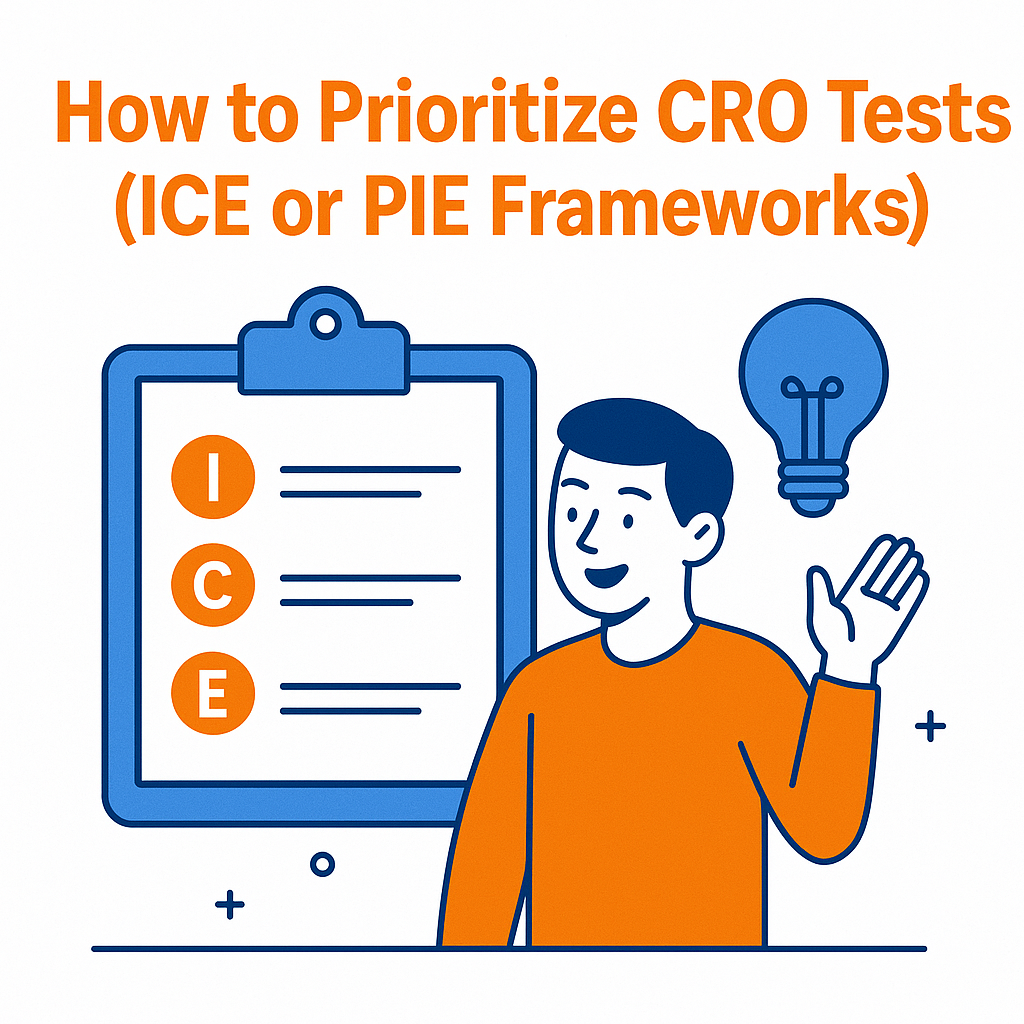
Prioritizing your Conversion Rate Optimization (CRO) tests is critical for getting the most value from your time, resources, and traffic. With dozens (or hundreds) of test ideas, how do you decide what to run first? That’s where prioritization frameworks like ICE and PIE come in.
In this guide, you’ll learn:
-
What ICE and PIE frameworks are
-
How to use them for CRO
-
Pros, cons, and real-world examples
-
Which one to choose (and why)
🧭 Why You Need a CRO Test Prioritization Framework
Without a prioritization framework, CRO efforts often fall into:
-
Testing what feels important
-
Running ideas based on seniority, not strategy
-
Wasting traffic on low-impact experiments
A framework gives structure. It ensures you:
-
Focus on impactful changes
-
Run tests you have confidence in
-
Choose ideas that are feasible to execute
🚀 Framework #1: ICE Score
What is ICE?
Developed by Sean Ellis (of GrowthHackers), ICE stands for:
-
Impact: How much the test could improve conversion rate or revenue
-
Confidence: How sure you are it will work
-
Ease: How easy it is to implement
Each factor is scored on a 1–10 scale.
Formula:
ICE Score = (Impact + Confidence + Ease) / 3
📊 ICE Example:
| Test Idea | Impact | Confidence | Ease | ICE Score |
|---|---|---|---|---|
| Change CTA text on pricing page | 6 | 7 | 9 | 7.3 |
| Add social proof near form | 8 | 8 | 7 | 7.6 |
| Redesign full checkout experience | 9 | 5 | 3 | 5.6 |
🎯 Start with the test that has the highest ICE score.
✅ Pros of ICE:
-
Simple, fast, and intuitive
-
Works well in agile environments
-
Factors in execution feasibility
❌ Cons of ICE:
-
“Ease” is subjective—design vs. dev may score it differently
-
Doesn’t factor in traffic or page importance
-
Confidence can be biased without real data
🔧 Framework #2: PIE Score
What is PIE?
Popularized by WiderFunnel, PIE stands for:
-
Potential: How much room for improvement exists on the page
-
Importance: How valuable the traffic is (volume, intent)
-
Ease: How easy it is to test
Each factor is also scored on a 1–10 scale.
Formula:
PIE Score = (Potential + Importance + Ease) / 3
📊 PIE Example:
| Test Area | Potential | Importance | Ease | PIE Score |
|---|---|---|---|---|
| Homepage hero headline | 7 | 9 | 8 | 8.0 |
| Pricing page CTA button color | 3 | 7 | 9 | 6.3 |
| Product page layout restructure | 9 | 6 | 3 | 6.0 |
🎯 Begin with the highest PIE scoring ideas.
✅ Pros of PIE:
-
Prioritizes where to test, not just what
-
Weighs traffic value into the decision
-
Forces evaluation of page-by-page performance
❌ Cons of PIE:
-
Best for page-level prioritization—not individual ideas
-
Doesn’t consider statistical confidence in results
-
Subjective scoring can lead to inconsistency
🧠 When to Use ICE vs. PIE
| Use Case | Best Framework |
|---|---|
| Prioritizing a list of test ideas | ICE |
| Prioritizing which pages to test | PIE |
| You want quick, lightweight scoring | ICE |
| You need traffic and value insights | PIE |
For most teams:
✅ Use PIE to identify high-opportunity pages
✅ Use ICE to prioritize test ideas on those pages
🛠️ Bonus: ICE & PIE Hybrid Template
| Test Idea | Page | Impact | Confidence | Potential | Importance | Ease | Avg Score |
|---|---|---|---|---|---|---|---|
| Add trust badges under CTA | Checkout Page | 8 | 7 | 8 | 9 | 8 | 8.0 |
| Remove 1 field from lead form | Landing Page | 7 | 8 | 6 | 8 | 9 | 7.7 |
Add a column for “Final Decision” with a status: Planned, In Progress, Live, etc.
💡 Tips to Improve Prioritization Accuracy
-
Always back “confidence” scores with data (session recordings, heatmaps, GA4)
-
Standardize scoring rules across team members
-
Use A/B test logs to refine future scores (learn from winners/losers)
-
Automate your scoring spreadsheet with color coding or filters
🎯 Final Thoughts
Both ICE and PIE offer powerful, easy-to-use systems to prevent random, unproductive CRO testing. The real power isn’t in choosing one over the other—but using them together strategically.
🔁 Start with PIE to find high-impact pages
🎯 Then apply ICE to test ideas on those pages
📊 Track results, iterate, and refine your scoring over time
Author