
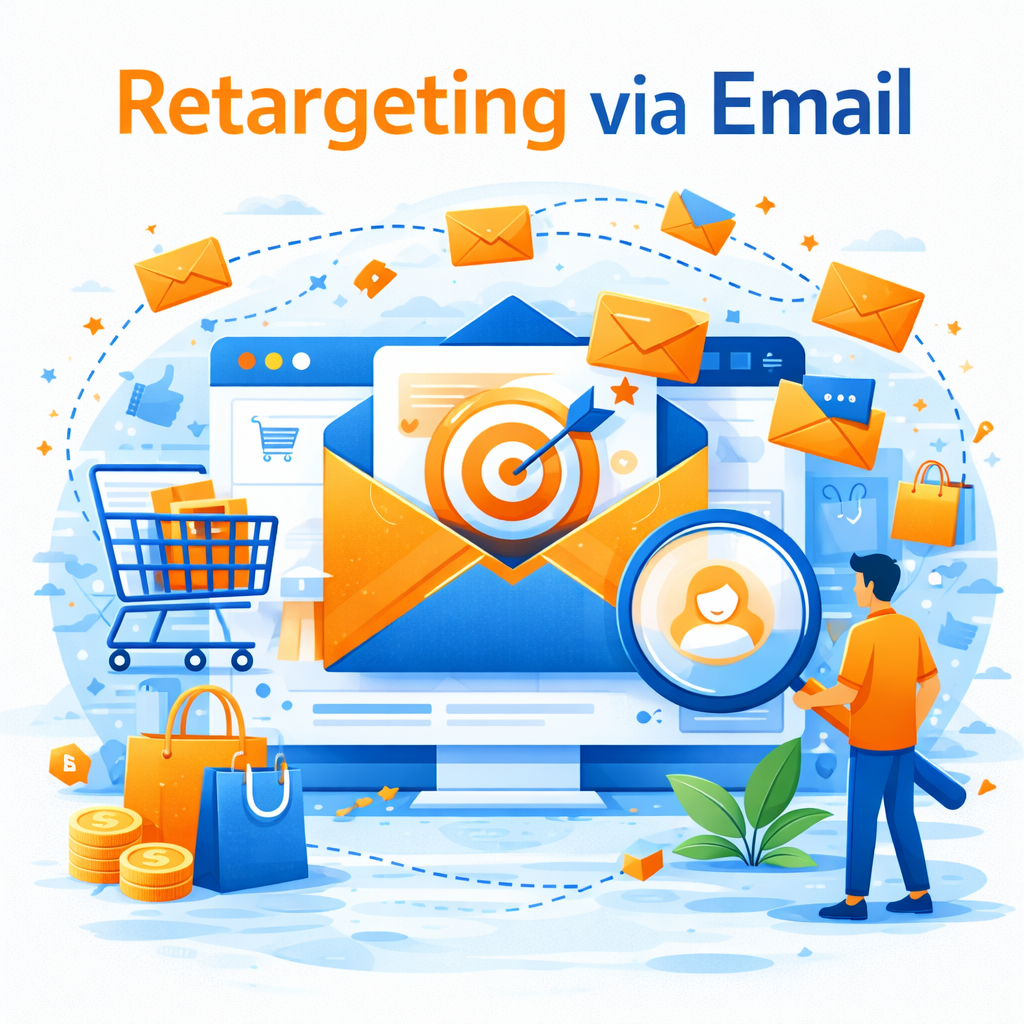
Retargeting via Email: Strategies That Actually Work
Retargeting via email is one of the most underutilized yet highest-ROI tactics in digital marketing. While paid retargeting on search and social platforms often gets the spotlight, email retargeting quietly outperforms most channels in terms of cost efficiency, conversion rates, and long-term customer value.
At its core, email retargeting is about re-engaging users who have already shown intent but did not complete the desired action. These users are not strangers. They have visited your website, interacted with your product, started a form, abandoned a cart, downloaded a resource, or even made a previous purchase. The relationship already exists. Email retargeting leverages this familiarity to move users closer to conversion—or back into the funnel—without the escalating costs of paid media.
This article explores how email retargeting works, why it is so effective, and which strategies consistently deliver results across industries.
Understanding Email Retargeting in a Performance Context
Email retargeting is not the same as generic email marketing. Traditional email campaigns are often broadcast-based, sending the same message to large lists. Retargeting via email, however, is behavior-driven, context-aware, and intent-focused.
It operates on a simple principle: user behavior signals interest. When someone visits a pricing page, abandons a checkout, watches a demo, or stops engaging mid-journey, they are telling you something. Email retargeting responds to that signal with relevant, timely communication designed to remove friction and reignite momentum.
Because these users are already warm, email retargeting typically delivers higher open rates, stronger click-through rates, and significantly better conversion rates compared to cold outreach.
Why Email Retargeting Outperforms Most Channels
Email retargeting works so well because it sits at the intersection of ownership, intent, and timing.
Unlike paid platforms, email is a first-party channel. You are not bidding for attention or competing in auctions. You control delivery, messaging, and frequency. This alone makes email retargeting far more predictable and cost-effective over time.
Secondly, email retargeting is driven by explicit behavioral intent. Users are not targeted because they resemble someone else, but because they personally took an action. This dramatically increases relevance.
Finally, email allows for precision timing. Messages can be triggered immediately after a behavior occurs—when intent is still fresh. This moment-based engagement is where email retargeting consistently wins.
Core Types of Email Retargeting Campaigns
Effective email retargeting strategies are built around user behavior and funnel position. Each type serves a distinct purpose and requires a different messaging approach.
Abandoned Cart and Checkout Retargeting
Abandoned cart emails are the most well-known form of email retargeting, but their effectiveness depends entirely on execution. Users abandon carts for many reasons—price hesitation, distraction, trust concerns, or technical issues.
High-performing abandoned cart sequences do not simply remind users that items are waiting. They address objections, reinforce value, and reduce anxiety. This may involve clarifying return policies, highlighting guarantees, offering social proof, or resolving common concerns.
Timing is critical. The first email should arrive quickly, while intent is still high. Follow-ups should escalate value, not repetition.
Browse and Product View Retargeting
Not all high-intent users add items to a cart. Many explore product pages, compare options, or return multiple times before deciding. Browse retargeting emails re-engage these users by continuing the conversation they already started.
These emails work best when they feel helpful rather than pushy. Reinforcing benefits, showcasing use cases, addressing FAQs, or presenting comparisons can gently guide users toward a decision without pressure.
Lead Form and Signup Abandonment
Lead generation funnels often suffer from incomplete forms and abandoned signups. Email retargeting in this context focuses on removing friction and clarifying value.
Users who abandon forms are usually interested but uncertain. Effective retargeting emails remind them why they started, simplify the next step, and reassure them about data usage, effort required, or expected outcomes.
Even small changes in messaging can dramatically improve completion rates.
Onboarding and Activation Retargeting
For SaaS and app-based businesses, the first few days after signup are critical. Many users never reach the “aha moment” that demonstrates value. Email retargeting helps guide users through key actions required for activation.
These campaigns are triggered by inactivity or partial usage. Rather than generic welcome emails, they focus on nudging users toward specific behaviors that correlate with long-term retention.
Activation-focused retargeting often has a bigger impact on revenue than acquisition-focused campaigns.
Re-Engagement and Win-Back Campaigns
Not all users convert immediately, and not all customers stay active. Re-engagement email retargeting targets users who have gone silent, stopped opening emails, or disengaged from the product.
These campaigns work best when they acknowledge the lapse rather than ignore it. They often reintroduce value, highlight updates, offer incentives, or simply ask if the user still wants to hear from you.
Win-back campaigns focus on reviving dormant customers by reminding them of benefits, improvements, or new reasons to return.
Personalization: The Engine Behind High-Performing Email Retargeting
Generic retargeting emails rarely perform well. Personalization is what transforms email retargeting from noise into relevance.
Effective personalization goes beyond using a first name. It incorporates behavioral data such as pages viewed, products explored, features used, time spent, and past interactions. This allows emails to reflect the user’s actual journey, making the message feel tailored rather than automated.
Contextual relevance builds trust. When users feel understood rather than targeted, engagement increases naturally.
Timing, Frequency, and Cadence Strategy
Email retargeting success is highly sensitive to timing. Messages sent too late lose intent. Messages sent too frequently create fatigue.
High-performing strategies balance urgency with restraint. Initial retargeting emails should arrive close to the triggering action. Subsequent emails should add new value rather than repeating the same reminder.
Cadence should adapt based on engagement. Users who open and click can receive more guidance, while disengaged users should be approached more cautiously to avoid list burnout.
Copy and Messaging That Converts
Email retargeting copy must align with the user’s psychological state. These users are already aware of the product or service; they do not need introductions. They need reassurance, clarity, and confidence.
Strong retargeting emails focus on outcomes rather than features. They reduce perceived risk, reinforce benefits, and make the next step feel easy. Clear calls-to-action matter, but pressure rarely works better than persuasion in email retargeting.
The tone should feel conversational and supportive, not sales-driven.
Measuring Success in Email Retargeting
Email retargeting performance should be measured beyond opens and clicks. The true metrics of success are conversion rate, revenue per user, time to conversion, and lifecycle impact.
Micro-metrics help diagnose issues, but macro-metrics determine value. A campaign with lower open rates but higher conversion efficiency may outperform a campaign that looks better on the surface.
Long-term measurement is equally important. Email retargeting often influences conversions indirectly by supporting decision-making over time. Attribution models should account for this assisting role rather than focusing only on last-click credit.
Common Mistakes That Undermine Email Retargeting
Many email retargeting programs fail not because email is ineffective, but because execution is flawed. Over-automation without relevance, excessive frequency, poor segmentation, and generic messaging are common pitfalls.
Another major mistake is treating email retargeting as a standalone tactic. It works best when integrated with on-site messaging, paid retargeting, CRM workflows, and lifecycle marketing.
Consistency across touchpoints reinforces trust and accelerates conversion.
The Future of Email Retargeting
As privacy regulations tighten and paid acquisition costs continue to rise, email retargeting is becoming more valuable—not less. Its reliance on first-party data makes it resilient, scalable, and compliant.
Advances in automation, behavioral analytics, and AI-driven personalization are pushing email retargeting beyond simple triggers into predictive engagement. The brands that invest in smarter segmentation, deeper intent signals, and customer-centric messaging will continue to outperform competitors who rely solely on paid channels.
Conclusion: Email Retargeting as a Revenue Growth Lever
Email retargeting is not just a recovery tactic—it is a strategic growth lever. It allows brands to maximize the value of existing traffic, reduce acquisition costs, and convert intent into revenue more efficiently.
When executed correctly, email retargeting turns missed opportunities into conversions, disengaged users into customers, and customers into long-term advocates.
In a performance-driven marketing landscape, few channels offer the same combination of control, scalability, and ROI as email retargeting.

Author