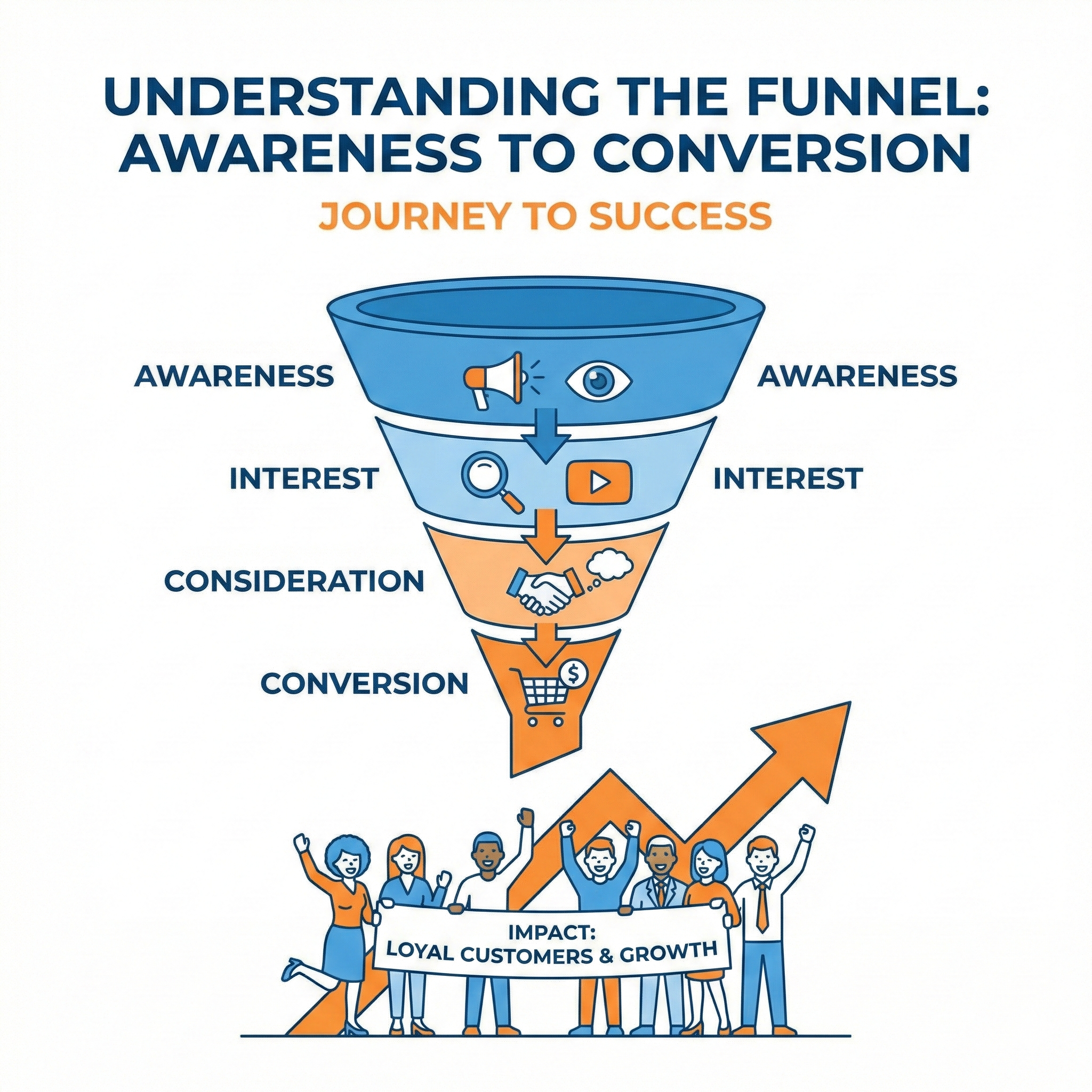
The marketing funnel is a strategic framework that illustrates the journey potential customers take before making a purchase. It helps businesses understand how strangers become leads, leads become prospects, and prospects convert into customers.
In today’s digital ecosystem — where users interact with brands across multiple channels — the funnel is no longer linear. Instead, it is dynamic, multi-touch, and influenced by personalization, trust signals, and user experience.
Understanding the funnel allows businesses to:
attract the right audience,
nurture interest and trust,
remove decision barriers,
optimize conversions,
and build long-term customer relationships.
What is the Marketing Funnel?
The marketing funnel represents the stages a potential customer passes through before making a purchase decision. It is called a funnel because many people enter at the top, but only a smaller percentage converts at the bottom.
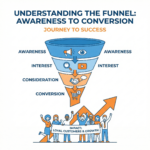
A modern funnel typically includes:
Awareness
Interest / Consideration
Evaluation / Intent
Conversion
Retargeting & Retention
Each stage reflects a different mindset and requires a different marketing approach.
Why Understanding the Funnel Matters
• Helps You Align Marketing With Customer Psychology
Customers do not purchase immediately after discovering a brand. They need awareness, familiarity, trust, and validation. The funnel framework helps marketers align messaging with the emotional and logical decision-making process of customers.
• Improves Budget Allocation & ROI
Understanding which stage needs more attention prevents overspending on traffic generation while neglecting conversion optimization or retention strategies.
• Enables Personalization & Better Targeting
Each stage requires different content and messaging. Funnel understanding enables personalized campaigns that match user intent and behavior.
• Identifies Drop-Off Points
A well-mapped funnel highlights where users abandon the journey, allowing businesses to fix friction points and improve conversion rates.
Stage 1: Awareness (Top of Funnel – TOFU)
What Happens at the Awareness Stage?
At the awareness stage, potential customers realize they have a problem, need, or desire. They are not looking for a specific brand yet; they are exploring information, solutions, or inspiration.
This stage focuses on visibility and discovery, not selling.
Goals of the Awareness Stage
introduce your brand to new audiences,
educate users about problems and solutions,
build familiarity and recognition,
attract qualified traffic.
Effective Awareness Stage Strategies
• Content Marketing & SEO
Educational blog posts, guides, and how-to articles help attract organic traffic. Search engines are often the first touchpoint for users seeking information, making SEO-driven content a powerful awareness tool.
• Social Media Discovery Content
Short-form videos, reels, carousels, and informative posts help introduce your brand to new audiences. The focus should be on value, entertainment, and relatability rather than selling.
• Paid Advertising for Reach
Display ads, YouTube ads, and social media awareness campaigns help introduce your brand to targeted audiences and build recognition.
• Influencer Collaborations
Influencers help expose your brand to relevant audiences and build trust through social proof.
• Educational Videos & Explainers
Videos simplify complex topics and help users understand problems and potential solutions.
Awareness Stage Metrics to Track
reach and impressions,
website traffic,
engagement rates,
brand search volume,
new users.
Stage 2: Interest & Consideration (Middle of Funnel – MOFU)
What Happens at This Stage?
Users now recognize their problem and begin researching solutions. They compare options, read reviews, and evaluate different approaches.
They are not ready to buy yet but are actively exploring.
Goals of the Consideration Stage
build trust and credibility,
position your brand as a reliable solution,
educate prospects about your offerings,
capture leads and nurture relationships.
Effective Consideration Stage Strategies
• In-Depth Guides & Comparison Content
Detailed comparison articles, product guides, and solution breakdowns help users evaluate options and understand differences.
• Lead Magnets & Email Capture
Offering ebooks, templates, or checklists in exchange for email addresses helps move users into nurturing workflows.
• Webinars & Live Demonstrations
Live sessions help explain benefits, answer questions, and build credibility.
• Case Studies & Testimonials
Real customer success stories reduce skepticism and demonstrate real-world effectiveness.
• Retargeting Campaigns
Remarketing ads remind users about your brand and bring them back to continue their journey.
Consideration Stage Metrics to Track
time on site,
pages per session,
email signups,
lead generation volume,
retargeting engagement.
Stage 3: Evaluation & Intent (Lower Funnel – BOFU)
What Happens at the Evaluation Stage?
Prospects narrow down their options and evaluate specific brands. They analyze pricing, features, reviews, trust signals, and guarantees.
They are close to purchasing but still evaluating risk.
Goals of the Evaluation Stage
remove hesitation,
build confidence,
address objections,
demonstrate value.
Effective Evaluation Stage Strategies
• Product Demos & Free Trials
Allowing users to experience your product reduces uncertainty and builds confidence.
• Detailed Product Pages
High-quality images, videos, FAQs, reviews, and feature breakdowns help users make informed decisions.
• Transparent Pricing & Offers
Clear pricing builds trust and prevents confusion.
• Trust Signals & Certifications
Security badges, return policies, warranties, and verified reviews reinforce credibility.
• Comparison Pages
Comparing your product with competitors helps users justify their decision.
Evaluation Stage Metrics to Track
cart additions,
checkout initiation,
product page engagement,
pricing page visits,
demo requests.
Stage 4: Conversion (Purchase Stage)
What Happens at Conversion?
The user decides to take action — making a purchase, signing up, booking a consultation, or subscribing to a service.
At this stage, even small friction points can prevent conversion.
Goals of the Conversion Stage
make the process seamless,
remove last-minute doubts,
reinforce trust and urgency,
simplify checkout or sign-up.
Conversion Optimization Strategies
• Simplified Checkout Process
Reducing steps, enabling guest checkout, and offering multiple payment options improve conversion rates.
• Clear Call-to-Action (CTA)
CTAs should be prominent, direct, and action-oriented.
• Limited-Time Offers & Urgency
Scarcity and urgency encourage immediate action.
• Transparent Shipping & Return Policies
Clear policies eliminate last-minute hesitation.
• Exit-Intent Offers
Providing discounts or reminders when users attempt to leave can recover lost conversions.
Conversion Metrics to Track
conversion rate,
cost per acquisition (CPA),
checkout abandonment rate,
revenue per visitor,
average order value.
Stage 5: Retargeting, Retention & Loyalty (Post-Conversion Funnel)
A funnel does not end at conversion. Customer retention and loyalty significantly impact profitability.
Why Retention Matters
Acquiring new customers is more expensive than retaining existing ones. Loyal customers provide repeat purchases, referrals, and long-term value.
Retention & Loyalty Strategies
• Email Follow-Ups & Onboarding
Welcoming customers and providing guidance enhances satisfaction and reduces returns.
• Loyalty & Rewards Programs
Rewarding repeat customers encourages long-term engagement.
• Personalized Recommendations
Using customer behavior data to suggest relevant products increases repeat purchases.
• Customer Feedback & Support
Actively seeking feedback demonstrates care and improves brand trust.
Retention Metrics to Track
repeat purchase rate,
customer lifetime value (CLV),
churn rate,
referral rate,
customer satisfaction scores.
Common Funnel Mistakes Businesses Make
• Focusing Only on Traffic, Not Conversions
Driving traffic without optimizing mid and bottom funnel stages leads to wasted ad spend and poor ROI.
• Ignoring Trust & Credibility Signals
Users hesitate when they lack trust indicators like reviews, guarantees, and secure payment badges.
• Poor Follow-Up & Lead Nurturing
Failing to nurture leads results in lost sales opportunities.
• Overcomplicated Checkout Processes
Long forms and hidden costs increase abandonment rates.
• Lack of Retargeting Strategy
Many users require multiple touchpoints before converting.
How the Funnel Has Evolved in the AI & Omnichannel Era
Today’s funnel is non-linear. Customers:
discover brands on social media,
research via Google and YouTube,
read reviews and comparisons,
revisit via retargeting ads,
convert through mobile devices.
Modern funnels are multi-touch ecosystems, not single-path journeys.
Conclusion
Understanding the funnel from awareness to conversion enables businesses to align their marketing with customer behavior and decision-making psychology.
Each stage requires targeted messaging, strategic content, and optimized experiences to guide users toward conversion.
When businesses optimize every stage — from discovery to loyalty — they not only increase conversions but also build sustainable, long-term growth.

Author