
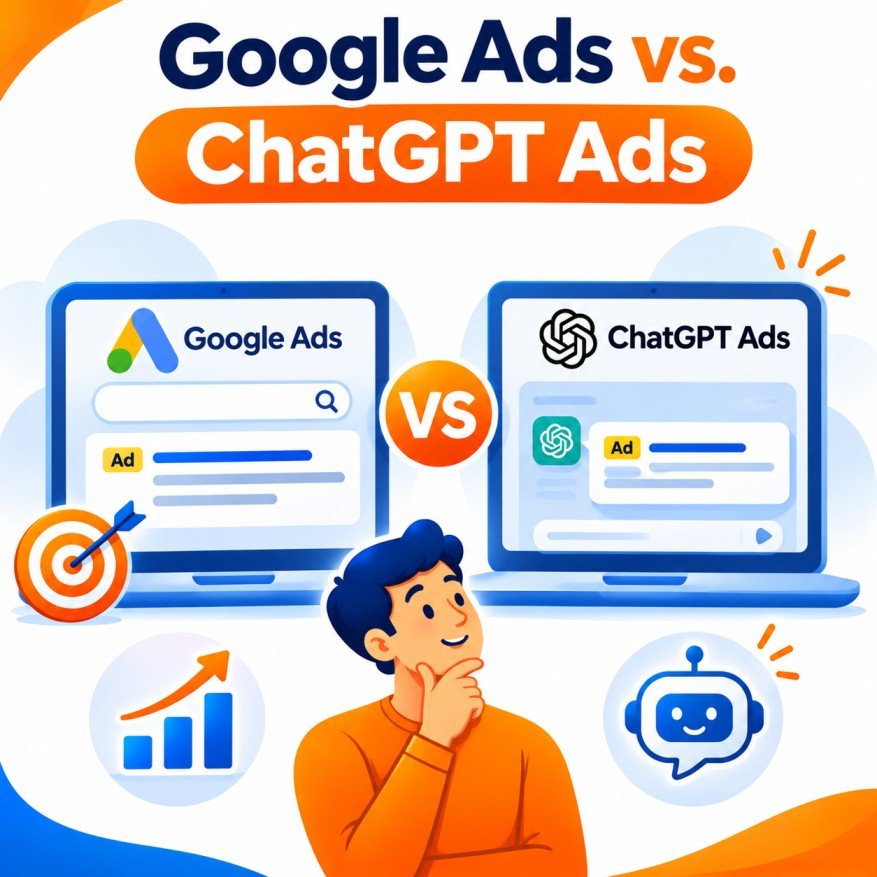
In the evolving landscape of digital advertising, two platforms stand out as fundamentally different approaches to reaching potential customers: Google Ads (the long-established leader) and ChatGPT Ads (OpenAI’s newer advertising system inside ChatGPT). As of late 2026, ChatGPT Ads has moved from early pilot testing (launched in the US in February 2026) to self-serve availability in roughly 89 countries, with more than 100,000 advertisers having run campaigns. Google Ads, by contrast, has over two decades of maturity, massive scale, and a highly refined ecosystem.
They are not direct substitutes. Google Ads primarily captures declared, active search intent. ChatGPT Ads reaches people during conversational exploration, comparison, and decision-making. Understanding the differences in depth is essential for any marketer allocating budget in 2026.
1. Core Philosophy and User Moment
Google Ads is built around the search box. A user types a query (“best project management software for small teams,” “emergency plumber near me,” “buy wireless headphones under $100”). The ad system matches that explicit signal to keywords, auctions the placement, and shows text, shopping, or other ads above or alongside organic results (and increasingly within AI Overviews in some markets). The user is already expressing a need in searchable language and is often closer to taking action.
ChatGPT Ads lives inside a conversation. A user might ask ChatGPT something like “I’m drowning in client emails and deadlines—what’s a better way to organize my work?” or “Should I repair or replace my water heater?” ChatGPT generates a full answer first. Below that answer, a clearly labeled sponsored card may appear if OpenAI’s system judges the advertiser’s offer relevant to the conversation’s context. The ad never alters or influences the AI’s response itself. This places the ad in a mid-funnel evaluation or advisory moment rather than a pure search-and-click moment.
Key implication: Google captures demand that already exists and is articulated. ChatGPT can intercept earlier consideration and comparison stages where the user is still thinking out loud with an AI.
2. Targeting Mechanisms
Google Ads uses a mature keyword system with match types (broad, phrase, exact), negative keywords, search-term reports, audience layers (in-market, remarketing, Customer Match, demographics, affinity), location targeting down to radius or postal code, device, schedule, and more. Advertisers have granular control and visibility into exactly which queries triggered spend.
ChatGPT Ads has no keyword bidding or exact-match system. Advertisers supply “context hints”—free-text descriptions of the types of conversations, topics, problems, or needs where their offer is relevant (often at the ad-group level). OpenAI’s system matches these hints, the ad creative, landing page content, and (when personalization is enabled) broader signals from the user’s ChatGPT experience against the live conversation. There is no search-term report equivalent; advertisers do not see the specific prompts that triggered their ads. Targeting options are more limited: country/region/city-level location, custom audiences (with matching thresholds), platform, and context. Demographic, dayparting, and traditional remarketing controls are weaker or absent compared with Google.
Result: Google offers precision and controllability for high-intent capture. ChatGPT offers contextual relevance inside ongoing dialogue but with less advertiser-side fine-tuning and transparency into the exact trigger.
3. Ad Placement, Format, and Visibility
Google Ads (especially Search) appears in prominent positions on the results page—often above organic results—competing for attention before the user digests other content. Formats include responsive search ads (multiple headlines and descriptions), Shopping ads with product images and prices, Display, YouTube video, Performance Max, and more. Multiple ads can appear on a single page. Extensions (sitelinks, callouts, structured snippets, etc.) add richness.
ChatGPT Ads appear strictly below the completed ChatGPT answer, labeled as sponsored and visually separated. Typical format: advertiser name/logo (favicon), title/headline, short description/copy, one or more images, and a link (sometimes a “Chat with us” or similar call-to-action in newer variants). Product feed/carousel options exist for retailers. A newer visual format is being tested in image-generation contexts. Generally one primary ad unit per conversation (though multi-advertiser testing has occurred). The answer itself remains ad-free and uninfluenced.
Implication: Google ads compete for the first glance. ChatGPT ads appear after the user has already received value from the AI, which can make engagement feel more contextual but also means lower baseline click-through rates in many reported tests.
4. Who Sees the Ads (Audience Reach and Restrictions)
Google Ads reaches virtually anyone searching on Google or using Google properties and partner networks—billions of daily searches globally, across devices, logged-in or not (with privacy constraints).
ChatGPT Ads are shown only to adult users on the Free and Go plans. Plus, Pro, Business, Enterprise, and Education users do not see ads. Accounts identified as under 18 are excluded. Logged-out sessions have sometimes shown ads in testing, but the core audience is Free/Go. ChatGPT has massive weekly active users (reported in the hundreds of millions to over a billion in some OpenAI statements), but only a subset of the free/Go tier in supported countries sees ads. Availability has expanded to approximately 89 countries for self-serve by late 2026.
Reach is therefore far smaller and more restricted than Google’s, though the users who do see ads are actively engaging in problem-solving conversations.
5. Pricing, Bidding, and Budget Requirements
Google Ads uses a sophisticated auction (Ad Rank based on bid, quality score/ad relevance, expected CTR, landing page experience, and context). Bidding options are extensive: Manual CPC, Maximize Clicks, Maximize Conversions, Target CPA, Target ROAS, Maximize Conversion Value, and more. Costs vary enormously by industry, competition, and quality (CPCs can range from cents to tens of dollars). No formal minimum daily budget is published for most accounts.
ChatGPT Ads also uses an auction (relevance-weighted, second-price style). Buying options include CPM (impressions/Reach objective) and CPC (Clicks objective). Conversion-oriented bidding (Target CPA, Target CPC, Intelligent Bidding) has been rolled out and is expanding. OpenAI has suggested starting CPC bids in the $3–$5 range in many materials; real-world reports vary by category (sometimes higher in competitive verticals like software or finance). A common minimum daily budget is around $25 (or equivalent in local currency) for USD-billed accounts, treated as a 7-day average with daily overspend allowances (up to 2× on a given day). Early pilot minimums were much higher and have been lowered significantly.
Early-stage competition is generally lower than mature Google categories, which can mean relatively attractive costs for testers, but performance data is still emerging and highly variable.
6. Measurement, Tracking, and Attribution
Google Ads has a highly mature measurement stack: Google tag, GA4 integration, offline conversion imports, enhanced conversions, call tracking, store visits, full search-term reporting, attribution models, and a vast third-party ecosystem. Advertisers can optimize tightly against business outcomes with rich historical data.
ChatGPT Ads supports the OpenAI Pixel, Conversions API, and UTM parameters. Reporting covers impressions, clicks, spend, CTR, CPC/CPM, and conversions. Attribution is available (with windows such as 7/14/30 days in various descriptions). However, there is no equivalent of a detailed search-term or conversation-prompt report. Measurement is newer, less granular, and still maturing. Conversions may post with some delay. Advertisers never receive individual conversation data—privacy is a core principle.
Google currently wins decisively on measurement depth and optimization feedback loops. ChatGPT requires more careful setup of tracking and often longer evaluation periods focused on incremental pipeline or revenue rather than pure last-click metrics.
7. Creative, Policy, and Category Considerations
Google supports highly varied creative (text, image, video, product feeds) and has detailed policies with certification paths for restricted industries (finance, healthcare, legal, etc.).
ChatGPT Ads emphasize clear labeling, separation from the answer, and relevance. Formats are more constrained (primarily the sponsored card under the answer). Certain sensitive categories face tighter restrictions or limited availability. OpenAI stresses that ads do not influence answers and that conversations remain private from advertisers. Newer features include AI-assisted creative suggestions in Ads Manager, integrations with tools like HubSpot and Shopify, and experiments with Sponsored Agents (clicking an ad can open a branded conversation with a business agent).
8. Performance Characteristics and Early Data Patterns
Reported patterns (from various 2026 tests and analyses, which should be treated as directional rather than universal benchmarks):
- Click-through rates on ChatGPT Ads are typically lower than strong Google Search campaigns (often well under 1–2% vs. several percent on Search).
- Cost-per-click can be competitive in the early market ($3–$5+ starting guidance vs. Google averages that vary widely).
- Conversion rates and revenue-per-visit in some e-commerce and lead-gen tests have favored Google Search so far, though some AI-referred traffic shows promising quality or incremental new-customer lift in partner case studies.
- Engagement after click (time on site, etc.) has sometimes been lower in early ChatGPT tests, consistent with users still in research mode.
- ChatGPT can surface in categories or conversation types where pure keyword search volume is limited.
These numbers fluctuate as the platform scales, competition increases, and measurement improves. Google’s long history provides more predictable benchmarks by industry.
9. Platform Maturity, Tools, and Ecosystem
Google Ads is a full-featured, stable platform with decades of documentation, third-party tools, agencies, scripts, automated rules, Performance Max, and deep integrations.
ChatGPT Ads is still evolving rapidly (new bidding options, visual formats, measurement tools, regional expansions, and AI creative helpers appear regularly). Self-serve Ads Manager has improved substantially since the May 2026 broader rollout, but the overall toolkit, historical data, and partner ecosystem lag Google’s. Changes can occur monthly.
10. Strategic Fit: When to Use Each (or Both)
Favor Google Ads when:
- You need to capture high-intent, bottom-funnel demand at scale.
- You rely on precise keyword control, negative keyword management, and detailed search-term insights.
- You require mature attribution, offline conversion tracking, and proven ROAS/CPA optimization.
- Your market or category has strong search volume and competitive but manageable costs.
- You need global reach or coverage beyond Free/Go ChatGPT users.
- Local/service businesses with “near me” or urgent intent queries.
Favor testing ChatGPT Ads when:
- Your customers research, compare options, seek advice, or work through complex problems in conversation before buying (SaaS, education, travel, home services, certain consumer products, B2B solutions that benefit from explanation).
- You want incremental mid-funnel reach that pure search may miss.
- You can start with a controlled test budget ($25+/day minimum range) and focus on learning context relevance rather than exact keyword volume.
- Your creative and landing experience can support a post-answer decision moment.
- Early competition is lower in your niche and you want to establish presence as the channel grows.
Best practice for most businesses in 2026: Treat Google Ads (especially Search and Shopping) as the foundational demand-capture channel. Allocate a smaller test budget (commonly suggested in the 5–15% range of search spend, or a fixed daily minimum) to ChatGPT Ads to explore conversational opportunities. Measure both against the same business outcomes (qualified leads, pipeline, revenue, profit after ad spend) rather than platform-native vanity metrics. Install tracking properly on both. Watch for category restrictions and policy differences. Re-evaluate as ChatGPT Ads matures and more performance data accumulates.
11. Additional Considerations and Future Outlook
Privacy and trust are central to OpenAI’s approach: ads stay separate, answers stay independent, and conversation data is not shared with advertisers. User controls (dismissal, personalization settings, opt-outs with usage trade-offs on Free) exist. Google has its own extensive privacy and policy framework shaped by regulation and years of operation.
New ChatGPT features (visual ads during image generation, Sponsored Agents that turn a click into a branded chat, AI campaign creation tools, CRM/ecommerce integrations) point toward more conversational and AI-native advertising experiences. Google continues expanding AI features within its own ecosystem (AI Overviews, Performance Max enhancements, etc.).
Neither platform replaces the other. They address different points in the same customer journey. The most sophisticated advertisers in 2026 and beyond will run both deliberately, with clear hypotheses about the moments each owns, dedicated tracking, and disciplined budget allocation based on incremental results rather than platform hype.
Summary Table of Key Differences
| Aspect | Google Ads (esp. Search) | ChatGPT Ads |
|---|---|---|
| Primary signal | Explicit keywords / search queries | Conversation context + context hints |
| User moment | Active search, often high intent | Exploration, comparison, advice-seeking |
| Placement | Prominent on results pages / network | Below the AI answer, labeled sponsored |
| Audience | Broad Google users | Free & Go adults only (supported countries) |
| Targeting control | Highly granular (keywords, audiences, etc.) | Context-driven, less granular |
| Formats | Text, Shopping, Video, Display, PMax, etc. | Sponsored card (title, copy, image, link) + emerging visuals |
| Bidding / Pricing | Extensive Smart Bidding options; variable CPCs | CPM / CPC / Target CPA-CPC; suggested $3–5 CPC start |
| Minimums | Generally none published | ~$25/day typical in many markets |
| Measurement | Mature, deep, search terms, offline, GA4 | Pixel + CAPI + UTM; newer and less granular |
| Maturity | 20+ years, full ecosystem | Rapidly evolving (self-serve since mid-2026) |
| Best starting use | Demand capture | Consideration / evaluation testing |
In short: Google Ads remains the reliable workhorse for capturing existing search demand at scale with precise control and proven measurement. ChatGPT Ads opens a new conversational surface for reaching people while they think, compare, and decide with an AI—valuable as a complementary test channel today and potentially more significant as the platform and its measurement tools continue to develop. The smartest strategy is not “either/or” but “both, with clear roles and rigorous testing

Author