
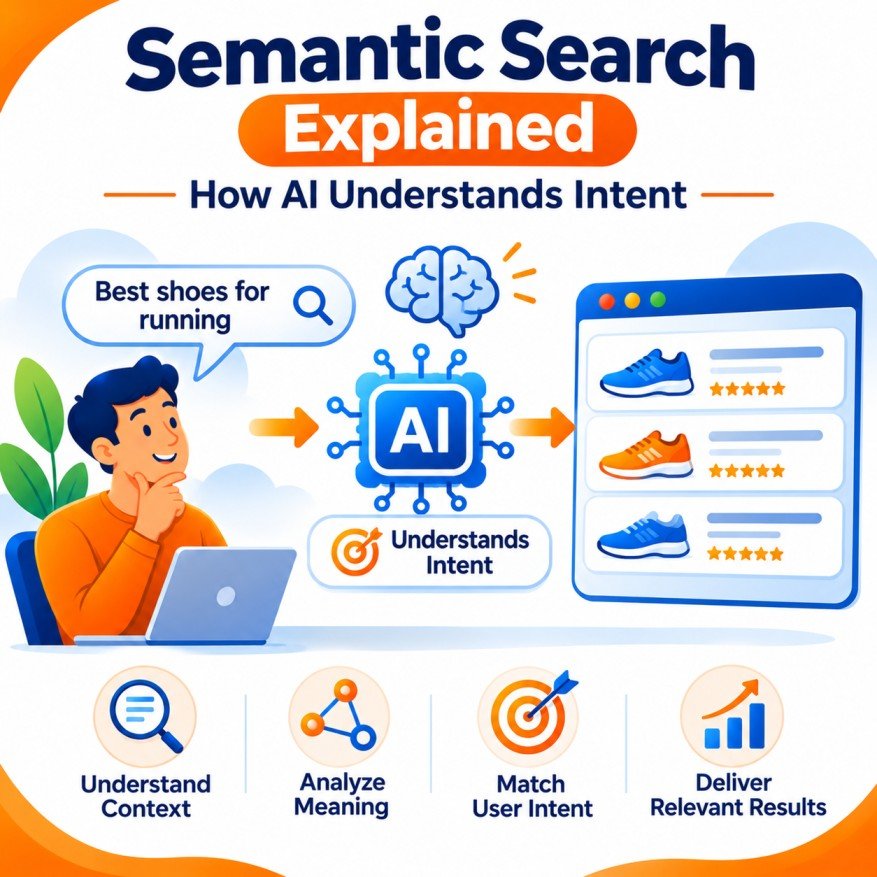
Search has evolved dramatically. For decades, digital search relied primarily on matching the exact words a user typed. Today, modern AI-powered systems aim to understand what the user actually means—their underlying goal, context, and intent—even when the words used are imprecise, incomplete, or different from the language in the content being searched. This capability is known as semantic search.
Semantic search represents a fundamental shift from lexical (keyword-based) matching to meaning-based retrieval. It powers the most advanced search experiences in Google, Bing, enterprise search tools, e-commerce platforms, recommendation systems, chatbots, and retrieval-augmented generation (RAG) applications. Understanding how it works is essential for marketers, SEO professionals, product managers, engineers, and anyone building or optimizing information systems.
This guide provides a comprehensive, detailed explanation of semantic search: what it is, how it differs from traditional search, the core technologies that enable AI to understand intent, the step-by-step process of semantic retrieval, practical applications, limitations, and implications for content and system design.
1. What Is Semantic Search?
Semantic search is a search methodology that seeks to improve accuracy by understanding the contextual meaning of a search query and the intent behind it, rather than relying solely on keyword matching.
Key characteristics:
- Focuses on meaning and relationships between concepts
- Interprets user intent (informational, navigational, transactional, commercial investigation, etc.)
- Handles synonyms, related concepts, paraphrasing, and natural language
- Incorporates context (previous queries, user profile, location, time, device)
- Returns results ranked by conceptual relevance, not just term frequency
In contrast, traditional lexical or keyword search matches the specific terms in the query to terms in documents, often using techniques such as TF-IDF, BM25, or Boolean logic. Lexical search is fast and precise when the exact words match, but it fails when users express the same idea differently.
2. Why Traditional Keyword Search Falls Short
Keyword-based systems struggle with several common real-world problems:
- Vocabulary mismatch: A user searches for “how to fix a leaky faucet” while the relevant article is titled “Repairing Dripping Kitchen Tap.” The words do not overlap enough.
- Synonyms and paraphrasing: “Buy running shoes” vs. “purchase sneakers for jogging.”
- Ambiguity: The word “apple” could mean the fruit, the company, or a record label.
- Intent blindness: The same keywords can support different goals (research vs. purchase).
- Long-tail and natural language queries: Conversational questions such as “What’s the best quiet coffee grinder under $100 for a small apartment?” are poorly handled by pure keyword matching.
- Lack of conceptual understanding: The system does not know that “heart attack” and “myocardial infarction” refer to the same medical event.
Semantic search addresses these gaps by modeling language in a way that captures meaning.
3. How AI Understands Intent – The Core Technologies
Modern semantic search is built on advances in natural language processing (NLP) and machine learning, particularly representation learning.
3.1 Embeddings: Turning Meaning into Numbers
At the heart of semantic search are embeddings—dense numerical vectors that represent the meaning of text.
- A sentence, paragraph, or document is converted into a fixed-length vector (typically hundreds or thousands of dimensions).
- Texts with similar meanings produce vectors that are close to each other in high-dimensional space (measured by cosine similarity, dot product, or Euclidean distance).
- Example: The embeddings for “automobile,” “car,” and “vehicle” will be near one another, while “banana” will be far away.
These embeddings are generated by neural network models trained on massive text corpora. The models learn statistical patterns of how words and concepts co-occur and relate.
3.2 Transformer Models and Large Language Models
The breakthrough technology enabling high-quality embeddings is the transformer architecture (introduced in 2017) and the large language models (LLMs) built on it.
Key models and approaches include:
- Early influential models such as BERT (Bidirectional Encoder Representations from Transformers), which could generate contextual embeddings.
- Sentence-level embedding models (Sentence-BERT and derivatives) optimized specifically for semantic similarity.
- Modern encoder or embedding-specialized models that produce high-quality vector representations of queries and documents.
- Decoder-based LLMs that can also be used for embedding or for re-ranking and intent classification.
Transformers process text by attending to all parts of a sequence simultaneously, capturing long-range dependencies and nuanced context that earlier sequential models missed.
3.3 Intent Classification and Query Understanding
Beyond pure similarity, advanced systems explicitly model user intent:
- Query classification: Determining whether the user wants information, wants to navigate to a specific site, wants to make a purchase, or is comparing options.
- Entity recognition: Identifying people, places, products, organizations, and concepts in the query.
- Query expansion and rewriting: Generating alternative phrasings or adding related terms while preserving meaning.
- Contextual understanding: Using conversation history, user profile, location, or session behavior to disambiguate.
Some systems combine embedding-based retrieval with classification heads or LLM-based reasoning to refine intent.
3.4 Vector Databases and Approximate Nearest Neighbor Search
Once documents are converted into embeddings, they must be stored and searched efficiently. This is the role of vector databases and indexing techniques:
- Documents (or chunks of documents) are embedded offline and stored as vectors.
- At query time, the user’s query is also embedded.
- The system finds the vectors most similar to the query vector using approximate nearest neighbor (ANN) algorithms (HNSW, IVF, product quantization, etc.).
- These algorithms trade a small amount of accuracy for massive speed gains, enabling real-time search over millions or billions of vectors.
Popular vector database technologies and libraries support hybrid search (combining vector similarity with traditional keyword filters).
4. The End-to-End Semantic Search Process
A typical modern semantic search pipeline works as follows:
Document preparation (offline)
- Content is cleaned, chunked into meaningful passages, and enriched with metadata.
- Each chunk is passed through an embedding model to produce a vector.
- Vectors and metadata are indexed in a vector store, often alongside a traditional inverted index for hybrid retrieval.
Query processing (online)
- The user enters a natural language query.
- The system may rewrite, expand, or classify the query.
- The (possibly rewritten) query is converted into an embedding using the same or a compatible model.
Retrieval
- Vector similarity search retrieves the top-k most semantically similar document chunks.
- Optional hybrid retrieval blends vector results with keyword (BM25) results.
- Filters (date, category, language, user permissions) are applied.
Re-ranking and refinement
- A more powerful (often cross-encoder or LLM-based) model re-ranks the candidates for finer relevance.
- Additional signals such as popularity, freshness, personalization, or business rules may be incorporated.
Result presentation or generation
- In classic search, ranked documents or passages are shown.
- In generative or RAG systems, the retrieved passages are fed to an LLM that synthesizes an answer, often with citations.
This pipeline allows the system to return relevant results even when exact keywords are absent.
5. Semantic Search vs. Lexical Search – Detailed Comparison
| Aspect | Lexical (Keyword) Search | Semantic Search |
|---|---|---|
| Matching basis | Exact or stemmed terms | Meaning and conceptual similarity |
| Handling of synonyms | Poor (unless manually expanded) | Strong |
| Natural language queries | Weak | Strong |
| Ambiguity resolution | Limited | Better (with context and models) |
| Computational cost | Relatively low | Higher (especially embedding + ANN) |
| Interpretability | High (you can see matched terms) | Lower (vectors are opaque) |
| Best for | Precise, known-item, short queries | Exploratory, conversational, conceptual queries |
| Typical algorithms | TF-IDF, BM25, Boolean | Embeddings + cosine similarity / ANN |
Most production systems today are hybrid: they combine the precision of lexical matching with the intelligence of semantic retrieval.
6. How AI Specifically Understands User Intent
Intent understanding goes beyond similarity. Modern systems attempt to answer:
- What is the user trying to achieve?
- What stage of a journey are they in?
- What constraints matter (price, location, time, expertise level)?
- What follow-up information might they need?
Techniques include:
- Supervised intent classification models trained on labeled queries
- Few-shot or zero-shot classification using LLMs
- Clustering of query embeddings to discover intent patterns
- Multi-task models that jointly predict intent, entities, and relevance
- Session and conversation modeling for multi-turn understanding
In e-commerce, intent might map to “research,” “compare,” or “buy now.” In enterprise search, it might map to “find policy document,” “troubleshoot error,” or “locate expert.”
7. Practical Applications
Semantic search powers:
- Web search engines — Better handling of natural language and long-tail queries
- E-commerce product search — “Comfortable shoes for standing all day” returns relevant footwear even without exact keyword matches
- Enterprise and internal knowledge search — Employees find documents by concept rather than exact title
- Customer support and chatbots — Matching user questions to knowledge base articles or generating grounded answers
- Recommendation systems — Content or product suggestions based on semantic similarity
- Retrieval-Augmented Generation (RAG) — Supplying LLMs with relevant context so generated answers stay factual and current
- Legal, medical, and scientific search — Matching concepts across specialized vocabularies
- Multilingual search — Cross-lingual embeddings enable searching in one language and retrieving content in another
8. Benefits of Semantic Search
- Higher relevance and user satisfaction
- Better handling of natural, conversational, and long-tail queries
- Reduced dependence on exact keyword optimization
- Improved discovery of related content
- Stronger performance on ambiguous or complex information needs
- Foundation for generative AI experiences that cite sources
9. Limitations and Challenges
- Computational cost — Embedding generation and vector search require more resources than pure keyword search
- Quality of embeddings — Performance depends heavily on the underlying model and training data
- Domain adaptation — General-purpose models may underperform in highly specialized fields without fine-tuning
- Opacity — It can be harder to explain why a particular result ranked highly
- Data privacy and bias — Models trained on large corpora can inherit biases; user data used for personalization raises privacy considerations
- Cold-start and long documents — Very new content or extremely long documents require careful chunking and indexing strategies
- Hybrid complexity — Combining lexical and semantic signals effectively requires careful tuning
- Evaluation difficulty — Measuring true semantic relevance is more subjective than exact-match metrics
10. Implications for Content Creators and SEO
Semantic search rewards content that:
- Clearly answers real user questions and covers topics comprehensively
- Uses natural language and related terminology (not just primary keywords)
- Demonstrates topical authority and depth
- Is well-structured with clear headings, entities, and context
- Provides useful information that matches likely search intent
Keyword stuffing becomes less effective; genuine topical relevance and helpfulness become more important. Structured data, clear entity definitions, and comprehensive coverage of related subtopics help both traditional and semantic systems understand content.
11. The Future of Semantic Search
Trends shaping the next phase include:
- Ever-larger and more capable embedding models
- Multimodal search (text + image + audio + video)
- Tighter integration with reasoning-capable LLMs
- Agentic search systems that plan multi-step retrieval
- Greater personalization balanced with privacy
- Improved efficiency techniques so high-quality semantic search runs at lower cost
- Better evaluation frameworks and human preference alignment
Conclusion
Semantic search marks the transition from matching words to understanding meaning and intent. By converting text into dense vector representations that capture conceptual relationships, and by combining those representations with intent classification, context, and sophisticated ranking, AI systems can deliver far more relevant results than keyword matching alone.
The technology rests on embeddings, transformer models, vector search infrastructure, and layers of query understanding. While it introduces new computational and interpretive challenges, the benefits—in relevance, natural language capability, and support for advanced AI applications—are transformative.
Whether you are optimizing content, building search products, implementing RAG pipelines, or simply trying to understand why modern search feels more intelligent, grasping how semantic search enables AI to understand intent is foundational knowledge for the current era of information retrieval. The systems that master meaning, not just matching, will continue to define the future of how humans find and interact with information.

Author