
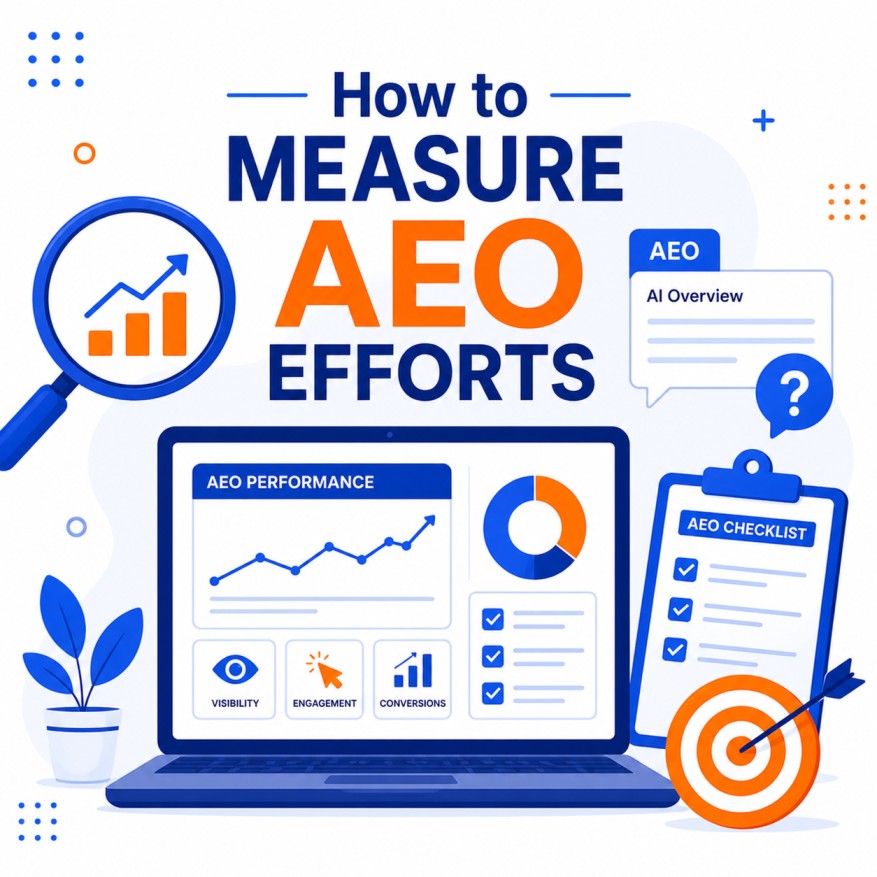
Answer Engine Optimization (AEO)—also closely overlapping with Generative Engine Optimization (GEO)—focuses on making your brand, content, and expertise visible, accurately represented, and preferably cited inside AI-generated answers. These answers appear in Google AI Overviews and AI Mode, ChatGPT, Perplexity, Gemini, Claude, Microsoft Copilot, and similar systems.
Traditional SEO metrics (rankings, organic clicks, impressions) remain useful but incomplete. AI answers often satisfy the query without a click, and visibility occurs inside synthesized responses rather than a ranked list of blue links. Measuring AEO therefore requires a new set of KPIs centered on presence, citation quality, competitive share, sentiment/accuracy, referral traffic, and downstream business impact.
This guide provides a comprehensive framework for measuring AEO efforts. It covers core metrics, how to build a reliable measurement system, tools and methods (manual and automated), establishing baselines, reporting cadence, ROI approaches, common pitfalls, and how to turn measurement into continuous improvement.
Why Measuring AEO Is Different from Measuring SEO
In classic search, success is largely visible through rankings and traffic. In answer engines:
- Many interactions are zero-click.
- Mentions can occur without a linked citation.
- Responses vary by model, session, location, personalization, and even repeated runs of the same prompt.
- Citation does not automatically equal recommendation or positive framing.
- Business value often appears as assisted demand (branded search lift, direct traffic, self-reported “I found you via ChatGPT”) rather than last-click sessions.
Effective measurement therefore combines visibility metrics (are you appearing?), quality metrics (how are you portrayed?), competitive metrics (how do you compare?), and impact metrics (does it drive pipeline or revenue?).
Core AEO Metrics and KPIs
Organize measurement into clear layers.
1. Visibility Metrics (Primary Leading Indicators)
- Citation Rate / AI Inclusion Rate
Percentage of target prompts where your brand or a specific URL is cited or clearly referenced as a source.
Formula: (Number of prompts where you appear ÷ Total prompts tested) × 100.
This is the closest equivalent to “ranking” in AI search. Track overall and by prompt cluster (informational, comparative, commercial). - Brand Mention Rate
Percentage of prompts where your brand name appears in the answer text, with or without a hyperlink. Mentions without citation still build entity recognition. - Prompt Coverage / Presence Rate
How many of your defined high-priority buyer questions currently surface your brand. Aim to expand coverage over time. - AI Impressions (where available)
Google Search Console provides data for AI Overviews and AI Mode. Bing Webmaster Tools offers equivalent signals for Copilot. These remain limited but useful directional indicators.
2. Competitive and Share Metrics
- Share of Voice (AI SoV or Citation Share)
Your citations (or mentions) as a percentage of total citations across a defined competitor set for the same prompt panel.
Formula: (Your citations ÷ Total citations of tracked brands) × 100.
This contextualizes raw citation rate—appearing in 25% of answers is weaker if a competitor appears in 60%. - Share of Answer / Position Prominence
When cited, are you the primary/lead source, a supporting source, or a minor footnote? Track average position or a simple scoring system (e.g., 1 = lead, 2 = supporting, 3 = minor).
3. Quality Metrics
- Sentiment and Framing
Is the mention positive, neutral, or negative? Does the AI accurately describe your positioning, strengths, and differentiators, or does it misrepresent you? - Accuracy / Factual Correctness
Are claims about your product, pricing, features, or company correct? Misinformation in AI answers can damage trust even if volume of mentions is high. - Narrative Alignment
Does the way AI describes you match your desired brand story and messaging?
4. Traffic and Engagement Metrics
- AI Referral Sessions
Visits arriving from AI platforms (detectable in GA4 via referrer or dedicated channel grouping when possible). Note that many AI interfaces do not pass clean referrers, so this undercounts true influence. - Engagement of AI-Referred Traffic
Bounce rate, pages per session, time on site, and conversion rate of sessions that can be attributed to AI sources.
5. Business Impact and ROI Metrics (Lagging Indicators)
- Branded Search Lift
Increases in branded query volume in Google Search Console, which often correlates with AI-driven discovery. - AI-Influenced Pipeline or Conversions
Leads, demos, trials, or revenue where AI is reported as a discovery source (CRM fields, surveys) or appears in multi-touch attribution. - Assisted Conversions
Paths in which an AI-related touch appears before conversion. - Modeled Value
Approaches such as equivalent paid media cost of the visibility, or estimated pipeline influenced by citation share.
Building a Reliable Measurement System
Step 1: Define Scope and Prompt Panel
Create a fixed, representative set of 30–150 prompts that reflect real buyer questions across the journey (category education, comparisons, “best tools for…”, feature questions, brand-specific queries). Base them on Search Console data, sales conversations, customer interviews, and competitor analysis. Keep the panel stable for trend tracking; expand it deliberately.
Step 2: Establish a Baseline
Before major AEO work, run the full prompt panel across target engines (ChatGPT, Perplexity, Gemini, Claude, Google AI Overviews/AI Mode, Copilot) multiple times (3–5 runs per prompt per engine in clean/logged-out sessions is recommended to account for variability). Log presence, citation details, position, sentiment, and competing sources. This baseline is essential for proving progress.
Step 3: Choose Measurement Methods
- Manual / Semi-Manual Prompt Panels — Highest control and transparency. Use spreadsheets or simple databases. Time-intensive but defensible.
- Dedicated GEO/AEO Tracking Tools — Platforms that automate prompt running, citation extraction, share-of-voice calculation, and competitor benchmarking across multiple engines. Examples in the current landscape include tools focused on multi-engine citation tracking, sentiment, and source analysis. Coverage and depth vary; evaluate based on the engines most important to your audience.
- Search Console & Bing Webmaster Tools — Native AI impression and citation-share signals where provided.
- Web Analytics (GA4) — AI referral traffic, engagement, and conversion tracking. Supplement with server-side or first-party methods when referrers are stripped.
- CRM and Survey Data — Self-reported discovery sources and multi-touch attribution.
Step 4: Set Cadence and Governance
- Weekly: Core visibility metrics (citation rate, mention rate) on priority prompts.
- Monthly: Full panel review, share of voice, sentiment analysis, traffic impact, competitive movements.
- Quarterly: Deeper ROI analysis, prompt panel refinement, content and entity audits tied to results.
Document methodology so results are comparable over time (same prompts, similar run conditions, consistent scoring rules).
Connecting Visibility to Business Value (ROI Approaches)
Pure citation volume is a leading indicator. To demonstrate ROI:
- Direct Attribution — Track AI-referred sessions through to conversions where technical signals allow.
- Branded Demand Lift — Correlate rising citation share with increases in branded search and direct traffic.
- Survey / Self-Reported Attribution — Add “How did you hear about us?” options that include AI assistants.
- Equivalent Media Value — Estimate the paid cost of achieving similar exposure.
- Assisted Pipeline Modeling — Use position-based or data-driven attribution that credits AI touches.
Report both leading visibility metrics and lagging business metrics. Leadership cares most about the latter; practitioners need the former to optimize.
Practical Reporting Structure
A strong monthly AEO report typically includes:
- Executive summary of citation rate and share-of-voice trends vs. baseline and competitors.
- Breakdown by engine and by prompt cluster.
- Notable wins (new citations, improved positioning) and losses.
- Sentiment/accuracy highlights or issues requiring content correction.
- AI referral traffic and conversion metrics.
- Actions taken and planned optimizations.
- Updated prioritization of content or entity work based on gaps.
Common Measurement Pitfalls and How to Avoid Them
- Relying on a single run of a prompt (AI responses vary—sample multiple times).
- Tracking only branded prompts (misses discovery opportunities).
- Measuring only one engine (audiences use multiple tools).
- Ignoring sentiment and accuracy (volume without quality can harm the brand).
- Treating AI referral traffic as the sole success metric (severe undercounting of influence).
- Changing the prompt panel too frequently (destroys trendability).
- Failing to maintain a clean competitor set for share-of-voice calculations.
- Overclaiming precise ROI without acknowledging the assisted and correlational nature of much of the impact.
Turning Measurement into Action
Measurement is only valuable when it drives decisions:
- Low citation rate on high-value prompts → prioritize content depth, original data, answer-first structure, and entity reinforcement for those topics.
- Good mentions but poor sentiment or inaccuracy → update source content and consider digital PR or corrections.
- Strong visibility but weak traffic/conversions → improve the cited pages’ on-page experience and offers.
- Competitor dominance in certain clusters → analyze their cited content and close gaps.
Feed insights back into content strategy, technical AEO (schema, crawlability, llms.txt), digital PR, and entity-building work.
Conclusion
Measuring AEO efforts requires shifting from a rankings-and-clicks mindset to a presence-citation-influence-impact framework. The most important starting metrics are citation rate and share of voice across a stable, buyer-relevant prompt panel, supported by sentiment/accuracy checks, AI referral signals, and business outcome tracking.
Begin with a well-designed prompt panel and an honest baseline. Combine manual rigor with automation where it adds scale and consistency. Report both leading visibility indicators and lagging business results. Most importantly, close the loop: use every measurement cycle to refine content, strengthen entities, earn higher-quality citations, and demonstrate compounding returns.
In 2026 and beyond, brands that treat AEO measurement as a core operational discipline—not a one-off experiment—will build durable advantages in how AI systems discover, understand, and recommend them. The organizations that can prove their visibility with clear metrics will secure the budgets and organizational support needed to win in the age of answer engines.

Author