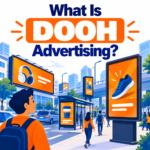
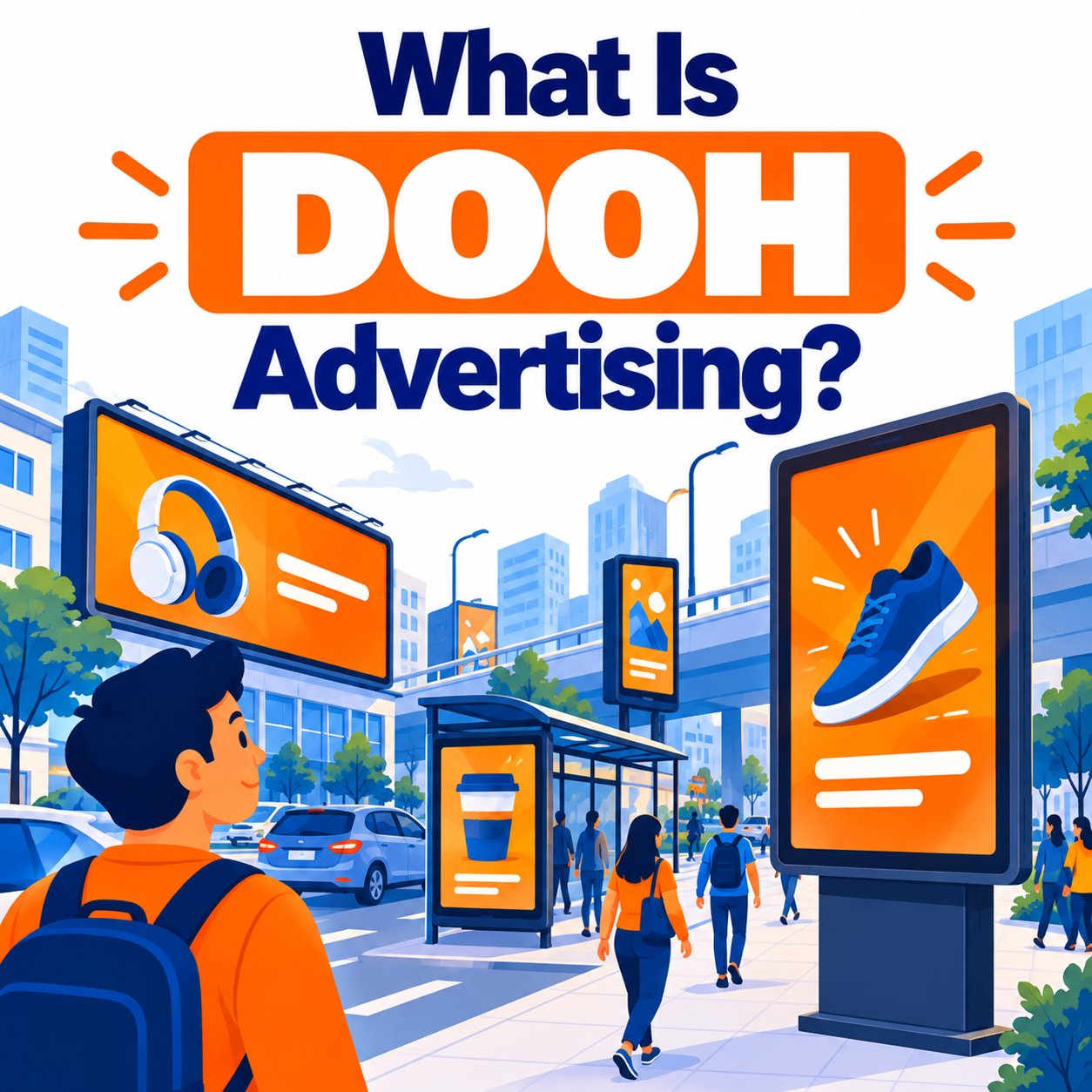
DOOH stands for Digital Out-of-Home advertising. It is the digital evolution of traditional out-of-home (OOH) media. Instead of static printed posters, vinyl billboards, or painted signs, DOOH delivers advertising on internet-connected digital screens placed in public and commercial environments—places people encounter while going about their daily lives outside the home.
These screens can display static images, motion graphics, video, or dynamic content that updates remotely in near real time. Because the displays are networked and software-driven, advertisers gain flexibility that traditional OOH never offered: dayparting, contextual triggers, rapid creative changes, programmatic buying, and improved measurement.
DOOH is not a replacement for all outdoor advertising. It is a rapidly growing subset of the broader OOH category. Traditional static OOH still exists and serves certain long-term branding needs, but DOOH accounts for an increasing share of OOH spend and attention because of its agility, data capabilities, and integration with modern media buying systems.
Core Definition and Scope
At its simplest, DOOH is any advertising shown on a digital screen located outside a private residence. Common environments include:
- Roadside and urban digital billboards
- Transit systems (buses, trains, subways, airports, shelters)
- Retail and grocery stores (endcaps, checkout, aisles)
- Shopping malls and elevators
- Gyms, bars, restaurants, and entertainment venues
- Point-of-care locations (doctors’ offices, pharmacies, clinics)
- Gas stations and convenience stores
- Street furniture and interactive kiosks
- Office buildings and other place-based networks
The defining technical characteristic is that content is delivered and controlled digitally rather than through physical printing and installation. Screens are typically connected so that playlists, schedules, and creative can be managed centrally.
DOOH vs. Traditional OOH: Key Differences
| Aspect | Traditional OOH | DOOH |
|---|---|---|
| Format | Printed vinyl, paper, paint | LED, LCD, digital screens |
| Creative updates | Physical reprint and reinstall | Remote update in minutes or hours |
| Targeting | Primarily location | Location + time, weather, context, audience signals |
| Buying method | Mostly direct, fixed bookings | Direct, managed, or programmatic |
| Flexibility | Locked for the full flight | Dayparting, dynamic creative, real-time triggers |
| Measurement | Estimates and traffic models | Play logs, verified impressions, attribution options |
| Motion / video | Limited or none | Fully supported |
| Multiple advertisers | One creative per face for the period | Rotating spots on the same screen |
Traditional OOH remains valuable for sustained, high-impact presence. DOOH adds speed, relevance, and measurability.
How DOOH Advertising Works
1. Inventory and screens
Media owners operate networks of digital screens. Each screen or face has defined specifications (size, resolution, orientation, dwell time, average audience).
2. Content management
Creative is uploaded to a content management system or ad server. Playlists determine what runs when. Updates can be pushed remotely.
3. Buying models
- Direct / traditional — Negotiated insertion orders for specific screens or packages over set dates.
- Programmatic DOOH (pDOOH) — Inventory is bought through demand-side platforms (DSPs) via private marketplaces, programmatic guaranteed deals, or (less commonly) open auction. This enables impression-based buying, audience and contextual targeting, and real-time optimization similar to other digital channels.
- Managed service — Agencies or specialists handle planning, buying, and optimization on the advertiser’s behalf.
4. Delivery and triggering
Ads can run on fixed schedules or respond to triggers such as time of day, weather, traffic conditions, nearby events, or audience composition data (where available and privacy-compliant).
5. Reporting
Play logs confirm when and how often creative ran. Audience delivery is modeled using traffic, footfall, and other data sources. Advanced campaigns layer on attribution (for example, foot traffic lift to stores or brand lift studies).
Main Types and Formats of DOOH
- Large-format digital billboards — Highways, city centers, building facades. High visibility and impact.
- Transit DOOH — Screens inside or on buses, trains, stations, airports, and shelters. Captures commuters with defined dwell times.
- Place-based / venue networks — Gyms, medical offices, bars, elevators, offices. Often longer dwell times and more captive audiences.
- Retail and point-of-sale screens — In-store displays that can influence shoppers near the moment of decision. Increasingly linked with retail media strategies.
- Street furniture and interactive units — Bus shelters, kiosks, sometimes with touch or mobile interaction capabilities.
- Premium / experiential formats — Large landmark screens, 3D/anamorphic creatives, and high-production installations designed for social amplification.
Key Advantages of DOOH
High attention and unavoidable presence
Unlike online ads, DOOH cannot be blocked, skipped with a click, or scrolled past in the same way. Premium large-format screens often earn significantly higher attention scores than many digital formats.
Flexibility and relevance
Creative can change by time of day (morning coffee vs. evening dining), weather (umbrella ads on rainy days), or other contextual signals. Multiple messages can rotate on the same screen.
Brand safety and trust
Ads appear in controlled physical environments. Many consumers view outdoor advertising more favorably than intrusive digital formats.
Cookieless and privacy-aligned by nature
Targeting relies primarily on location, venue, time, and aggregated audience data rather than individual device tracking. This makes DOOH resilient in a privacy-first advertising landscape.
Complement to digital and omnichannel plans
DOOH builds awareness and brand presence in the physical world while digital channels handle retargeting, search, and conversion. It also supports retail media and location-based strategies.
Measurability improvements
Verified plays, opportunity-to-see metrics, foot-traffic studies, brand-lift research, and growing attribution capabilities allow DOOH to sit more comfortably alongside other performance and brand channels.
Creative impact
Motion, video, bold visuals, and innovative formats (including 3D effects) create memorable experiences that static print cannot match.
Targeting Capabilities
DOOH targeting is environment- and context-driven rather than person-level in most cases:
- Geographic location and specific screen or venue selection
- Time of day and day of week (dayparting)
- Weather and environmental triggers
- Audience composition estimates for venues or corridors
- Proximity to points of interest (stores, events, competitors)
- In programmatic buys: additional data layers and deal types (PMP, guaranteed)
The goal is to reach the right people in the right places at the right moments, not to track individuals across the open web.
Measurement and Attribution
Common metrics and approaches include:
- Impressions / Opportunity-to-See (OTS) — Modeled audience delivery based on traffic, footfall, and screen visibility.
- Play logs and verification — Confirmation that creative actually ran as scheduled.
- Reach and frequency estimates — Within defined geographies or audience segments.
- Foot traffic and store visit lift — Using location data partnerships to measure increases in visits after exposure.
- Brand lift studies — Surveys measuring awareness, consideration, or favorability.
- Cross-channel attribution and marketing mix modeling — Understanding DOOH’s contribution alongside other media.
- Engagement proxies — QR codes, unique URLs, NFC, or social amplification for interactive or highly creative executions.
DOOH is rarely judged by click-through rate. Success is typically framed in terms of attention, reach, brand impact, and downstream real-world outcomes.
Programmatic DOOH and Industry Evolution
Programmatic buying has become a major growth driver. Advertisers can access DOOH inventory through the same DSPs they use for other digital media, apply audience and contextual strategies, and optimize in closer to real time. Private marketplaces and programmatic guaranteed deals currently dominate much of the traded volume in many markets.
Industry bodies continue to work on standardization, better automation, improved reporting, and tighter integration with retail media and omnichannel measurement. AI is increasingly used for creative optimization, bidding, and matching inventory to campaign goals.
Creative Best Practices
- Design for glanceability and distance—large, bold visuals and minimal text.
- Use motion purposefully; avoid overly complex or rapid sequences that reduce legibility.
- Adapt creative by daypart, location type, or trigger when possible.
- Consider the environment (highway speed vs. long dwell time in a gym or elevator).
- Ensure brand elements are instantly recognizable.
- For interactive or QR-driven campaigns, make the call-to-action clear and easy.
- Test and iterate where the buying model allows.
Who Uses DOOH and Common Objectives
Brands across categories use DOOH for:
- Broad brand awareness and presence
- Product launches and time-sensitive promotions
- Local and regional store traffic
- Event and entertainment marketing
- Retail and point-of-purchase influence
- Supporting larger omnichannel campaigns
- Building cultural relevance through high-impact or landmark placements
Both national advertisers and local businesses can access DOOH, though buying methods and minimum spends vary by market and inventory type.
Limitations and Considerations
- Not a direct-response click medium in the traditional digital sense.
- Audience data is typically aggregated and modeled rather than individual.
- Creative production for large or premium formats can require specialized expertise.
- Availability and pricing vary significantly by market, screen quality, and demand.
- Measurement, while much improved, still differs from pure digital channels and requires appropriate expectations and methodologies.
Current Trends Shaping DOOH
- Continued growth in digital’s share of total OOH spend
- Expansion of programmatic trading and automation
- Stronger links with retail media networks and in-store screens
- Advances in attention metrics, verification, and attribution
- Dynamic and data-triggered creative
- Immersive formats (including 3D/anamorphic) designed for social sharing
- Integration into broader omnichannel and AI-influenced media planning
- Focus on standardization and easier workflow for buyers
Conclusion
DOOH advertising is the digital, flexible, and increasingly measurable form of out-of-home media. It places dynamic ads on screens in the physical world—billboards, transit, retail, venues, and more—where people cannot easily avoid them. Compared with traditional static OOH, it offers remote creative updates, contextual relevance, programmatic access, and stronger reporting. Compared with many online channels, it delivers high attention, brand safety, and a cookieless environment.
As screens proliferate, buying becomes more automated, and measurement improves, DOOH has moved from a pure awareness add-on to a core consideration in modern media plans. It works best when treated as a real-world attention and brand channel that complements digital, retail, and performance tactics rather than trying to replicate them.
For advertisers, the opportunity lies in matching the right screens and contexts to campaign goals, using creative that respects the environment and glanceability of the medium, and applying the growing set of targeting and measurement tools available in 2026 and beyond. When executed thoughtfully, DOOH delivers visible, memorable presence in the physical world at a time when digital attention is fragmented and increasingly mediated by algorithms and AI.

Author