
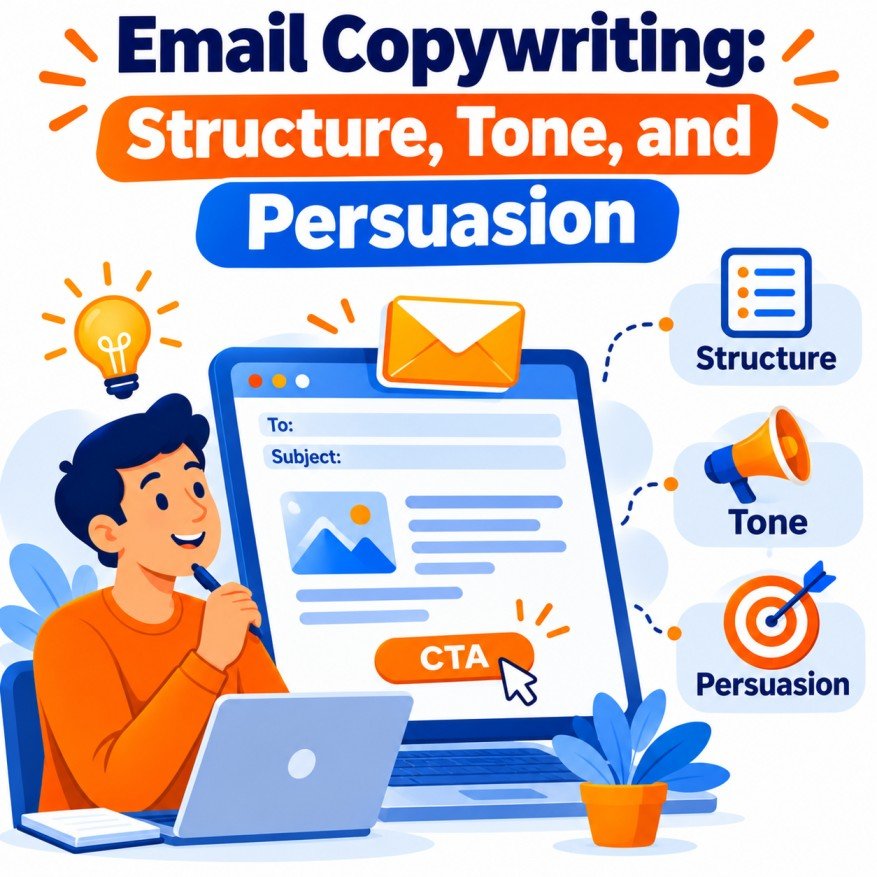
Email remains one of the highest-ROI channels in digital marketing because it reaches people who have already given permission to hear from you. Yet most emails underperform not because of deliverability or design alone, but because the copy fails to earn attention, build desire, and drive action. Effective email copywriting rests on three interdependent pillars: structure, tone, and persuasion. Master these and your emails become clearer, more relevant, and significantly more profitable.
This guide provides a comprehensive, practical framework for writing email copy that works. It covers proven structural models, how to calibrate tone for different audiences and goals, the core principles of persuasion applied to email, subject-line and preheader strategy, body-copy techniques, call-to-action craft, personalization, mobile considerations, testing methods, and common pitfalls.
1. Why Email Copywriting Is Different
Email is an interruptive yet permission-based medium. Recipients scan rather than read deeply. They decide within seconds whether to open, keep reading, or delete. Unlike a landing page, an email must succeed in a crowded inbox where competing messages, visual noise, and limited attention are constant.
Successful email copy therefore prioritizes:
- Immediate relevance and clarity
- Scannability
- Emotional and rational resonance
- A single, obvious next step
- Consistency with the relationship stage and brand voice
2. The Structural Foundation of High-Performing Emails
Structure is the skeleton that makes persuasion possible. Without clear architecture, even strong ideas get lost.
2.1 Subject Line + Preheader: The Gatekeepers
These two elements determine whether the email is opened.
Subject line principles:
- Clarity over cleverness in most cases
- Specificity and relevance to the recipient
- Curiosity or benefit when appropriate
- Urgency or scarcity only when genuine
- Personalization (name, behavior, location, or past action) when it adds value
- Optimal length varies by audience and device, but front-loading key words helps
Preheader (preview text) principles:
- Complements the subject line rather than repeating it
- Adds a second benefit, clarifying detail, or curiosity hook
- Avoids generic defaults such as “View this email in your browser”
Treat the subject line and preheader as a single two-part headline.
2.2 Opening Hook (First 1–3 Sentences)
The opening must instantly confirm relevance and reward the open. Strong openings typically:
- Reference a known problem, desire, or recent action
- Deliver an immediate insight or benefit
- Speak directly to the reader with “you” language
- Avoid long company-centric introductions
Weak openings talk about the sender. Strong openings talk about the reader.
2.3 Body Structure Models
Several reliable frameworks guide the body:
AIDA (Attention, Interest, Desire, Action)
Still one of the most effective for promotional emails. Capture attention, build interest with relevant detail, intensify desire through benefits and proof, then ask for action.
PAS (Problem, Agitate, Solve)
Especially powerful for pain-point-driven offers. Identify the problem, agitate the consequences of inaction, then present the solution.
BAB (Before, After, Bridge)
Show the current frustrating state, paint the desired future state, then position your offer as the bridge.
4Ps (Promise, Picture, Proof, Push)
Make a clear promise, help the reader picture the outcome, support it with proof, and push toward the next step with a strong CTA.
Narrative / Story structure
Short, relevant stories can increase engagement when they illustrate transformation or insight. Keep stories tight and tied to the offer.
For most marketing emails, a hybrid approach works best: a clear hook, concise value delivery, proof or social validation, and a focused call to action.
2.4 Scannability Architecture
Most recipients scan. Support them with:
- Short paragraphs (1–3 sentences)
- Subheadings or bolded key phrases
- Bullet points for benefits or features
- White space to reduce cognitive load
- A clear visual hierarchy that guides the eye toward the CTA
2.5 The Call to Action (CTA)
Every email should have one primary desired action. Secondary links can exist, but the main CTA must be unmistakable.
Effective CTA copy:
- Uses action-oriented language (“Get the checklist,” “Start my free trial,” “See pricing”)
- Focuses on the reader’s outcome rather than the mechanics (“Download” vs. “Get instant access”)
- Creates appropriate urgency when real
- Appears more than once in longer emails (early and at the end)
Button copy and surrounding text should reinforce each other.
2.6 Closing and Signature
Close with reinforcement of the benefit or a low-friction reminder of the next step. A human signature (name, title, photo in some cases) increases trust. Include necessary compliance elements (unsubscribe, address) without letting them dominate.
3. Tone: Matching Voice to Audience, Brand, and Context
Tone is the emotional and relational quality of the writing. The same message can succeed or fail depending on how it sounds.
3.1 Core Tone Dimensions
- Formal vs. conversational
- Authoritative vs. peer-to-peer
- Serious vs. light or humorous
- Urgent vs. relaxed
- Empathetic vs. direct
Most modern email performs better with a clear, conversational, human tone—even in B2B—provided it stays professional and respectful.
3.2 Aligning Tone with the Customer Journey
- Welcome / onboarding emails: Warm, helpful, encouraging
- Educational or newsletter content: Knowledgeable, generous, clear
- Promotional emails: Benefit-focused, confident, respectful of attention
- Re-engagement emails: Empathetic, value-first, low-pressure
- Transactional emails: Clear, reassuring, efficient
- Crisis or sensitive communications: Transparent, accountable, calm
3.3 Brand Voice Consistency
Tone should feel like a natural extension of the brand. A playful consumer brand can use humor; a financial or healthcare brand usually cannot. Document voice guidelines (words to use, words to avoid, example phrases) so multiple writers maintain consistency.
3.4 Audience Calibration
Consider:
- Relationship stage (new subscriber vs. long-time customer)
- Demographics and psychographics
- Industry norms (enterprise software vs. lifestyle ecommerce)
- Cultural and regional expectations
- Current context (economic climate, season, recent interactions)
The best tone feels like a message from a knowledgeable, helpful human who understands the reader’s situation.
4. Persuasion Principles Applied to Email
Persuasion in email is not manipulation. It is the ethical alignment of your offer with the reader’s existing desires and the reduction of friction and doubt.
4.1 Core Psychological Levers
Reciprocity
Give value first (insights, tools, exclusive information). People are more inclined to respond when they have received something useful.
Commitment and Consistency
Reference past behavior (“Because you downloaded X…”) to make the next step feel consistent with previous choices.
Social Proof
Cite numbers, testimonials, logos, case results, or user-generated content. Specificity beats vague claims.
Authority
Demonstrate expertise through credentials, data, process transparency, or thoughtful analysis.
Liking
Write as a human. Shared values, empathy, and personality increase liking and receptivity.
Scarcity and Urgency
Effective only when genuine. Artificial scarcity damages trust. Real deadlines, limited seats, or seasonal relevance can motivate action.
Unity / Belonging
Position the reader as part of a group that shares values or goals (“Join other operators who…”).
4.2 Benefit-Driven Writing
Features describe what something is. Benefits describe what it does for the reader. Strong email copy translates features into outcomes:
- Feature: “24/7 support”
- Benefit: “Get answers the moment you need them—even at 2 a.m.”
Lead with benefits; support with features and proof.
4.3 Handling Objections in Copy
Anticipate common doubts (price, time, risk, complexity, “will this work for me?”) and address them briefly with reassurance, guarantees, social proof, or clarity.
4.4 The Single-Minded Proposition
Most effective emails advance one primary idea and one primary action. Multiple competing messages dilute response. If you have several offers, consider separate emails or a clear hierarchy.
5. Advanced Copy Techniques
- Specificity: “Save 3 hours a week” outperforms “Save time.”
- Sensory and concrete language: Helps readers picture the outcome.
- Pattern interrupts: Unexpected but relevant openings can increase engagement when used sparingly.
- Questions: Rhetorical or direct questions engage the mind, but overuse weakens impact.
- Power words and emotional triggers: Use judiciously and authentically.
- Rhythm and sentence variety: Mix short punchy sentences with slightly longer explanatory ones.
- Editing discipline: Cut every unnecessary word. Email rewards ruthless brevity.
6. Personalization and Dynamic Content
Beyond using a first name, effective personalization references:
- Past purchases or browsing behavior
- Content previously consumed
- Location or time zone
- Lifecycle stage
- Stated preferences
Dynamic modules (different blocks for different segments) allow relevance at scale while keeping the core narrative coherent. Personalization should feel helpful, never invasive.
7. Mobile-First Copy Considerations
The majority of emails are opened on mobile devices. Therefore:
- Keep subject lines concise and front-loaded
- Make the first screen fully understandable on its own
- Use short paragraphs and ample white space
- Ensure CTA buttons are large enough and spaced for thumbs
- Avoid relying solely on images for key messages (many clients block images by default)
8. Testing and Optimization
Copy improvement is iterative. High-impact elements to test include:
- Subject lines and preheaders
- Opening hooks
- CTA wording and placement
- Benefit framing versus feature framing
- Tone variations (more direct vs. more empathetic)
- Length (short vs. longer value-driven emails)
- Personalization depth
Measure opens, clicks, conversions, unsubscribes, and downstream revenue. Statistical significance and practical significance both matter. Document learnings so institutional knowledge compounds.
9. Common Email Copywriting Mistakes
- Writing about the company instead of the reader
- Weak or generic subject lines
- Burying the main benefit or CTA
- Multiple competing calls to action
- Overly long paragraphs and dense blocks of text
- Inconsistent or off-brand tone
- Artificial urgency or hype that damages trust
- Neglecting the preheader
- Failing to proofread (typos destroy credibility)
- Ignoring segment differences and sending the same copy to everyone
10. Putting It All Together: A Practical Writing Process
- Define the single goal of the email and the primary CTA.
- Identify the segment and their current relationship stage.
- Clarify the core benefit and the main objection to address.
- Write the subject line and preheader as a paired unit.
- Draft a strong, reader-focused opening.
- Build the body using a clear framework (AIDA, PAS, etc.).
- Craft a benefit-oriented, action-specific CTA.
- Adjust tone for brand and audience.
- Edit ruthlessly for clarity, brevity, and scannability.
- Review on mobile and check for personalization accuracy.
- Test when volume allows and refine based on data.
Conclusion
Great email copywriting is the disciplined combination of clear structure, appropriate tone, and ethical persuasion. Structure guides the reader from subject line to action without confusion. Tone makes the message feel human and aligned with the relationship. Persuasion connects your offer to the reader’s existing motivations while reducing doubt and friction.
When these three elements work together, emails stop feeling like interruptions and start feeling like useful, timely communication. The result is higher open rates, stronger engagement, better conversion, and a healthier long-term relationship with the list.
Treat every email as a focused conversation with one primary purpose. Write for the reader first, stay consistent with your brand, support claims with proof, and make the next step obvious and easy. Continuous testing and ruthless editing turn good copy into consistently high-performing copy. Master structure, tone, and persuasion, and email becomes one of the most reliable growth levers available.

Author