Difference between LLM.txt and Robots.txt
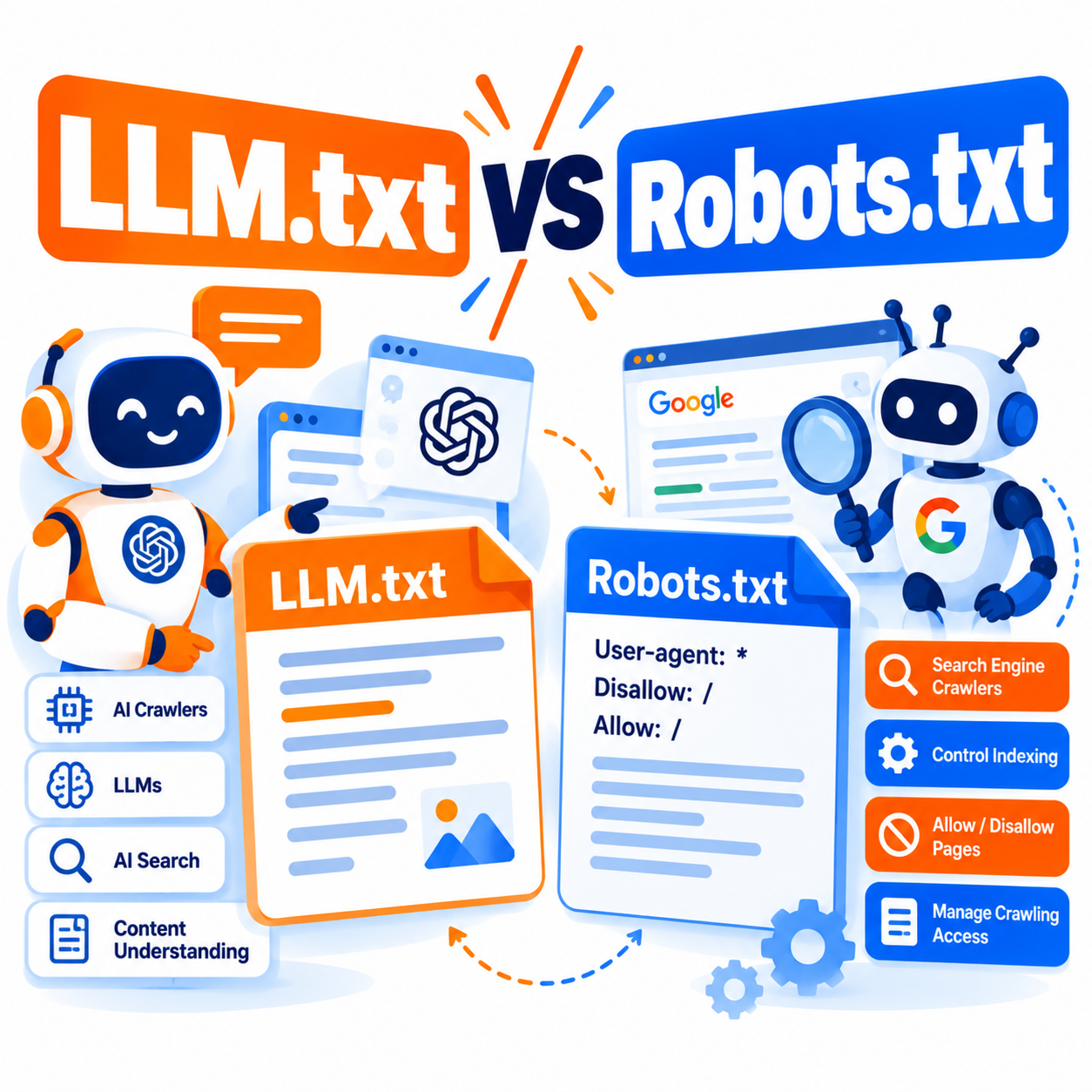
Two small text files placed at the root of a website—robots.txt and llms.txt (also written as llm.txt in some discussions)—are frequently confused because both are machine-readable, live at well-known URLs, and relate to how automated systems interact with web content. In reality, they serve completely different purposes, follow different formats, carry different levels of authority, and produce different outcomes.
This guide explains each file in depth, compares them side-by-side, clarifies what they can and cannot do, covers practical implementation, and shows how they fit into a modern strategy for search engines and AI systems as of 2026.
1. What Is robots.txt?
robots.txt is a long-standing web standard formally known as the Robots Exclusion Protocol. It originated in 1994 and was standardized as RFC 9309 in 2022. The file lives at https://example.com/robots.txt and tells compliant crawlers which parts of a site they may or may not fetch.
Core purpose: Access control and crawl guidance.
It answers the question: “May this crawler fetch this URL or path?”
Key characteristics:
- Plain-text format with simple directives (User-agent, Allow, Disallow, Crawl-delay, Sitemap, etc.).
- Voluntary but near-universally respected by major legitimate crawlers, including search-engine bots and most major AI crawlers (GPTBot, ClaudeBot, Google-Extended, and others).
- Can target specific user-agents or apply rules to all bots.
- Does not provide authentication or security; it is a request, not a technical barrier. Malicious bots can ignore it.
- Widely supported and checked before crawling begins.
Typical use cases:
- Blocking sensitive paths (/admin/, /cart/, private APIs).
- Managing crawl budget by preventing unnecessary fetching of low-value pages.
- Giving different rules to different bots (e.g., allowing Googlebot while restricting certain AI training bots).
- Declaring the location of an XML sitemap.
Example structure:
User-agent: *
Disallow: /private/
Disallow: /tmp/

User-agent: GPTBot
Disallow: /

User-agent: Googlebot
Allow: /

Sitemap: https://example.com/sitemap.xml
2. What Is llms.txt?
llms.txt is a community proposal introduced in September 2024 by Jeremy Howard (Answer.AI / fast.ai). The canonical location is https://example.com/llms.txt. It is a Markdown file designed to give large language models and AI agents a concise, curated overview of a website’s most important content.
Core purpose: Content guidance and discoverability for AI agents.
It answers the question: “If you are an LLM or agent trying to understand or use this site, which pages matter most and what are they about?”
Key characteristics:
- Markdown format (human- and model-readable).
- Not a formal IETF or W3C standard—only a proposal.
- Contains no Allow/Disallow or access-control directives. It cannot block or permit any crawler.
- Intended mainly for inference-time use (when an agent needs information to answer a user) rather than large-scale training crawls.
- Optional. Major AI providers have not made it a requirement, and evidence of widespread fetching by training or search crawlers remains limited as of late 2026.
- Google has publicly stated that sites do not need special AI text files or markup to appear in AI Overviews or AI Mode.
Typical structure (per the proposal):
- An H1 heading with the site or project name (required).
- A blockquote containing a short summary.
- Optional additional explanatory paragraphs.
- One or more H2 sections containing curated lists of links, each with an optional short description.
Example (simplified):
# Acme Documentation

> Official docs and API reference for the Acme platform.

## Core Documentation
- [Getting Started](https://example.com/docs/start.md): Installation and first steps
- [API Reference](https://example.com/docs/api.md): Endpoints, authentication, and limits
- [Pricing](https://example.com/pricing): Current plans and features
Some sites also publish a companion llms-full.txt that expands the content for agents that can handle larger context.
3. Side-by-Side Comparison
| Dimension | robots.txt | llms.txt |
|---|---|---|
| Primary job | Access control / crawl permissions | Content curation / reading list for AI agents |
| Question answered | “May you fetch this path?” | “Which pages are worth reading and what are they about?” |
| Format | Plain text with directives | Markdown |
| Can it block crawlers? | Yes (by request, for compliant bots) | No |
| Status | Established standard (RFC 9309) | Community proposal (2024, updated 2026) |
| Enforcement | Voluntary but widely respected by major bots | None – purely advisory |
| Who primarily uses it | Search engines + AI crawlers | AI agents / tools that choose to consult it |
| Affects SEO rankings? | Indirectly (via crawl efficiency) | No proven ranking or citation effect |
| Location | /robots.txt | /llms.txt |
| Complements | sitemap.xml, meta robots, HTTP headers | robots.txt, sitemap.xml, clean Markdown versions of pages |
Critical takeaway: llms.txt cannot replace or override robots.txt. If a path is disallowed in robots.txt, listing it in llms.txt does not grant access. Conversely, allowing a bot in robots.txt does not require or guarantee that the bot will read or follow llms.txt.
4. How AI Crawlers Actually Behave
Major AI-related crawlers generally respect robots.txt:
- OpenAI (GPTBot for training, ChatGPT-User / OAI-SearchBot for user-triggered browsing)
- Anthropic (ClaudeBot, Claude-User)
- Google (Google-Extended for AI features, separate from classic Googlebot)
- Others such as PerplexityBot (with some historical nuance)
Control over whether these bots may crawl your content is therefore exercised primarily through robots.txt user-agent rules. llms.txt plays no role in that permission decision.
Evidence as of 2026 indicates that major AI systems do not systematically rely on third-party llms.txt files for training or core search ranking. Some coding agents, documentation tools, and experimental retrieval systems may fetch it when present, especially on developer-focused or documentation-heavy sites. Adoption exists, but it is far from universal, and measurable impact on AI citations or visibility remains unproven for most sites.
5. Practical Implementation Guidance
For robots.txt (high priority for almost every site):
- Maintain a clear, correctly formatted file at the root.
- Use specific user-agent blocks when you want different treatment for training bots versus search/user-triggered bots.
- Keep sensitive or low-value paths disallowed.
- Reference your sitemap.
- Test with Google’s robots.txt tester and equivalent tools.
- Remember it is not security—use authentication and server-side controls for truly private content.
For llms.txt (optional, situational value):
- Useful mainly for documentation sites, API references, open-source projects, or content-heavy sites where you want to give agents a clean entry point.
- Keep it short and high-signal. Curate only the most important pages.
- Prefer links to clean Markdown or text versions of pages when available.
- Update it when key content changes; an outdated file is worse than none.
- Do not expect it to improve classic SEO rankings or guarantee AI citations.
- Pair it with strong robots.txt rules and high-quality, well-structured content.
Recommended mental model:
- robots.txt = the gate and traffic rules.
- sitemap.xml = the full inventory of pages you want discovered.
- llms.txt = an optional curated guidebook for agents that already have access and want a fast orientation.
6. Common Misconceptions
- “llms.txt blocks AI crawlers” — False. It has no blocking capability.
- “llms.txt is required for AI Overviews or ChatGPT citations” — False. Google and others have stated otherwise.
- “llms.txt replaces robots.txt” — False. They address different problems.
- “Adding llms.txt will boost my AI search visibility” — Unproven and unlikely to be a primary lever. Content quality, structure, authority, and proper crawl access matter far more.
- “All AI bots ignore robots.txt” — False for the major reputable ones; they generally honor it.
7. Strategic Recommendations in 2026
- Treat robots.txt as essential infrastructure. Get the access policy right first.
- Decide deliberately which AI crawlers you want to allow for training versus real-time user queries, and encode that in robots.txt.
- Consider llms.txt only if you have a clear use case (especially documentation or agent-friendly content) and are willing to maintain it.
- Focus primary effort on high-quality, well-structured, authoritative content, proper technical SEO, and clear information architecture—these influence both traditional search and AI systems far more than either text file alone.
- Monitor server logs for actual bot behavior rather than assuming any file is being read or followed.
- Use real access controls (authentication, rate limiting, bot management at the CDN/WAF level) for anything that must stay private.
8. Conclusion
robots.txt and llms.txt are not competitors or substitutes. robots.txt is the established, widely honored mechanism for telling crawlers what they may fetch. llms.txt is a newer, optional Markdown proposal that offers a curated reading list and site summary for AI agents that choose to consult it. One controls access; the other attempts to guide comprehension.
For almost every website, a correct and intentional robots.txt remains the higher-priority file. llms.txt can be a helpful supplement in specific contexts—particularly documentation and developer resources—but it carries no enforcement power and currently delivers limited, unproven benefits for general AI visibility or SEO. Use both appropriately, keep expectations realistic, and invest the majority of effort in the content and technical foundations that actually determine how both search engines and language models understand and represent your site.

Author