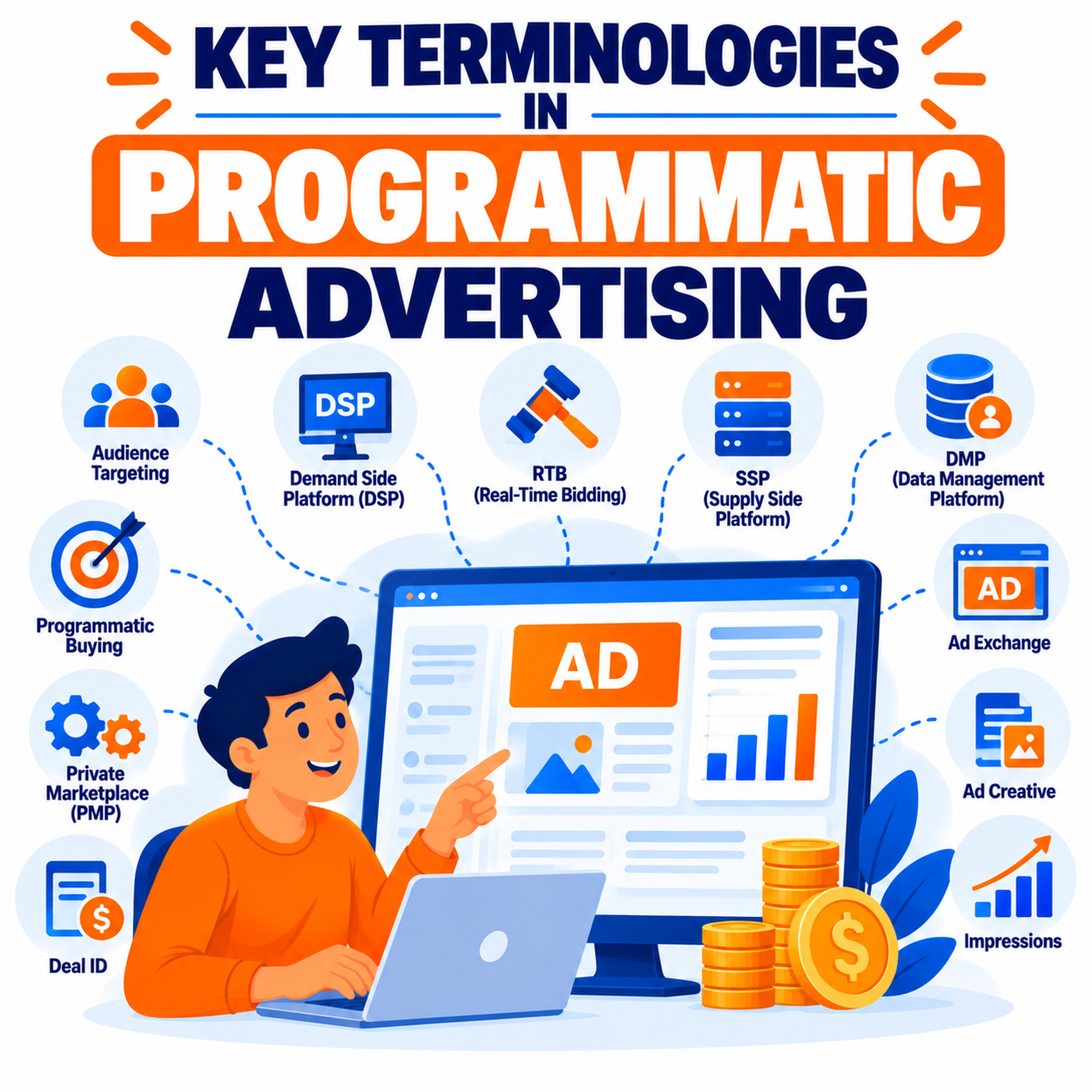
Key Terminologies in Programmatic Advertising
Programmatic advertising is the automated buying and selling of digital ad inventory using software, data, and real-time decisioning. It has transformed how brands, agencies, and publishers transact media across display, video, native, connected TV (CTV), digital out-of-home (DOOH), and other channels. Because the ecosystem is complex and highly technical, a solid grasp of its core terminology is essential for anyone working in media planning, trading, ad operations, or publishing.
This guide provides a comprehensive, structured explanation of the most important terms in programmatic advertising. Each term is defined clearly, placed in context, and connected to related concepts so you can understand not only what the words mean, but how the system actually works.
1. Foundational Concepts
Programmatic Advertising
The use of automated technology and data to buy and sell digital advertising inventory. Instead of manual insertion orders and human negotiation for every placement, algorithms and platforms handle bidding, targeting, optimization, and reporting at scale. Programmatic can include real-time auctions as well as automated guaranteed deals.
Real-Time Bidding (RTB)
A method of buying and selling ad inventory through instantaneous auctions that occur in the milliseconds between a user requesting a page or app content and the ad being displayed. When a user loads a page, information about the impression is sent to an auction; buyers bid in real time; the highest eligible bid wins; and the winning ad is served—all usually within 100 milliseconds or less.
Ad Impression
A single instance of an ad being served (and ideally viewed) to a user. Impressions are the basic unit of inventory in most programmatic transactions.
Bid Request
The data package sent by a supply-side platform or exchange that describes an available impression. It typically includes information about the publisher, placement, user (in privacy-compliant form), device, location, and other signals that buyers use to decide whether and how much to bid.
Bid Response
The reply from a demand-side platform containing the bid price, creative, and other required information if the buyer wishes to compete for the impression.
2. The Core Technology Stack
Demand-Side Platform (DSP)
Software used by advertisers and agencies to buy ad inventory programmatically across multiple exchanges and publishers from a single interface. DSPs allow campaign setup, audience targeting, bidding strategies, creative management, optimization, and reporting. Examples of functions include setting campaign goals, applying data segments, and using algorithms to maximize performance within budget constraints.
Supply-Side Platform (SSP)
Software used by publishers and inventory owners to manage, sell, and optimize their ad inventory programmatically. SSPs connect publishers to multiple demand sources (exchanges, DSPs, networks), help set floor prices, control which buyers can access inventory, and maximize yield through auction dynamics and deal structures.
Ad Exchange
A digital marketplace that connects SSPs (supply) and DSPs (demand) and facilitates the real-time auctioning of ad impressions. Exchanges provide the technical infrastructure for bid requests and responses, auction logic, and clearing of transactions. Some exchanges are independent; others are integrated with larger platforms.
Ad Server
Technology that stores creatives, makes decisions about which ad to show, records impressions and clicks, and delivers the actual ad to the user’s device. Both publishers and advertisers use ad servers (publisher ad servers and third-party/campaign ad servers).
Data Management Platform (DMP)
A platform that collects, organizes, and activates audience data from first-party, second-party, and third-party sources. DMPs help create audience segments that can be used for targeting in DSPs. In a privacy-centric world, the role of traditional third-party-data DMPs has evolved, with greater emphasis on first-party data and clean-room approaches.
Customer Data Platform (CDP)
A system that consolidates first-party customer data from multiple sources into unified profiles. CDPs are increasingly important for building first-party audiences that can be activated in programmatic environments in privacy-safe ways.
3. Buying Methods and Deal Types
Open Auction (Open Marketplace / Open Exchange)
The most common form of RTB, where any eligible buyer can bid on available impressions in a public auction. Prices fluctuate based on competition. It offers scale but generally less control and transparency than private deals.
Private Marketplace (PMP)
An invitation-only auction where a publisher offers inventory to a select group of buyers. PMPs combine some of the efficiency of programmatic with greater control over who can buy the inventory and often higher quality or more transparent placements. They are frequently used for premium inventory.
Programmatic Guaranteed (PG) / Automated Guaranteed
A deal type in which the publisher and buyer agree on fixed inventory, volume, and pricing in advance, but the transaction is executed programmatically (through automated systems rather than manual insertion orders). It provides certainty of delivery and pricing while retaining automation benefits.
Preferred Deal
A non-auction arrangement in which a buyer is given preferential access to inventory at a fixed price before it is offered in the open auction. The buyer can choose to purchase or pass; if they pass, the impression may proceed to other auctions.
Header Bidding (Client-Side and Server-Side)
An advanced technique that allows publishers to offer inventory to multiple demand sources simultaneously before calling their primary ad server. In client-side header bidding, the auction runs in the user’s browser; in server-side (or hybrid) versions, much of the process occurs on servers. Header bidding generally increases competition and publisher yield compared with traditional waterfall methods.
Waterfall
An older sequential method of offering inventory to demand sources in a prioritized order. If the first source does not fill the impression at an acceptable price, it passes to the next, and so on. Header bidding has largely replaced pure waterfalls for many publishers because simultaneous competition yields better results.
4. Targeting, Data, and Audience Terms
First-Party Data
Data collected directly by a company from its own audiences (website behavior, CRM data, app activity, email engagement, etc.). It is considered the most valuable and privacy-resilient data asset.
Second-Party Data
Another organization’s first-party data that is shared directly through a partnership.
Third-Party Data
Data aggregated by external providers from various sources and sold to advertisers. Its availability and use have been significantly restricted by privacy changes and the deprecation of third-party cookies.
Audience Segment
A group of users defined by shared attributes or behaviors (demographics, interests, purchase intent, lookalikes, etc.) used for targeting.
Lookalike Audience
An audience modeled to resemble a valuable seed audience (for example, existing customers or high-value converters).
Contextual Targeting
Targeting based on the content of the page or environment rather than user identity (e.g., serving outdoor gear ads on hiking articles). It has regained importance in a privacy-first environment.
Cookie / Device ID / Universal ID
Identifiers historically used to recognize users across sites and sessions. Third-party cookies have been phased down in major browsers; the industry has moved toward first-party identifiers, authenticated traffic, and alternative identity solutions.
Clean Room
A secure, privacy-safe environment where two or more parties can match and analyze data without exposing raw personal information to each other. Clean rooms support measurement and audience activation in ways that align with modern privacy standards.
5. Auction and Pricing Mechanics
Floor Price (Reserve Price)
The minimum price a publisher is willing to accept for an impression. Bids below the floor are rejected.
Clearing Price
The final price the winning buyer pays. In second-price auctions, this was traditionally the second-highest bid plus a small increment; many modern auctions use first-price dynamics.
First-Price Auction
The winner pays the amount they actually bid. This model has become dominant in programmatic.
Second-Price Auction
The winner pays just above the second-highest bid. Once the standard in RTB, it has largely been replaced by first-price auctions.
Bid Shading
Algorithms used by buyers in first-price auctions to bid less than their maximum willingness to pay while still trying to win, thereby improving efficiency.
CPM (Cost Per Mille)
Cost per thousand impressions. The standard currency of most programmatic display and video buying.
CPC, CPA, CPCV, etc.
Other pricing or optimization goals (Cost Per Click, Cost Per Acquisition, Cost Per Completed View). Even when campaigns optimize toward these outcomes, the underlying inventory is often still transacted on a CPM basis.
6. Measurement, Verification, and Quality Terms
Viewability
A measure of whether an ad had the opportunity to be seen. Common standards require a certain percentage of the ad pixels to be in view for a minimum amount of time.
Brand Safety
Practices and technology that prevent ads from appearing next to inappropriate, harmful, or brand-damaging content.
Fraud / Invalid Traffic (IVT)
Non-human or deceptive traffic (bots, spoofed domains, manufactured engagement). Detection and filtration are critical to protecting spend.
Ad Verification
Third-party services that measure viewability, brand safety, fraud, and sometimes geography or other delivery attributes independently of the buying platform.
Attribution
The process of assigning credit for conversions or outcomes to specific touchpoints in the customer journey. Programmatic platforms and analytics tools use various attribution models.
Incrementality
Measurement of the true causal lift generated by advertising—i.e., outcomes that would not have occurred without the ads. Increasingly important as last-click and platform-reported metrics face scrutiny.
7. Channel-Specific and Emerging Terms
CTV (Connected TV) Programmatic
Programmatic buying of advertising on internet-connected television devices and streaming platforms. It combines TV-scale creative with digital targeting and measurement capabilities.
DOOH (Digital Out-of-Home) Programmatic
Automated buying of digital billboards and place-based screens using programmatic infrastructure, often with venue and audience data.
In-App Advertising
Programmatic inventory inside mobile applications, which often relies on device IDs or other identifiers rather than cookies.
Retail Media
Advertising inventory on retailer websites, apps, and sometimes in-store screens, frequently bought programmatically and tied to closed-loop sales data.
Supply Path Optimization (SPO)
Buyer-side efforts to identify and prioritize the most efficient, transparent, and high-quality paths to publisher inventory, reducing unnecessary intermediaries.
Identity Resolution
Technology and methods used to connect identifiers across devices and environments in a privacy-compliant manner to build more complete user understanding.
8. How the Pieces Fit Together – A Simplified Flow
- A user requests content from a publisher.
- The publisher’s SSP or header bidding wrapper initiates an auction by sending bid requests to multiple demand sources.
- DSPs evaluate the bid request against campaign criteria, data, and algorithms, then return bid responses.
- The auction determines a winner based on price and any deal rules.
- The winning creative is served via an ad server.
- Impression, viewability, click, and conversion data flow back for reporting and optimization.
- Verification partners may independently assess quality and safety.
This entire process typically completes in a fraction of a second.
9. Why Terminology Matters
Misunderstanding these terms leads to poor decisions: overpaying in auctions, choosing the wrong deal types, misinterpreting performance data, or failing to adapt to privacy changes. Clear language enables better collaboration between marketing, agency, trading, and publisher teams, and it supports more effective strategy, negotiation, and optimization.
Conclusion
Programmatic advertising rests on a rich vocabulary that describes technology platforms (DSPs, SSPs, exchanges), transaction types (open auction, PMP, programmatic guaranteed), data and targeting concepts, auction mechanics, and quality measurement. Mastering these key terminologies provides the foundation for understanding how automated media buying actually works, where value is created or lost, and how the ecosystem continues to evolve in response to privacy, identity, and measurement challenges.
Whether you are planning campaigns, operating trading desks, managing publisher yield, or evaluating new channels such as CTV and retail media, fluency in these terms turns a complex system into a manageable and optimizable one. Use this guide as a reference, revisit the relationships between concepts, and stay current as new standards and solutions emerge. A strong command of programmatic language is one of the most practical skills in modern digital advertising.

Author