
AI crawlers are specialized automated software programs (bots) operated primarily by artificial intelligence companies. They systematically discover, fetch, parse, and process web content. Unlike traditional search engine crawlers (such as Googlebot or Bingbot), which primarily build indexes to rank and display links in response to human searches, AI crawlers serve distinct and often overlapping purposes tied to large language models (LLMs), generative AI systems, and AI-powered search or answer engines.
As of late 2026, AI crawlers have become a major component of web traffic. They collect data for model training, build retrieval indexes that power AI answers and citations, and perform on-demand fetches when a user asks an AI assistant about specific content. Understanding how they work—from technical mechanics to purpose-based distinctions, politeness protocols, JavaScript limitations, and control mechanisms—is essential for website owners, publishers, SEO professionals, and anyone concerned with content visibility, copyright, or server load.
This article provides a detailed examination of the entire process.
1. What Exactly Are AI Crawlers?
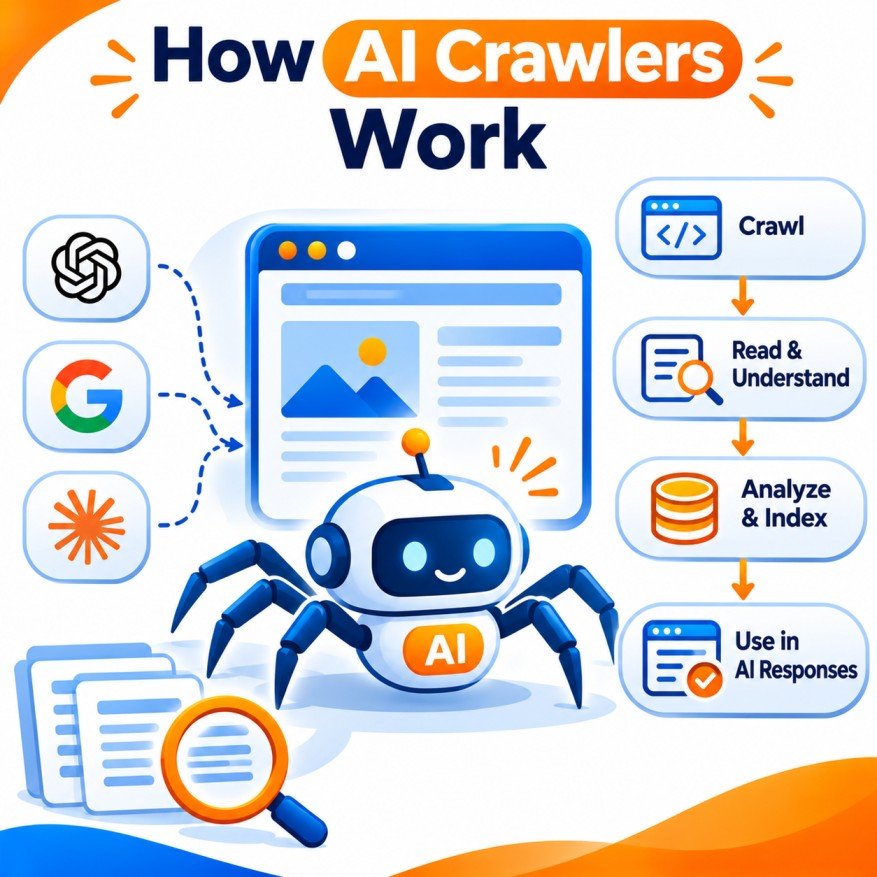
An AI crawler is an HTTP client that starts from seed URLs (known starting points), downloads pages, extracts text, links, metadata, and other elements, and queues newly discovered URLs for further exploration. The collected data is then used for one or more of the following:
- Training data collection: Gathering vast amounts of text to improve foundation models (e.g., teaching an LLM language patterns, facts, and reasoning).
- Search/index building: Creating specialized indexes so AI systems can retrieve and cite relevant pages when generating answers (often called retrieval-augmented generation or RAG).
- User-triggered (on-demand) fetching: Loading a specific page in near real time because a human user asked a question that requires current information from that URL.
These purposes are deliberately separated by most major operators into different user-agent strings. This allows site owners to permit or block specific behaviors independently via robots.txt.
Major documented AI-related agents (as of late 2026) include:
- OpenAI: GPTBot (training), OAI-SearchBot (ChatGPT search index), ChatGPT-User (user-triggered fetches; robots.txt rules may not always apply), OAI-AdsBot (for ad landing page checks).
- Anthropic: ClaudeBot (training), Claude-SearchBot (search indexing), Claude-User (user-triggered).
- Perplexity: PerplexityBot (search; not used for training), Perplexity-User (user-triggered; often ignores robots.txt).
- Google: Googlebot (Search, including AI Overviews/AI Mode), Google-Extended (robots.txt token controlling Gemini training and grounding—not a separate crawler), Google-Agent (for agents).
- Others: CCBot (Common Crawl, a major open dataset widely used for training), Meta-ExternalAgent / Meta-WebIndexer / Meta-ExternalFetcher, Bytespider (ByteDance), Amazonbot, Applebot / Applebot-Extended, and various others (ExaSearchBot, etc.).
Common Crawl remains one of the most important public sources; its monthly crawls produce petabytes of data that many AI labs incorporate.
2. The Core Technical Loop: How a Crawler Operates
At a high level, every production web crawler (AI or traditional) follows a continuous cycle:
Seeding and Discovery
The process begins with a seed list: previously known high-quality URLs, sitemaps submitted by sites, links from earlier crawls, popular domains, or other discovery signals. From each fetched page, the crawler extracts outbound links (anchor tags, etc.), normalizes them (handling relative URLs, stripping tracking parameters, resolving canonicals), and adds new ones to a queue. This creates a graph traversal of the web.URL Frontier and Scheduling (Politeness + Priority)
Pending URLs are managed in a sophisticated queue system.- Front queues prioritize by importance, freshness needs, or other signals.
- Back queues are typically one per hostname to enforce politeness (rate limiting so a single site is not overwhelmed).
Crawl delay, concurrent connection limits, and respect for server capacity are applied. AI crawlers can sometimes be more aggressive than traditional ones, leading to noticeable load spikes on popular sites.
DNS Resolution and robots.txt Check
Before requesting a path on a host, the crawler resolves the domain and fetches (and caches) the site’s robots.txt file (following RFC 9309). It looks for rules matching its specific user-agent (or the wildcard *). If the path is disallowed, the request is skipped. Many operators publish IP ranges as machine-readable lists so sites can verify authenticity via reverse DNS or IP matching.Fetching
The crawler issues an HTTP(S) request with its identifying User-Agent string, often supporting HTTP/2, conditional headers (If-None-Match / ETag, If-Modified-Since) to avoid re-downloading unchanged content (304 responses), and other standard headers. It records status codes, headers, and the response body.Parsing and Extraction
The response is parsed for:- Main textual content
- Metadata (title, description, Open Graph, schema.org structured data if present in the initial HTML)
- Links
- Other signals (canonical tags, noindex directives, etc.)
Content is often cleaned, chunked into passages, and prepared for storage or indexing. Duplicates are detected via hashing techniques (e.g., SimHash or similar locality-sensitive methods).
Selective JavaScript Rendering (or Lack Thereof)
This is one of the most important practical differences. Googlebot typically performs a two-pass process: initial fetch of the HTML, followed by rendering in a headless browser-like environment to execute JavaScript and capture dynamically loaded content.Most AI crawlers (GPTBot, ClaudeBot, many others) do not fully render JavaScript at scale because it is computationally expensive. They primarily consume the initial HTML response. Content injected client-side via JavaScript (review widgets, pricing tables loaded from APIs, tabbed/accordion content, schema injected by tag managers, many single-page application elements) is frequently invisible to them.
A practical test: disable JavaScript in a browser and view the page. What remains is roughly what many AI crawlers see. Server-side rendering (SSR), static generation, or ensuring critical content appears in the initial HTML is therefore essential for AI visibility.
Storage, Indexing, or Downstream Use
- Training crawlers feed cleaned text into large datasets used for pre-training or fine-tuning.
- Search/index crawlers build retrieval indexes optimized for passage-level lookup, provenance (source attribution), and freshness.
- User-triggered fetchers return content immediately for the current conversation context.
The loop repeats continuously, with prioritization of high-value, frequently updated, or previously successful pages.
3. Key Differences Between AI Crawlers and Traditional Search Crawlers
| Aspect | Traditional Search Crawlers (e.g., Googlebot) | AI Crawlers (Training / Search / User) |
|---|---|---|
| Primary Goal | Build index for ranking blue links and traffic referral | Train models, build RAG indexes, or fetch for live answers |
| JavaScript Rendering | Usually yes (full or delayed) | Often limited or none |
| Content Unit | Whole pages primarily | Often passages/chunks |
| Crawl Frequency & Aggression | Sophisticated crawl budget based on authority, freshness, server health | Can be more aggressive; patterns vary widely |
| robots.txt Compliance | Strong, well-established | Generally yes for automatic crawlers; user-triggered often exempt or partial |
| Value Exchange | Referral traffic to the site | Training: none direct; Search: potential citations/visibility in AI answers |
| Output | Ranked list of links | Synthesized answers with citations |
AI crawlers do not “rank” in the traditional sense for most use cases; they enable the model or retrieval system to surface or synthesize information.
4. Controlling Access: robots.txt, Tokens, and Server-Level Blocks
The primary voluntary control mechanism is robots.txt. Because operators split purposes into different user-agents, granular control is possible:
- Block training while allowing search: Disallow GPTBot and ClaudeBot (and Google-Extended / Applebot-Extended tokens), while Allowing OAI-SearchBot, Claude-SearchBot, PerplexityBot, etc.
- A shared training opt-out token (
User-agent: __usage_ai-trainingwithDisallow: /) was announced in late 2026 by major players (OpenAI, Google, Microsoft, Anthropic). Support is rolling out gradually; site-specific named agents still take precedence where implemented.
User-triggered fetchers (ChatGPT-User, Perplexity-User, etc.) frequently ignore or partially ignore robots.txt because a human initiated the request. Server- or CDN-level blocking (by User-Agent string matching or IP ranges) is required for stronger enforcement. Cloudflare and other providers offer managed rules for AI bots.
Always verify authenticity: legitimate crawlers publish IP lists or support reverse DNS verification. Impersonators exist.
5. Practical Implications for Website Owners
- Visibility in AI answers: Allowing search crawlers (OAI-SearchBot, etc.) increases the chance of being cited or linked in ChatGPT, Claude, Perplexity, and similar systems. Blocking them removes that channel.
- Training opt-out: A legitimate choice for copyright or competitive reasons. It does not affect current AI search visibility when search bots are left open.
- Technical readiness: Prioritize server-rendered or statically generated critical content. Front-load important information. Keep pages lean. Ensure clean HTML structure, proper headings, and accessible text.
- Server load and monitoring: AI crawlers can generate significant traffic. Monitor logs for User-Agent strings, use rate limiting or CDN protections, and watch for aggressive behavior.
- Sitemaps and discovery: Submitting high-quality sitemaps still helps discovery for many systems.
- No universal “re-index” button: Unlike Google Search Console, most AI systems lack a simple public request-indexing tool. Consistency and technical accessibility matter more.
6. Broader Context and Ongoing Evolution
AI crawling raises ongoing questions around copyright, fair use, data ownership, compensation models for publishers, and the environmental cost of large-scale crawling and training. Some publishers block training crawlers while welcoming search ones; others take broader positions. Common Crawl continues to serve as a foundational open resource.
The landscape evolves rapidly: new user-agents appear, rendering capabilities may improve, shared opt-out signals mature, and hybrid agent systems (that browse more like users) emerge. Verification via official documentation, IP lists, and log analysis remains essential.
In summary, AI crawlers operate on the same fundamental principles as traditional web crawlers—seed, fetch, parse, queue, repeat—but are optimized for different downstream goals: building the knowledge and retrieval systems that power modern AI assistants. Their limited JavaScript rendering, purpose-split user-agents, and varying politeness create both opportunities and challenges for content creators. By understanding the mechanics in depth, site owners can make informed decisions about access, optimize technical foundations for AI discoverability, and balance visibility against control over how their content is used.

Author