
Launching paid advertising without thorough preparation is one of the fastest ways to waste budget. Studies and practitioner audits consistently show that a large percentage of campaigns underperform or fail not because of poor creative or weak offers, but because foundational elements—tracking, messaging alignment, audience definition, compliance, landing pages, or technical setup—were incomplete or incorrect at launch.
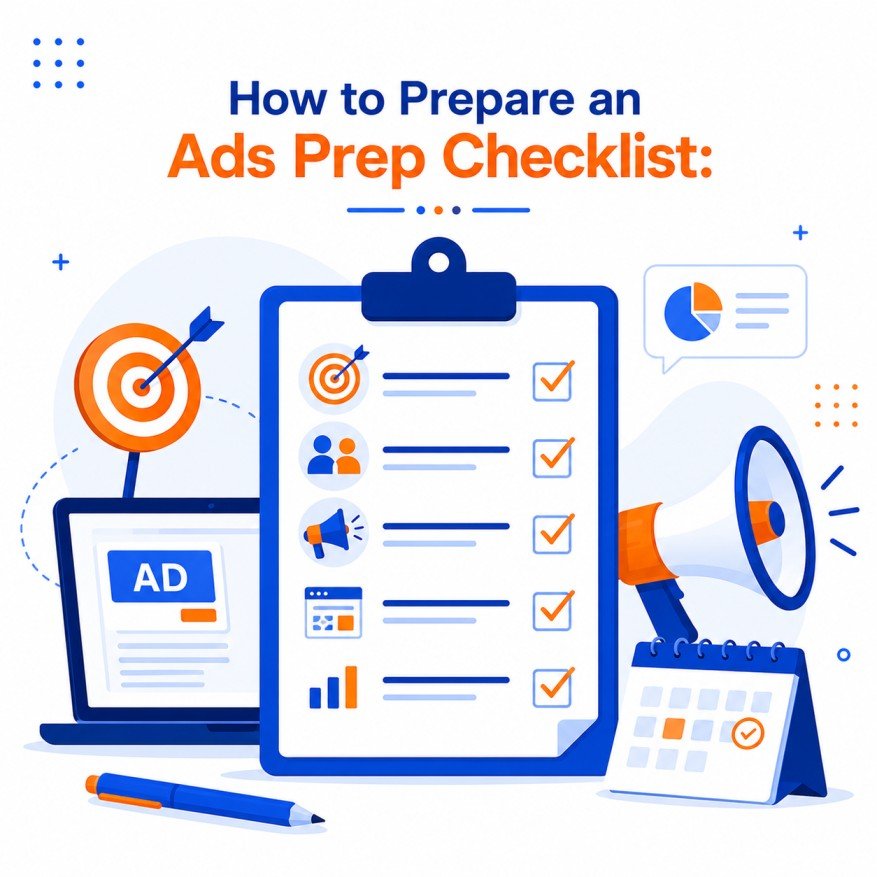
An Ads Prep Checklist (also called a pre-flight, pre-launch, or campaign readiness checklist) is a structured, repeatable process that forces teams to verify every critical element before spend begins. It reduces costly errors, improves measurement accuracy, accelerates learning, protects brand and legal risk, and dramatically increases the odds of profitable results.
This comprehensive guide explains how to build and use a robust Ads Prep Checklist. It covers strategy, tracking and measurement, creative and assets, audience and targeting, technical and platform setup, landing pages and conversion paths, compliance and brand safety, budgeting and pacing, naming conventions, QA processes, and post-launch readiness. The checklist is designed to work across major platforms (Google Ads, Meta, LinkedIn, TikTok, and others) while highlighting platform-specific considerations.
Why a Formal Ads Prep Checklist Matters
Without a checklist, teams rely on memory, tribal knowledge, or last-minute reviews. Common consequences include:
- Conversion tracking that does not fire or attributes incorrectly
- Ads that violate platform policies and get disapproved
- Message mismatch between ad and landing page
- Audiences that are too narrow, overlapping, or poorly defined
- Creative that fails technical specifications or lacks variety
- Budget and bidding settings that cause overspend or under-delivery
- Legal or claim issues that create regulatory risk
- Inability to diagnose performance because baselines were never established
A well-designed checklist turns preparation into a reliable system rather than an ad-hoc scramble. It also creates documentation that supports handoffs, audits, agency management, and continuous improvement.
How to Structure Your Ads Prep Checklist
Organize the checklist into logical phases or categories so it is scannable and assignable:
- Strategy & Objectives
- Tracking, Measurement & Data
- Audience & Targeting
- Creative, Copy & Assets
- Landing Pages & Conversion Experience
- Platform & Technical Setup
- Compliance, Legal & Brand Safety
- Budget, Bidding & Scheduling
- Naming, Organization & Documentation
- Final QA & Launch Readiness
- Post-Launch Monitoring Plan
Assign owners, due dates, and status (Not Started / In Progress / Complete / Blocked) for each item. Require sign-off from relevant stakeholders (media, creative, analytics, legal/compliance, brand) before launch.
1. Strategy and Objectives
Clarify the “why” before any creative or targeting work begins.
- Define the primary business goal (revenue, leads, pipeline, app installs, brand lift, store visits, etc.).
- Translate the goal into a platform-specific campaign objective (e.g., Sales, Leads, Traffic, Awareness, App Promotion).
- Set specific, measurable KPIs and targets (ROAS, CPA, CPL, CTR, view-through rate, incremental lift, etc.) with time frames.
- Identify the funnel stage (prospecting, consideration, retargeting, retention) and how this campaign fits the broader media mix.
- Document the core offer or value proposition that the ads will promote.
- Confirm budget range, expected learning period, and success criteria for scaling or pausing.
- Align stakeholders on what “good” looks like and when optimization decisions will be made.
A clear strategy prevents the common error of choosing the wrong objective, which fundamentally changes how the algorithm optimizes delivery.
2. Tracking, Measurement, and Data Infrastructure
You cannot optimize what you cannot accurately measure.
- Confirm primary conversion events are defined and prioritized (purchase, lead, signup, key micro-conversions).
- Install and verify platform pixels/tags (Meta Pixel, Google tag / GA4, TikTok Pixel, LinkedIn Insight Tag, etc.).
- Test events with real actions using platform tools (Events Manager, Tag Assistant, Test Events).
- Implement Enhanced Conversions, server-side tracking, or Conversions API where available to improve data quality under privacy restrictions.
- Set up UTM parameter standards and ensure consistent application across all links.
- Verify that conversion data flows correctly into the ad platforms and analytics (GA4, CRM, etc.).
- Establish backup or redundant tracking where critical (call tracking, offline conversion imports).
- Confirm attribution settings and lookback windows align with business reality.
- Prepare reporting dashboards or templates before launch so results are immediately visible.
- Document baseline metrics if historical data exists.
Broken or incomplete tracking is one of the most expensive pre-launch failures because it renders optimization and ROAS calculation unreliable.
3. Audience and Targeting
- Define primary and secondary audience segments with clear personas or firmographics.
- Map targeting methods: interest/behavior, custom audiences, lookalikes/similar, first-party data, keyword themes (search), or broad + creative-led approaches.
- Build and upload necessary custom audiences (website visitors, customer lists, engagers, video viewers) with proper matching and exclusions.
- Apply exclusions to prevent overlap, wasted spend on existing customers (when appropriate), or irrelevant segments.
- Check estimated audience sizes for learning phase viability.
- Confirm geographic, language, device, and demographic restrictions.
- Plan audience testing structure (separate ad sets or campaigns for clean learning).
- Document why each audience was chosen and what hypothesis it tests.
4. Creative, Copy, and Assets
Creative is often the highest-leverage variable in modern advertising.
- Develop a clear creative brief covering audience, single-minded message, offer, proof points, tone, mandatory elements, and exclusions.
- Produce sufficient volume and variety of concepts (not just minor variations) for testing.
- Create assets in all required aspect ratios and formats (feed, stories/reels, landscape, square, vertical, etc.).
- Ensure video hooks appear in the first 1–3 seconds; add captions for sound-off viewing.
- Write multiple headline, primary text, and description variations that align with the offer and audience stage.
- Include clear, benefit-oriented calls-to-action.
- Verify all claims are substantiated and approved.
- Check brand guidelines compliance (logo usage, colors, fonts, tone).
- Confirm file specifications (resolution, file size, length, text overlay limits where relevant).
- Prepare a testing matrix so winners and losers can be identified quickly.
5. Landing Pages and Conversion Experience
The ad’s job is to earn the click; the landing page’s job is to convert it.
- Confirm message match between ad creative/copy and landing page headline, visuals, and offer.
- Test page load speed (ideally under 3 seconds on mobile) and Core Web Vitals.
- Verify mobile responsiveness and usability.
- Ensure the primary conversion action is obvious and low-friction.
- Check form length, required fields, and error handling.
- Confirm trust signals, social proof, and key information (pricing, shipping, guarantees) are visible.
- Test all links, buttons, and tracking parameters on the live URL.
- Validate that the page can handle traffic spikes.
- Align any dynamic parameters or personalization.
6. Platform and Technical Setup
- Confirm account structure, Business Manager / MCC access, and user permissions.
- Verify billing method is active and spending limits are appropriate.
- Set correct time zone, currency, and account-level settings.
- Choose campaign structure (campaigns, ad sets/ad groups, ads) that supports testing and scaling without excessive fragmentation.
- Configure placements, devices, and delivery optimizations intentionally (or knowingly use Advantage+/Performance Max automation).
- Set budgets (daily or lifetime) and bids/bidding strategies aligned with goals.
- Apply any necessary brand safety, inventory, or content exclusions.
- Upload product catalogs or feeds if using dynamic/retargeting formats.
- Double-check start and end dates, dayparting, and ad scheduling.
7. Compliance, Legal, and Brand Safety
- Review all claims, testimonials, and imagery for accuracy and substantiation.
- Add required disclosures, disclaimers, and legal lines in legible form.
- Confirm assets and music are properly licensed.
- Check platform-specific restricted content policies (health, finance, alcohol, politics, etc.).
- Ensure age-gating or targeting restrictions where required.
- Verify privacy notices, consent mechanisms, and data handling align with regulations (GDPR, CCPA, etc.).
- Obtain formal approvals from legal, compliance, or brand stakeholders as needed.
- Document the approval chain for auditability.
8. Budget, Bidding, and Pacing
- Allocate budget across prospecting, retargeting, and testing according to strategy (e.g., 70/20/10 frameworks).
- Set realistic daily budgets that allow the algorithm to exit learning phase.
- Choose bidding strategies that match the optimization event and data volume.
- Plan for initial learning period volatility and avoid premature optimization.
- Establish rules or alerts for overspend, underspend, or anomalous CPA/ROAS.
9. Naming Conventions and Organization
Consistent naming is operational infrastructure.
- Adopt a standardized naming taxonomy for campaigns, ad sets, and ads (objective, funnel stage, audience, offer, geo, date, etc.).
- Apply the convention before launch so reporting and analysis remain clean.
- Maintain a living glossary of abbreviations and controlled vocabulary.
- Organize assets and documentation in shared, version-controlled locations.
10. Final QA and Launch Readiness
Perform a structured pre-flight review, ideally by someone not deeply involved in production:
- All tracking events fire correctly on real conversions.
- Every ad preview looks correct on mobile and desktop.
- Links and UTMs resolve properly.
- No policy-sensitive language or imagery remains.
- Budgets, dates, and targeting match the brief.
- Creative variety and testing plan are in place.
- Stakeholders have signed off.
- Reporting dashboard is live and accurate.
- Team is notified of launch timing and monitoring responsibilities.
11. Post-Launch Monitoring Plan
Preparation does not end at launch.
- Define the first 24–72 hour monitoring cadence.
- List early warning signals (delivery issues, sudden CPA spikes, tracking anomalies, policy flags).
- Assign ownership for daily checks during the learning phase.
- Schedule the first optimization review after sufficient data accumulates.
- Document learnings for the next campaign cycle.
Building and Maintaining the Checklist as a Living System
- Start with a comprehensive master checklist and create platform-specific or campaign-type variants (search vs social, prospecting vs retargeting, brand vs performance).
- Store it in a shared tool (Notion, Airtable, Google Sheets, project management software) with status tracking.
- Review and update the checklist quarterly as platforms, privacy rules, and internal processes evolve.
- Train every team member and agency partner on its use.
- Treat completion of the checklist as a non-negotiable gate before budget is released.
Common Pitfalls the Checklist Prevents
- Launching with untested tracking
- Message mismatch between ad and page
- Insufficient creative volume or format coverage
- Audience overlap or contamination
- Policy rejections after spend begins
- Inability to diagnose results due to poor naming or missing UTMs
- Legal exposure from unapproved claims
- Budget exhaustion during an unbroken learning phase
Conclusion
A rigorous Ads Prep Checklist transforms paid media from a high-risk, reactive activity into a controlled, measurable growth system. The time invested in preparation is repaid many times over through reduced waste, faster optimization, cleaner data, lower compliance risk, and higher confidence in scaling decisions.
Build your checklist around the categories above, customize it to your platforms and business model, assign clear ownership, and enforce it as a launch gate. Over time, the discipline of systematic preparation becomes a competitive advantage: while others scramble to fix preventable problems after spend starts, your campaigns enter the market ready to learn, optimize, and perform.
Use the framework in this guide as a foundation. Expand it with your specific technical requirements, brand guidelines, and regulatory constraints. The result will be fewer expensive surprises and consistently stronger advertising outcomes.

Author