
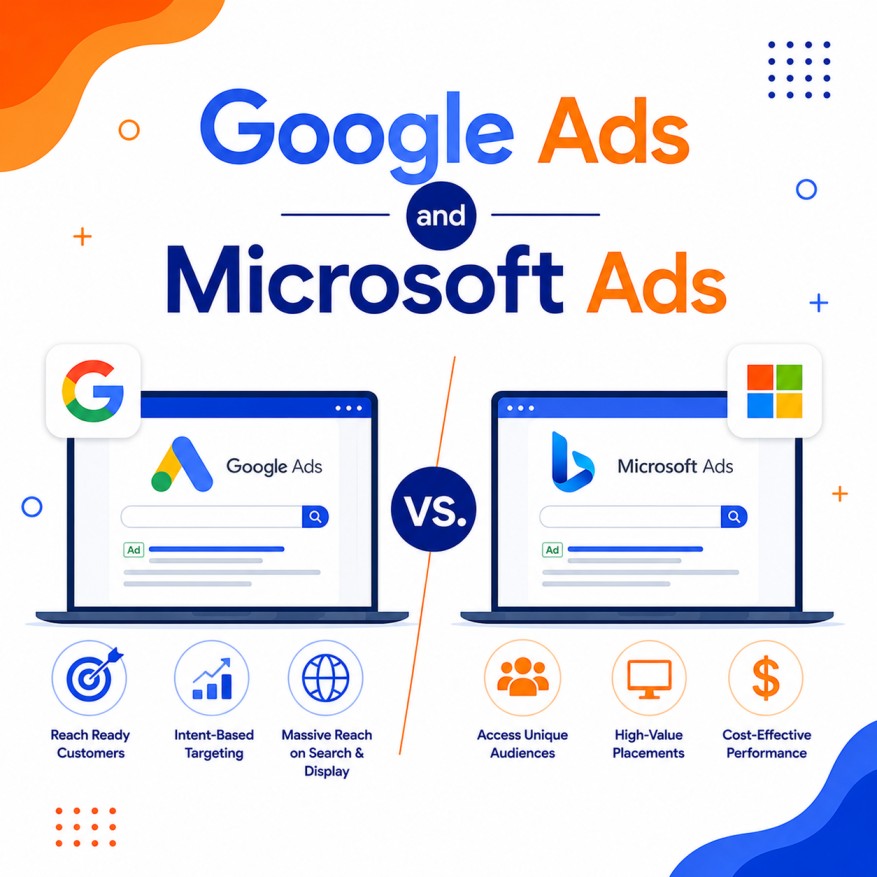
In the world of pay-per-click (PPC) advertising, Google Ads and Microsoft Ads (formerly known as Bing Ads) are the two dominant players. While Google Ads commands the lion’s share of the market, Microsoft Ads offers unique advantages that smart advertisers are increasingly leveraging for better efficiency, lower costs, and access to high-value audiences. Understanding the differences between these two platforms is essential for building a balanced, high-ROI digital advertising strategy in 2026.
This exhaustive guide provides a detailed comparison across every major dimension — market reach, audience demographics, costs, features, targeting options, ad formats, performance benchmarks, integration capabilities, and strategic use cases. We’ll also explore when to use each platform, how to combine them effectively, optimization best practices, common pitfalls, and future trends. Whether you’re running campaigns for e-commerce, SaaS, B2B services, or local businesses, this article will help you make informed decisions.
1. Overview and Market Position
Google Ads is the undisputed leader in digital advertising. It operates across Google Search, YouTube, Gmail, the Display Network, Discover, Maps, and more through formats like Performance Max. As of 2026, Google controls approximately 82–90% of the global search market share, processing billions of searches daily.
Microsoft Ads powers advertising on Bing, Yahoo, AOL, DuckDuckGo (via partnerships), MSN, Outlook, Xbox, and LinkedIn integrations. It holds roughly 4–12% of the global search market (higher on desktop in certain regions), reaching over 700 million unique users monthly.
While Google offers unmatched scale, Microsoft Ads often delivers higher efficiency and better ROI for specific segments due to lower competition.
2. Audience Demographics and User Behavior
This is one of the most significant differences:
- Google Ads Audience: Broad, diverse, and mobile-first. Strong appeal to younger users (Gen Z and Millennials), global reach, and users across all income levels. Searches tend to be high-intent but also include more casual browsing.
- Microsoft Ads Audience: Skews older (35+), higher household income, higher education level, and more professional. Users are often decision-makers in B2B contexts. Desktop usage is significantly higher compared to Google, and users tend to have higher purchase intent and buying power.
Key Insight: If your ideal customer is a business professional, high-income consumer, or B2B buyer, Microsoft Ads frequently delivers stronger quality traffic at lower costs.
3. Cost Comparison: CPC, CPA, and Competition
- Google Ads: Higher competition leads to elevated costs. Average CPCs are often 30–50% (sometimes up to 242%) higher than Microsoft Ads, depending on the industry.
- Microsoft Ads: Consistently lower CPCs and CPAs — often 20–50% cheaper. Less competition makes it easier to achieve positive ROAS, especially for mid-sized budgets.
However, lower costs on Microsoft Ads come with lower search volume. Google wins on absolute scale, while Microsoft excels in cost efficiency and incremental profit.
4. Reach and Inventory
- Google Ads: Massive ecosystem including Search, Shopping, YouTube (video), Display, Performance Max, and more. Unparalleled for demand generation and full-funnel campaigns.
- Microsoft Ads: Strong on search (Bing + partners), plus unique placements like Xbox, LinkedIn profile targeting, Netflix CTV, and multimedia ads. Growing integration with Microsoft ecosystem (Edge, Outlook, Copilot).
Google offers broader reach, especially on mobile. Microsoft performs better on desktop and professional contexts.
5. Targeting Capabilities
- Google Ads: Advanced AI-driven targeting, custom intent audiences, in-market audiences, remarketing, and Performance Max automation. Strong for broad and behavioral targeting.
- Microsoft Ads: Excellent B2B targeting via LinkedIn profile data (company, job title, industry, job function). Also offers strong demographic, location, and device targeting. LinkedIn integration is a major differentiator that Google cannot match.
Microsoft often wins for precise professional audience targeting.
6. Ad Formats and Creative Options
Both platforms support Search, Shopping, and Display-style ads, but with differences:
- Google Ads: Performance Max, Demand Gen, YouTube video ads, Discovery ads, and highly sophisticated dynamic formats.
- Microsoft Ads: Responsive Search Ads, Multimedia Ads (unique image + text combinations on SERP), Shopping campaigns, and strong native ad options. Growing AI tools (Copilot integration).
Google leads in creative variety and automation. Microsoft offers unique formats like impression-based remarketing for multimedia ads.
7. Campaign Management and User Interface
- Google Ads: More complex interface with advanced automation (Smart Bidding, AI recommendations). Steeper learning curve but powerful for large accounts.
- Microsoft Ads: Simpler, more user-friendly interface. Easy campaign import from Google Ads. Stronger manual control in some areas, though automation is catching up.
Many advertisers find Microsoft Ads quicker to set up and manage, especially for smaller teams.
8. Performance Benchmarks (2025–2026)
- CTR: Google often shows higher CTR due to larger volume and brand familiarity. Microsoft can deliver competitive or better CTR in niche B2B segments.
- Conversion Rates: Varies by industry. Microsoft frequently shows stronger conversion quality due to higher-intent, affluent users.
- ROAS: Microsoft Ads often achieves higher return per dollar spent because of lower costs and better audience match for certain verticals.
9. Strategic Use Cases
Choose Google Ads when:
- You need maximum scale and volume.
- Targeting younger or mobile-first audiences.
- Running full-funnel campaigns (awareness via YouTube + conversion via Search).
- Operating in highly competitive B2C categories.
Choose Microsoft Ads when:
- Targeting B2B, professionals, or high-income consumers.
- Seeking lower CPCs and better efficiency.
- Running desktop-heavy campaigns.
- Looking for incremental revenue with lower budgets.
- Leveraging LinkedIn-style professional targeting.
Best Practice: Run both platforms. Use Google for volume and Microsoft for efficiency. Many brands allocate 70–80% budget to Google and 20–30% to Microsoft for optimal results.
10. Integration with Other Channels
Both platforms integrate well with Google Analytics, Microsoft Clarity, CRM systems, and landing pages. Microsoft offers stronger synergy with LinkedIn and the Microsoft ecosystem (Outlook, Teams). Google excels with YouTube and Android.
11. Common Challenges and Solutions
- Google: High costs and competition. Solution: Focus on Quality Score, negative keywords, and smart bidding.
- Microsoft: Lower volume. Solution: Use it for testing and incremental gains rather than primary volume driver.
- Import Issues: When importing from Google, adjust match types and UTMs carefully.
12. Future Trends (2026+)
- Deeper AI integration on both (Gemini for Google, Copilot for Microsoft).
- Continued growth of multimedia and CTV formats on Microsoft.
- Stronger privacy-compliant targeting.
- Potential convergence as both platforms enhance automation.
Difference Between Google Ads and Microsoft Ads: Comprehensive Comparison Table (2026 Edition)
Here is a detailed, side-by-side comparison table covering all major aspects of Google Ads and Microsoft Ads (Bing Ads). This table is designed for quick reference while remaining highly informative for performance marketers, agencies, and business owners.
| Aspect | Google Ads | Microsoft Ads (Bing Ads) |
|---|---|---|
| Market Share | 82–90% of global search market | 4–12% of global search market (stronger in certain regions and desktop) |
| Primary Platforms | Google Search, YouTube, Gmail, Display Network, Discover, Maps, Performance Max | Bing, Yahoo, AOL, DuckDuckGo (partner), MSN, Outlook, Xbox, LinkedIn integration |
| Audience Demographics | Broad, younger (Gen Z & Millennials), mobile-first, diverse income levels | Older (35+), higher income, higher education, professionals, decision-makers |
| User Intent & Behavior | High volume, mix of high & low intent | Generally higher purchase intent, more research-oriented, higher buying power |
| Average CPC | Higher (often 30–50%+ more expensive) | Significantly lower (20–50% cheaper on average) |
| Competition Level | Extremely high | Moderate to low |
| Reach & Scale | Massive global reach, especially mobile | Stronger on desktop, good reach in professional & high-income segments |
| Best For | Volume, brand awareness, full-funnel campaigns, B2C, e-commerce | Efficiency, B2B, high-value customers, professional audiences, incremental ROI |
| Targeting Capabilities | Advanced AI audiences, in-market, custom intent, remarketing, Performance Max | Excellent LinkedIn profile targeting (job title, company, industry, function) |
| Ad Formats | Performance Max, Demand Gen, YouTube Video, Responsive Search, Shopping | Responsive Search, Multimedia Ads, Shopping, Audience Ads, Video |
| Automation Level | Very high (Smart Bidding, Performance Max, AI recommendations) | Moderate to high (improving rapidly with Copilot integration) |
| Bidding Strategies | Highly sophisticated (Target ROAS, Maximize Conversions, etc.) | Strong options, but slightly less advanced than Google |
| Campaign Management | Complex interface, powerful but steeper learning curve | Simpler, cleaner interface, easier to manage |
| Import from Google | Not applicable | Easy campaign import tool available |
| Conversion Tracking | Excellent with Google Analytics 4 integration | Strong, especially with Microsoft Clarity and LinkedIn integration |
| Typical CTR | Generally higher due to volume | Competitive or better in B2B/professional niches |
| Typical ROAS | Strong on scale, but higher costs can reduce efficiency | Often higher due to lower CPCs and better audience quality |
| B2B Performance | Good, especially with Demand Gen and Search | Excellent — LinkedIn profile data gives clear advantage |
| Mobile Performance | Dominant | Weaker compared to Google |
| Desktop Performance | Strong | Very strong |
| Cost Efficiency | Lower due to competition | Significantly better for most industries |
| Creative Flexibility | Highest (especially video and dynamic formats) | Good, with unique Multimedia Ads format |
| Reporting & Insights | Very detailed but sometimes overwhelming | Cleaner, more actionable insights |
| Integration Strength | Best with Google ecosystem (Analytics, YouTube, Merchant Center) | Strong with Microsoft ecosystem (LinkedIn, Outlook, Teams, Clarity) |
| Budget Recommendation | 70–80% of total PPC budget for most advertisers | 20–30% for efficiency and incremental gains |
| Learning Curve | Steep | Moderate |
| Best Use Cases | High-volume e-commerce, brand campaigns, YouTube video, broad reach | B2B lead gen, professional services, high-income consumers, desktop campaigns |
| Limitations | High costs, intense competition, less precise B2B targeting | Lower overall volume, weaker mobile reach |
Conclusion: A Dual-Platform Strategy Wins
Google Ads and Microsoft Ads are not direct competitors — they are complementary tools. Google provides unmatched scale and versatility. Microsoft delivers cost efficiency, high-value audiences, and unique B2B capabilities.
The smartest marketers in 2026 use both: Google Ads for broad reach and demand creation, Microsoft Ads for efficient conversion and incremental profit. Test both platforms with a portion of your budget, analyze performance by audience and goal, and allocate spend accordingly.
Start today by importing your Google campaigns into Microsoft Ads for a quick test. You may discover profitable opportunities you’ve been missing. In a world of rising advertising costs, combining the strengths of Google Ads and Microsoft Ads can deliver superior overall ROAS and sustainable growth.
Master both platforms, align them with your audience and objectives, and build a resilient PPC strategy that maximizes every advertising dollar. The difference between the two isn’t about choosing one winner — it’s about leveraging their unique strengths together.

Author