
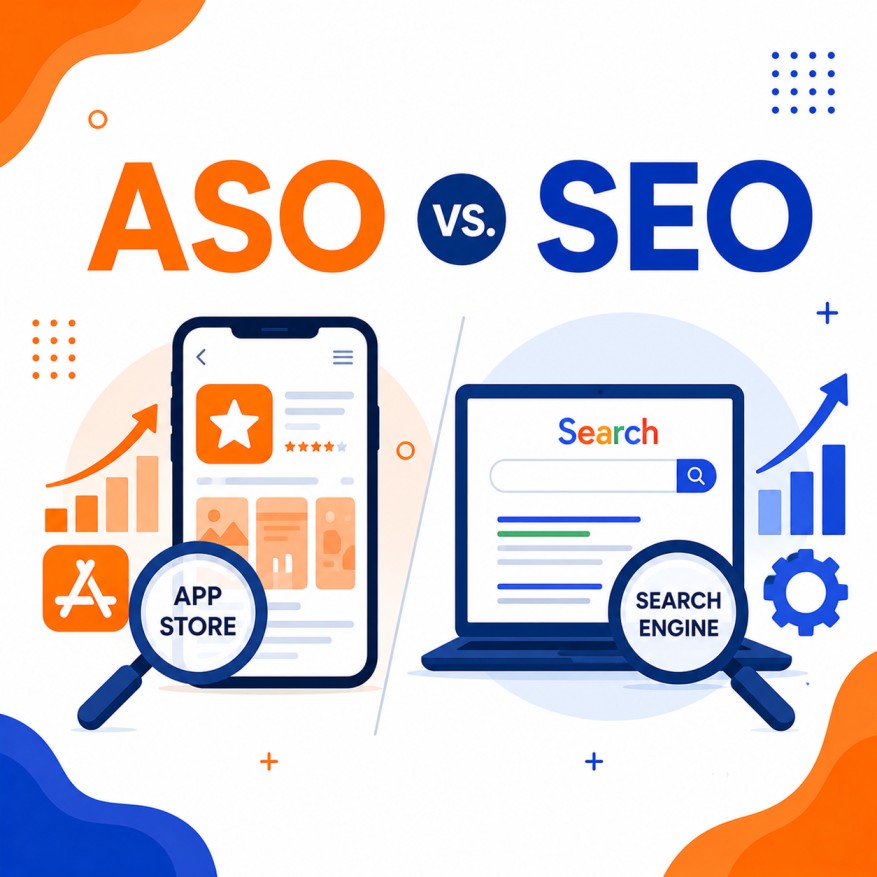
The digital ecosystem is no longer neatly divided into desktop web browsers and isolated mobile applications. Today’s consumer journeys are fluid, often beginning with a Google search on a laptop, shifting to an informational blog post on a mobile browser, and culminating in an app installation.
For full-stack digital marketers, treating Search Engine Optimization (SEO) and App Store Optimization (ASO) as siloed disciplines is a critical missed opportunity. While both are built on the foundational principles of organic discovery, keyword targeting, and Conversion Rate Optimization (CRO), their algorithms, user intents, and ranking signals differ fundamentally.
This comprehensive guide dissects the architectural differences between ASO and SEO and provides an advanced, multi-channel blueprint for synchronizing your web and app store presence to dominate user acquisition across both realms.
Part 1: The Fundamental Architecture – SEO vs. ASO
At their core, both SEO and ASO aim to increase visibility and drive organic conversions. However, the environments in which they operate dictate completely different strategies.
1. The Environment and Algorithm
-
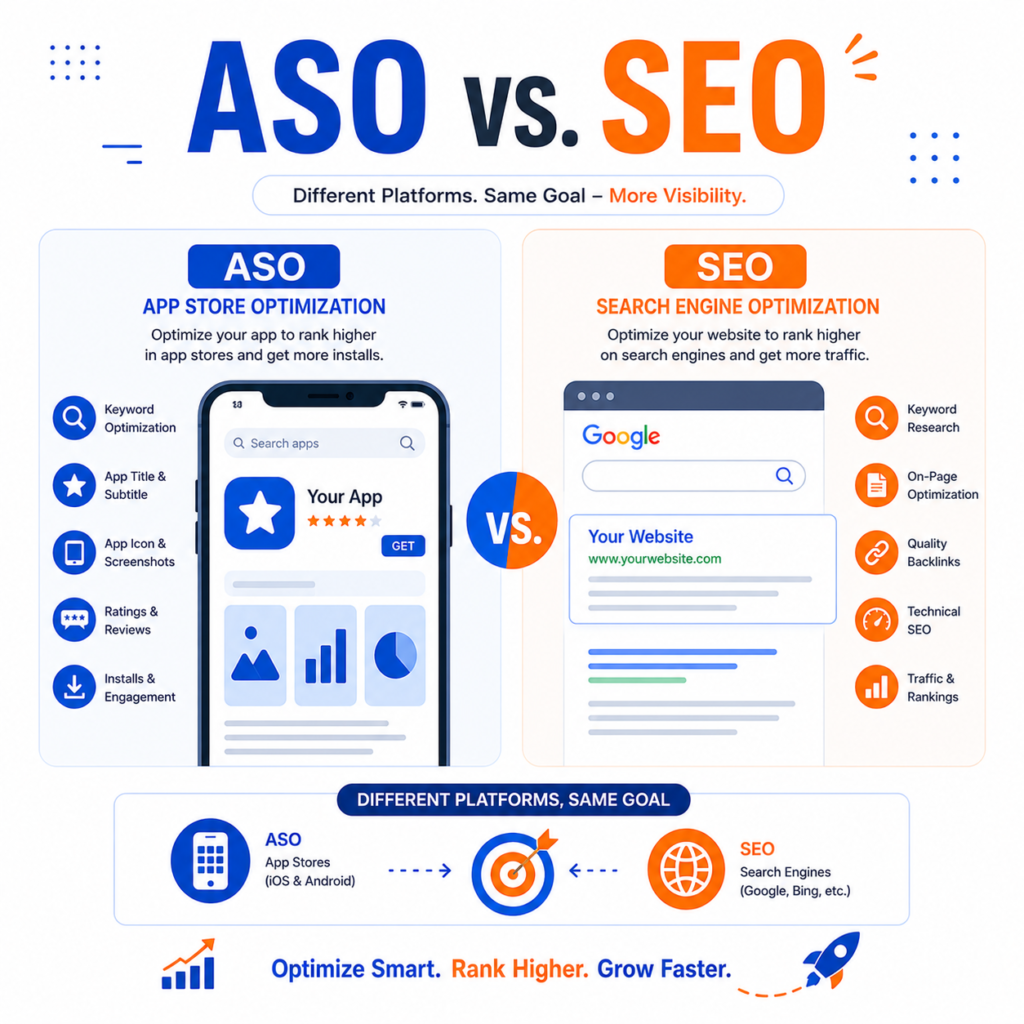
SEO (Google, Bing): Operates on an open-web architecture. The algorithm relies heavily on crawling millions of interconnected pages. The primary ranking signals are content relevance (semantic depth) and domain authority (backlinks). Google’s goal is to provide the best answer to a query.
-
ASO (Apple App Store, Google Play): Operates within a closed ecosystem. The algorithms are less concerned with content depth and more focused on behavioral metrics. The primary ranking signals are metadata relevance, download velocity, and user retention. The app stores’ goal is to provide a software utility that users will install and keep.
2. User Intent and Search Behavior
-
SEO Intent: Search queries on the web are predominantly informational or navigational. Users ask complex, long-tail questions (e.g., “How to track personal expenses automatically” or “Best inventory management software for e-commerce”).
-
ASO Intent: App store searches are heavily transactional and feature-driven. Users search in short-tail, specific bursts, often looking for a direct solution or a known brand (e.g., “Budget tracker,” “Photo editor,” or “Spotify”).
3. The Core Ranking Factors Compared
| Feature | SEO (Web Search) | ASO (App Stores) |
| Primary Goal | Traffic, Lead Gen, Sales | App Installs, Active Users |
| Search Queries | Long-tail, Informational (3-5+ words) | Short-tail, Feature/Brand specific (1-3 words) |
| Key Text Signals | Title tags, Headers (H1/H2), Deep Content | App Title/Name, Subtitle, Keyword Field, Prominent Description |
| Key Off-Page Signals | Backlinks, Brand Mentions, Core Web Vitals | Download Velocity, Uninstalls, Ratings/Reviews |
| Conversion Focus | Landing Page UX, Call to Action, Page Speed | Screenshots, Video Previews, First 3 Lines of Description |
| Lifecycle | Long-term compounding growth | Fast spikes; heavily influenced by recent momentum |
Part 2: The ASO Mechanics – Mastering the Closed Ecosystem
To synchronize both channels, you must first master the specific levers of the app stores.
1. Metadata Optimization
Unlike SEO, where Google can semantically understand an entire 2,000-word article, Apple’s App Store algorithm primarily looks at specific, rigid fields:
-
App Name/Title: Carries the heaviest weight. It must include your brand and your highest-volume, highest-relevance keyword.
-
Subtitle: The secondary weight. Used to capture complementary keywords and articulate the value proposition.
-
Keyword Field (iOS): A hidden 100-character field. Commas separate words, no spaces. It requires extreme precision to maximize combinations.
-
Google Play Description: Unlike Apple, Google Play crawls the entire description for keywords. Keyword density (used naturally) matters here, similar to early-2010s SEO.
2. Visual CRO (The Install Catalyst)
Once you rank, you must convert. ASO relies intensely on visual CRO because the user makes a split-second decision based on visual assets.
-
Iconography: Must stand out against competitors in the same category.
-
Screenshots: The first three screenshots are critical. They must feature bold text callouts and demonstrate the UI solving the user’s primary problem.
-
App Previews (Video): Highly effective for complex SaaS, Fintech, or gaming apps where the user needs to see the software in action before committing space on their device.
3. Behavioral Velocity
An app’s ranking is heavily dictated by its Install Velocity (how many downloads it gets in a short timeframe). A sudden spike in traffic (perhaps from an influencer campaign or a massive web SEO push) signals to the app stores that the app is trending, which naturally pushes it higher in organic rankings.
Part 3: The Synchronization Strategy – The Full-Stack Approach
Treating SEO and ASO as separate workflows leads to cannibalization and wasted budget. When synchronized, your web presence acts as a massive, low-cost funnel that feeds high-intent users directly into your app, boosting your ASO metrics in a virtuous cycle.
Here is how to execute a synchronized strategy.
Strategy 1: The “Web-to-App” Content Funnel
App stores are terrible for informational searches. If a user wants to learn “How to invest in mutual funds,” they go to Google, not the App Store.
-
Capture Intent via SEO: Use tools like SEMrush or Ahrefs to identify high-volume informational queries related to your app’s niche (e.g., Edtech, Fintech, or Healthcare). Build deep, authoritative blog content targeting these queries.
-
Transition via Smart App Banners: Once the user lands on your mobile web article, do not rely on a standard hyperlink to drive them to the app. Implement native Smart App Banners (iOS) and similar prompt banners for Android. These banners provide a frictionless, one-tap route from the browser to the exact App Store listing.
-
The Result: You acquire a user via a low-cost informational SEO click, and pass them to the app store. This increases your app’s download volume, which in turn boosts your ASO rankings.
Strategy 2: Dominating the Google “App Packs”
Google Search frequently includes “App Packs”—a carousel of recommended apps—directly in the SERPs for mobile queries (e.g., “best calorie counter apps”).
-
How to Rank Here: App Packs are generated by Google’s web algorithm, not the Play Store algorithm. To feature here, your app’s landing page on your website must have strong SEO authority. Ensure your website has a dedicated, highly optimized landing page for your app, rich with schema markup (specifically
SoftwareApplicationschema), detailing ratings, features, and direct links to both app stores.
Strategy 3: Cross-Pollinating Keyword Data
SEO tools provide infinitely richer data than ASO tools. You can use web search data to predict app store trends.
-
Keyword Expansion: If you notice a specific long-tail keyword driving high-converting traffic to your SaaS website (e.g., “team task delegation software”), test the core roots of that keyword (“team tasks”, “task delegation”) in your Apple Search Ads or ASO metadata.
-
Brand Protection: If your SEO data shows competitors bidding on your brand name in Google Ads, they are likely doing the same in the App Stores. Synchronize your defensive brand bidding across both Google Ads and Apple Search Ads.
Strategy 4: Deep Linking and the Post-Install SEO Boost
Google indexes app content through Firebase App Indexing (Android) and Universal Links (iOS).
-
How it Works: If a user has your e-commerce app installed and searches for a specific product on Google via their mobile browser, deep linking allows Google to open that exact product page inside your app, bypassing the web browser entirely.
-
The Benefit: This dramatically increases user engagement and session length inside your app. High engagement and low uninstall rates are massive positive signals to the App Store algorithms, strengthening your ASO profile.
Strategy 5: Unified Review Generation
Both Google’s local SEO algorithm and the App Store algorithms prioritize review volume and sentiment.
-
The Synchronization: Build a unified reputation management loop. If a user completes a high-value action on the web portal, trigger an email asking for a Trustpilot or Google review. If they complete the action in the app, trigger a native in-app review prompt. Consistent 4.5+ star ratings across the web (visible in your site’s schema) and the app stores build immense brand trust, increasing CRO across all touchpoints.
Summary: The Virtuous Cycle of Discovery
To achieve maximum discovery, digital strategists must view SEO and ASO not as a binary choice, but as a continuous loop:
-
SEO captures top-of-funnel, informational intent. (The user asks a question).
-
Optimized web-to-app funnels convert web traffic into app installs. (The user downloads the solution).
-
The influx of web-driven installs boosts App Store velocity. (The app climbs the ASO charts).
-
Higher ASO rankings generate organic, high-intent app downloads. (The app acquires users natively).
-
In-app engagement and deep linking signal authority back to Google search. (The brand’s overall digital footprint strengthens).
By architecting a strategy where web content feeds app velocity, and app engagement reinforces web authority, you create an acquisition engine that outpaces competitors who remain stuck in siloed marketing mentalities.