
Understanding Shopify SEO: The Foundation
Before diving into execution, it’s important to understand how SEO works specifically for Shopify.
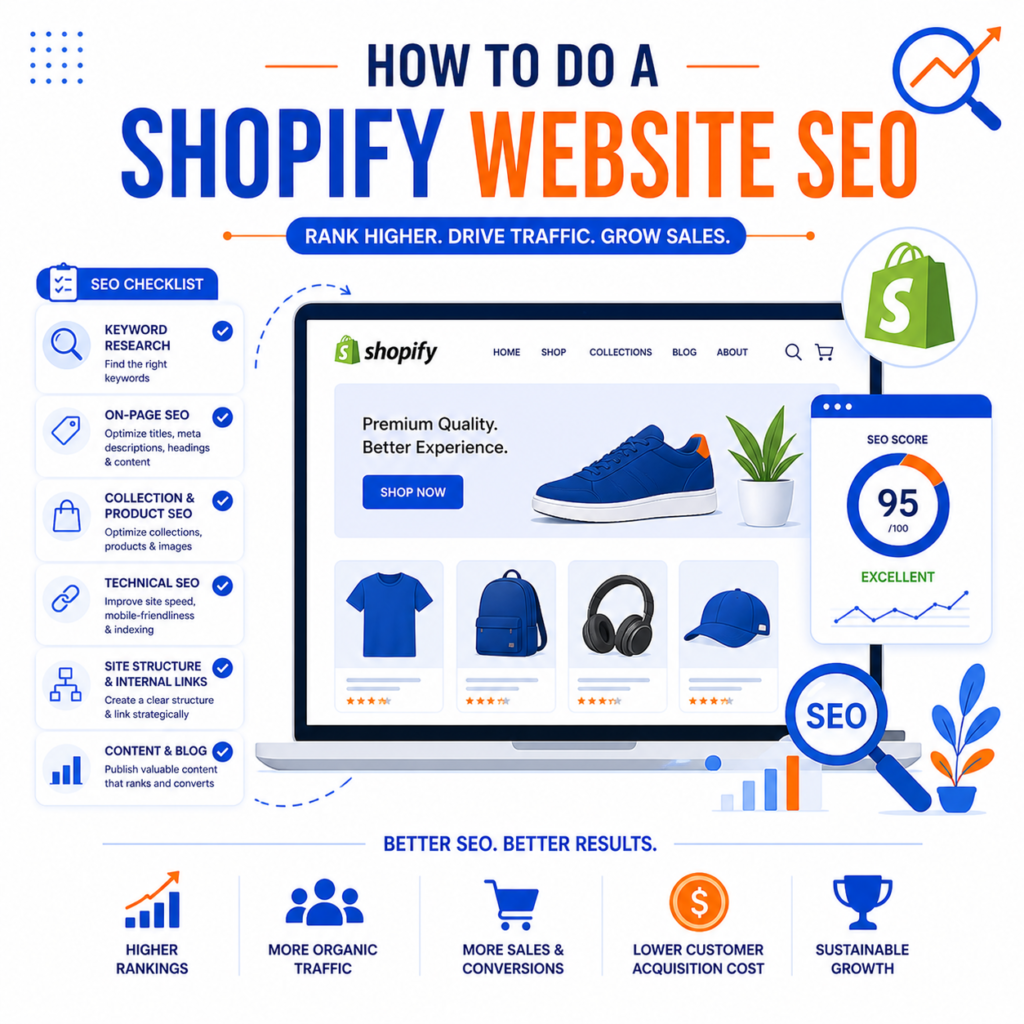
Search engines like Google crawl your website, index your pages, and rank them based on relevance, authority, and user experience. Shopify stores are primarily product-driven, which means your SEO strategy revolves around:
- Product pages
- Collection (category) pages
- Blog content
- Site structure
- Technical performance
Unlike content-heavy websites, Shopify stores often struggle because they rely too much on product pages, which are usually thin in content. This is where a smart SEO strategy makes the difference.
Shopify Site Structure Optimization
A well-structured site is the backbone of SEO. Shopify has a predefined URL structure, but you can still optimize how your pages are organized.
Shopify uses URLs like:
/products/product-name/collections/category-name
You cannot remove these prefixes, but you can optimize everything around them.
Your goal is to create a logical hierarchy that looks like this:
- Homepage
→ Category (Collection) Pages
→ Subcategories (if needed)
→ Product Pages
This structure helps search engines understand the relationship between pages and distribute authority effectively.
Internal linking plays a crucial role here. Your collection pages should link to product pages, and your blog content should link back to both collections and products. This creates a strong internal SEO network.
Keyword Research for Shopify
Keyword research is where your SEO success begins.
For Shopify, you need to focus on three types of keywords:
- Transactional Keywords (high intent)
These are used on product and category pages
Example: “buy running shoes online” - Commercial Investigation Keywords
Example: “best running shoes for beginners” - Informational Keywords
Used for blog content
Example: “how to choose running shoes”
The mistake most Shopify store owners make is targeting only transactional keywords. That limits traffic potential. You should build a full funnel strategy:
- Blog attracts users
- Collection pages guide them
- Product pages convert them
Use tools like keyword planners, competitor analysis, and search suggestions to find keywords with good volume and realistic competition.
On-Page SEO for Shopify
On-page SEO is where you optimize individual pages for search engines.
Product Page Optimization
Most Shopify stores fail here because they use default manufacturer descriptions. This creates duplicate content issues.
Instead, you should:
Write unique, detailed product descriptions that go beyond features and focus on benefits, use cases, and user intent. A strong product page includes storytelling, FAQs, and semantic keywords.
Your title tag should include primary keywords naturally, and your meta description should be compelling enough to increase click-through rates.
Images should be optimized with descriptive alt text. Shopify automatically compresses images, but you should still ensure file names are SEO-friendly.
Collection Page Optimization
Collection pages are your real SEO powerhouses.
Instead of just listing products, you should:
Add 300–1000 words of content explaining the category. This helps search engines understand context and improves ranking potential.
Use keyword-rich headings (H1, H2) and include internal links to relevant products and blog content.
Think of collection pages as landing pages designed for both SEO and conversion.
Blog Content Strategy
Blogging is essential for Shopify SEO, especially if you want to rank for informational queries.
Your blog should:
- Target long-tail keywords
- Answer real user questions
- Link to products naturally
For example, if you sell skincare products, a blog on “how to treat dry skin in winter” can drive traffic and lead users to your product pages.
This is how you build top-of-funnel traffic that converts over time.
Technical SEO for Shopify
Shopify handles many technical aspects automatically, but you still need to optimize key elements.
Site Speed
Site speed is critical for both rankings and conversions.
You should:
- Use lightweight themes
- Avoid excessive apps (they slow down your site)
- Compress images
- Use lazy loading
A slow Shopify store will hurt both SEO and revenue.
Mobile Optimization
Most Shopify traffic comes from mobile devices. Your theme must be fully responsive and optimized for mobile UX.
Google uses mobile-first indexing, so your mobile experience directly impacts rankings.
URL and Canonicalization
Shopify creates duplicate URLs in some cases, especially with collections.
For example:
/products/shoe-name/collections/shoes/products/shoe-name
Shopify handles canonical tags automatically, but you should still ensure no duplicate content issues arise through poor internal linking.
Sitemap and Robots.txt
Shopify automatically generates a sitemap (/sitemap.xml) and manages robots.txt.
However, you can customize robots.txt if needed to block unnecessary pages like:
- Admin pages
- Cart pages
- Checkout pages
This ensures search engines focus only on important pages.
Link Building for Shopify
Backlinks are one of the strongest ranking factors.
For Shopify stores, link building should focus on:
- Guest blogging
- Influencer collaborations
- PR campaigns
- Product reviews
- Affiliate marketing
You can also create linkable assets like guides, research articles, or tools related to your niche.
For example, if you sell fitness products, a detailed guide on workout routines can attract backlinks naturally.
Shopify Apps for SEO
While Shopify has built-in SEO features, certain apps can enhance your efforts.
SEO apps help with:
- Meta tag optimization
- Schema markup
- Image optimization
- Broken link fixing
However, avoid overloading your store with apps. Each app adds scripts that can slow down your site.
Conversion Rate Optimization (CRO) + SEO
SEO traffic is only valuable if it converts.
Your Shopify store should:
- Have clear CTAs
- Use trust signals (reviews, ratings, guarantees)
- Optimize product pages for user experience
- Simplify checkout process
SEO brings traffic, but CRO turns that traffic into revenue.
Content + SEO Flywheel for Shopify
The most effective Shopify SEO strategy is building a content flywheel.
Here’s how it works:
- Create blog content targeting informational keywords
- Link blogs to collection pages
- Optimize collection pages for transactional keywords
- Convert users on product pages
Over time, this creates a self-sustaining ecosystem where traffic grows organically.
Common Shopify SEO Mistakes
Many store owners unknowingly damage their SEO by making avoidable mistakes.
One of the biggest issues is relying solely on product pages without building content. Another is using duplicate manufacturer descriptions, which prevents pages from ranking.
Overusing apps, ignoring site speed, and neglecting internal linking are also common problems.
SEO is not about shortcuts. It’s about building a solid foundation and improving it consistently.
Long-Term SEO Strategy for Shopify
SEO is not a one-time task. It’s an ongoing process.
A strong long-term strategy includes:
- Regular content creation
- Continuous keyword research
- Updating old pages
- Building backlinks
- Monitoring performance
You should track metrics like:
- Organic traffic
- Keyword rankings
- Conversion rates
- Bounce rate
SEO success comes from consistency, not quick wins.
Final Thoughts
Doing SEO for a Shopify website requires a balance between technical optimization, content strategy, and user experience. Shopify gives you a solid starting point, but it’s your strategy that determines whether your store ranks or not.
If you treat your Shopify store like a content-driven platform rather than just a product catalog, you unlock its full SEO potential. The brands that win in Shopify SEO are the ones that educate, guide, and build trust—not just sell.
Over time, SEO becomes your most powerful acquisition channel, bringing in high-intent users without recurring ad costs. And in a competitive eCommerce landscape, that’s a serious advantage.