


The Evolution of Machine Readability: Understanding the LLM.txt Standard
The rapid proliferation of Large Language Models has fundamentally altered how information is consumed on the internet. For decades, the web was designed primarily for human eyes, utilizing visual hierarchies, CSS styling, and complex layouts to convey meaning. However, as AI agents and LLMs become the primary “users” of web content—crawling sites to summarize news, provide research, or answer direct queries—the need for a streamlined, machine-optimized format has become apparent. This is where the llm.txt proposal enters the landscape.
Defining the LLM.txt Concept
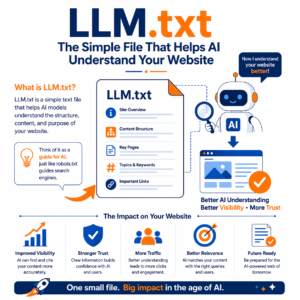
At its core, llm.txt is a proposed standard for a text file that resides in the root directory of a website, similar in placement to the well-known robots.txt or sitemap.xml. Its primary purpose is to provide a clean, Markdown-formatted, and highly compressed version of a website’s most essential information. While a human can easily navigate a website with sidebars, advertisements, and pop-ups, an AI model processing that same page often encounters “noise” that can lead to hallucinations or inefficient token usage.
The llm.txt file serves as a dedicated gateway for AI. It offers a structured roadmap of what the site contains and provides the full text of the most important pages in a format that is ready for immediate ingestion by a context window.
How the LLM.txt Protocol Functions
The mechanism behind llm.txt is elegant in its simplicity. It relies on the existing infrastructure of the web but repurposes it for programmatic efficiency.
1. Centralized Discovery
By placing the file at /llm.txt, a website owner signals to any visiting AI agent that there is a “fast lane” for data acquisition. Instead of the agent having to guess which pages are the most important or spending computational power stripping HTML tags from a complex React-based frontend, the agent simply fetches this single text file.
2. Markdown as the Lingua Franca
The standard mandates the use of Markdown. This is a deliberate choice because Large Language Models are natively proficient at understanding Markdown syntax. Headers, lists, and code blocks in Markdown provide just enough structure for the model to understand the hierarchy of information without the overhead of heavy markup languages.
3. The Use of “H-Level” Hierarchy
In a typical llm.txt file, the structure follows a specific logic:
The primary heading defines the site or the specific project.
The subsequent sections provide brief descriptions of the site’s purpose.
Crucially, it includes a list of links to other text-based resources, often pointing to an
/llm-full.txtor a directory of.txtfiles that contain the actual long-form documentation.
4. Integration with Tool-Use and RAG
When an AI uses a “browser” tool or a “search” tool, it can specifically look for this file. If the file exists, the AI can perform Retrieval-Augmented Generation (RAG) much more accurately. It doesn’t have to worry about accidentally “reading” the text of an advertisement or a “Subscribe to our Newsletter” modal because the llm.txt file contains only the signal, none of the noise.
Why This Standard is Becoming Essential
The internet is currently facing a “signal-to-noise” crisis. Modern web development practices often involve heavy JavaScript, tracking scripts, and complex DOM structures that make “scraping” a fragile and resource-intensive process. For an AI developer, training a model or building an agent that can reliably extract information from a million different bespoke website designs is a massive challenge.
Token Efficiency and Cost
Large Language Models process information in units called tokens. Processing a standard HTML page might require 5,000 tokens due to all the hidden metadata and formatting code. The same information presented in an llm.txt format might only require 500 tokens. For developers paying for API usage, this represents a 90% reduction in cost and a significant increase in speed.
Accuracy and Hallucination Prevention
When a model is fed clean, structured text, the likelihood of it misinterpreting the data drops significantly. If a model has to parse a website where the “Price” of a product is located five divs away from the “Product Name” due to a complex visual layout, it might associate the wrong price with the wrong item. In a dedicated text file, those relationships are explicit and linear.
The Structure of an LLM.txt File
A well-constructed llm.txt file is usually divided into two main parts: the “Brief” and the “Full Documentation.”
The Brief section is what the agent reads first to decide if the site is relevant to the user’s query. It contains a high-level summary and an index of available resources. If the agent determines that the site has the answer, it follows the internal references to the more detailed files.
Furthermore, the proposal often suggests a companion file called llm-full.txt. This is a concatenated version of the entire website’s documentation. While this might seem like a massive file, for a modern LLM with a context window of 128,000 or even 1,000,000 tokens, reading an entire documentation library in one go is not only possible but preferred over making hundreds of individual web requests.
Why is llms.txt Crucial for Your Website?
Implementing this file isn’t just a technical novelty; it is a vital business strategy for the AI era.
Generative Engine Optimization (GEO): Traditional SEO gets you to the top of Google. GEO gets you cited accurately in ChatGPT and Perplexity. By feeding AI clean data, you increase the likelihood of being referenced as an authoritative source in AI responses.
Eliminates AI Hallucinations: When AI models have to guess your product’s capabilities by scraping messy HTML, they often make things up. Giving them a direct
llms.txtmanual ensures they repeat the exact facts, features, and brand messaging you want them to.Protects Server Bandwidth: AI scrapers can be aggressive. Instead of letting a bot recursively click through every random path and tag on your site,
llms.txtgives them everything they need upfront, saving your server from heavy scraping loads.Empowers Developer Tools: If you offer software or APIs, developers using AI coding assistants (like GitHub Copilot or Cursor) rely on these models understanding your documentation. An
llms.txtfile allows these tools to instantly understand your codebase and write correct code for your users.
How to Create and Structure an llms.txt File
Creating the file is entirely free and takes only a few minutes. It requires no complex programming, just basic Markdown formatting.
The Standard Structure
H1 Header (
#): The name of your website or project.Blockquote (
>): A concise, 1-2 sentence summary of what the project/business does.H2 Headers (
##): Categories to organize your paths (e.g., Features, Documentation, Legal).Markdown Syntax (
[Title](URL)): In a live file, this is where you format your paths to the specific pages, optionally followed by a brief description.
Example of an llms.txt File (Links Removed)
# Acme Corp Cloud Solutions

> Acme Corp provides scalable cloud storage and serverless computing solutions for enterprise businesses. This file guides AI agents to our core documentation and services.

## Core Products
- Acme Storage Server: Overview of our S3-compatible storage solutions.
- Acme Compute: Serverless container deployment guide.

## Documentation
- API Reference: Complete list of API endpoints and authentication methods.
- Quickstart Guide: How to deploy your first application in 5 minutes.

## Company Information
- Pricing: Current subscription tiers and enterprise pricing details.
- Support & FAQs: Answers to common troubleshooting questions.
Best Practices for Implementation
Keep it brief: AI models thrive on conciseness. Do not stuff this file with marketing fluff or keyword density. Be direct.
Use Markdown Targets: If your CMS supports it, point the paths in your
llms.txtto markdown versions of your pages (e.g., yoursite.com/about.md instead of just yoursite.com/about).Upload to Root: Save the file strictly as
llms.txtand place it in the root orpublicdirectory of your server so it resolves at yourdomain.com/llms.txt (or occasionally yourdomain.com/.well-known/llms.txt).Treat it as a Living Document: Whenever you launch a major new product, update your pricing, or rewrite your core documentation, update your
llms.txtfile so AI agents always have the freshest data.
Implementation for Webmasters
For a developer or site owner, implementing this standard is a low-effort, high-reward task. It does not require changing the existing user interface for human visitors. It simply involves adding a build step to the website’s deployment pipeline that scrapes its own content, converts it to Markdown, and saves it as a static text file.
This creates a symbiotic relationship between the content creator and the AI. The creator ensures their information is represented accurately in AI responses, and the AI gets to provide high-quality information to the end-user without the technical debt of traditional web scraping.
The Future of the Machine-Readable Web
As we move toward a future where “AI Agents” perform tasks on our behalf—such as booking travel, researching technical specifications, or comparing insurance policies—the llm.txt file will likely become as standard as the favicon. It represents a shift in philosophy: acknowledging that the web is no longer just a visual medium for humans, but a massive database for intelligence. By providing a clean, text-based interface, websites ensure they remain discoverable and useful in the age of generative artificial intelligence.