



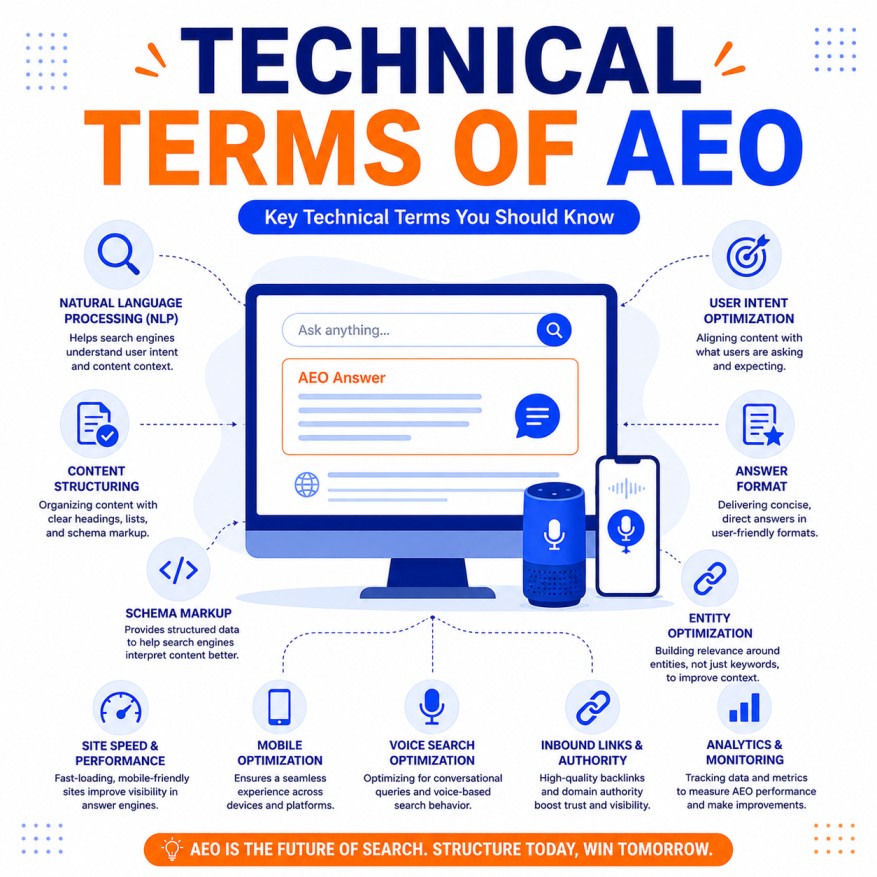
- AEO (Answer Engine Optimization) AEO is the practice of optimizing digital content specifically so that AI-powered answer engines (such as Google AI Overviews, Perplexity, ChatGPT Search, Gemini, and Claude) can easily discover, understand, extract, and cite it as direct answers. Unlike traditional SEO which focuses on ranking in link-based search results, AEO prioritizes being selected as a trusted source for synthesized responses.
- GEO (Generative Engine Optimization) GEO refers to strategies and techniques used to improve visibility, prominence, and citation frequency in generative AI outputs. It involves optimizing content so that AI models not only find it but also prefer it when generating long-form, conversational, or summarized answers.
- AI Overview AI Overview is Google’s generative AI feature that appears at the top of search results. It creates a synthesized summary by combining information from multiple web sources. Optimizing for AI Overviews requires clear, authoritative, and well-structured content that AI can confidently pull from.
- Schema Markup Schema Markup is a form of structured data (usually in JSON-LD format) added to web pages. It helps AI systems understand the context, entities, relationships, and meaning of content. Common types include Article, FAQPage, HowTo, and Person schema.
- E-E-A-T E-E-A-T stands for Experience, Expertise, Authoritativeness, and Trustworthiness. It is a quality framework originally from Google that AI engines now heavily rely on to evaluate whether a source is credible enough to cite in answers, especially for important topics.
- Entity Optimization Entity Optimization involves clearly defining and strengthening mentions of people, organizations, concepts, places, and products in content. This helps AI models accurately recognize and connect these entities across different sources.
- llms.txt llms.txt is a proposed standard file (similar to robots.txt) placed in the root of a website. It provides specific instructions, data summaries, or guidelines to Large Language Models about how they should use or credit the website’s content.
- Conversational Search Conversational Search refers to natural, dialogue-style queries that users type or speak to AI systems (e.g., “Explain quantum computing like I’m 15 years old”). AEO focuses on creating content that matches these question-based, context-aware searches.
- Zero-Click Search Zero-Click Search occurs when users get complete answers directly on the search results page or in AI chat without clicking through to any website. AEO aims to increase the chances of your content being used in these direct answers.
- Featured Snippet Featured Snippet is the direct answer box that appears in traditional Google search results. These snippets are frequently used as source material by AI answer engines, making them important for AEO.
- Knowledge Graph Knowledge Graph is a structured database maintained by search engines that stores information about entities and the relationships between them. Optimizing for it helps AI engines better understand and connect your content to real-world concepts.
- Hallucination Hallucination is when an AI model generates plausible-sounding but factually incorrect or fabricated information. AEO helps reduce this by providing clear, accurate, and well-supported content that AI can reliably reference.
- Intent Mapping Intent Mapping is the process of understanding the underlying user goal behind conversational or complex queries and aligning your content to directly fulfill that intent.
- Citation Frequency Citation Frequency measures how often a particular website, author, or brand is referenced by AI models across various queries on a topic. Higher citation frequency indicates stronger AEO performance.
- Structured Data Structured Data is information organized in a specific format (like tables, lists, or schema) that machines can easily read and interpret, as opposed to unstructured plain text.
- Article Schema (BlogPosting) Article Schema (BlogPosting) is a specific type of schema markup that tells AI engines about the article’s title, author, publication date, images, and content type, improving how it is understood and cited.
- FAQPage Schema FAQPage Schema is structured data used to mark up question-and-answer sections. It makes it easier for AI engines to extract and directly use individual Q&A pairs in their responses.
- BreadcrumbList Schema BreadcrumbList Schema shows the hierarchical structure of a website (e.g., Home > Category > Subcategory > Article). This helps AI understand the topical context and authority of the page.
- Natural Language Processing (NLP) NLP is the AI technology that enables machines to understand, interpret, and generate human language. AEO works by creating content that performs well under advanced NLP analysis.
- Semantic Search Semantic Search focuses on understanding the meaning and context behind queries and content rather than just matching exact keywords. It powers most modern AI answer engines.
- Topical Authority Topical Authority is the perception by AI systems that a website or author has deep, comprehensive knowledge in a specific subject area. It is built through consistent, high-quality coverage of related topics.
- Direct Answer Formatting Direct Answer Formatting involves writing content in clear, concise, scannable formats such as bullet points, numbered lists, tables, and bolded key takeaways so AI can easily extract answers.
- Agentic AEO Agentic AEO refers to using autonomous AI agents to monitor, analyze, and optimize content performance in answer engines automatically.
- AI Crawler AI Crawler is a bot used by AI companies (like OpenAI’s GPTBot, Google’s bots, or Anthropic’s) to crawl and index websites for training or real-time answer generation.
- Prompt Intelligence Prompt Intelligence involves studying common user prompts and questions asked to AI tools and then creating content optimized to appear in responses to those specific prompts.
- YMYL Content YMYL stands for “Your Money or Your Life.” It refers to content related to health, finance, safety, or legal topics that requires especially high E-E-A-T standards for AI citation.
- Entity Recognition Entity Recognition is the AI capability to identify and classify named entities (people, places, organizations, dates, etc.) within text.
- Nested Entities Nested Entities occur when multiple related entities are mentioned within the same phrase or sentence (e.g., “Elon Musk, CEO of xAI, launched Grok”). This helps AI understand complex relationships.
- Chunking Chunking is the process of breaking down large documents, articles, or web pages into smaller, meaningful segments (called chunks) for efficient processing by AI systems. In AEO and RAG pipelines, proper chunking improves retrieval accuracy, context preservation, and the quality of generated answers by ensuring each chunk contains coherent, self-contained information.
- Citation Intelligence Citation Intelligence involves tracking and analyzing which sources AI models prefer to cite for different topics and queries.
- Ask Engine Optimization Ask Engine Optimization is another term for AEO that emphasizes optimizing for direct “asks” or questions in conversational AI interfaces.
- Large Language Model (LLM) LLM is a powerful AI model trained on massive amounts of text data (examples: GPT-4o, Claude 3.5, Gemini 1.5) that powers today’s answer engines.
- Retrieval-Augmented Generation (RAG) RAG is a technique where AI first retrieves relevant information from external sources and then uses it to generate more accurate and up-to-date answers.
- Source Attribution Source Attribution is how AI systems credit or link back to original websites and authors when generating answers.
- Content Freshness Content Freshness refers to how recently content was published or updated. AI engines often prioritize fresher content for time-sensitive topics.
- Author Schema Author Schema is structured data that highlights the author’s name, bio, credentials, and expertise to build trust with AI systems.
- Organization Schema Organization Schema provides structured information about a company, including logo, contact details, social profiles, and founding information.
- Voice Search Optimization Voice Search Optimization prepares content for spoken, natural-language queries used in voice assistants and AI chat interfaces.
- Synthesized Answer Synthesized Answer is a response created by AI by combining and summarizing information from multiple different sources.
- Brand Mention Velocity Brand Mention Velocity measures the speed and frequency at which a brand appears in relevant AI-generated conversations and answers.
- Topical Depth Topical Depth means providing comprehensive coverage of all important subtopics within a main subject to demonstrate authority to AI engines.
- Machine-Readable Content Machine-Readable Content is written and structured in ways that AI systems can easily parse, understand, and extract information from.
- AI Traffic AI Traffic refers to visitors who reach a website either through AI recommendations or by following citations shown in AI answers.
- Prompt Engineering Prompt Engineering is the skill of crafting effective inputs to AI models. It is useful in AEO for testing how different content performs in AI responses.
- Knowledge Panel Knowledge Panel is the rich information box that appears for entities (people, brands, places) in search results. Strong entity optimization helps AI use and display this data.
- Canonical Entity Canonical Entity is the primary, standardized version of a person, brand, or concept that AI systems recognize as the main reference.
- Noise Reduction Noise Reduction in AEO means minimizing conflicting, outdated, or low-quality information around your topic so AI can more confidently cite your content.
- Earned Media in AI Earned Media in AI refers to organic citations and mentions your content receives from AI systems based on its quality and authority.
- Answer Engine Answer Engine is any AI system (chatbot or search feature) that delivers direct synthesized answers instead of traditional lists of links.
- Visibility Tracker Visibility Tracker is a tool or system used to monitor how frequently a website, brand, or content is being cited across different AI answer engines.

Author
Admin
Related Posts
AEO (Answer Engine Optimization) and GEO (Generative Engine Optimization) are becoming important parts of...
Answer Engine Optimization (AEO)—also closely overlapping with Generative Engine Optimization (GEO)—focuses on making your...