
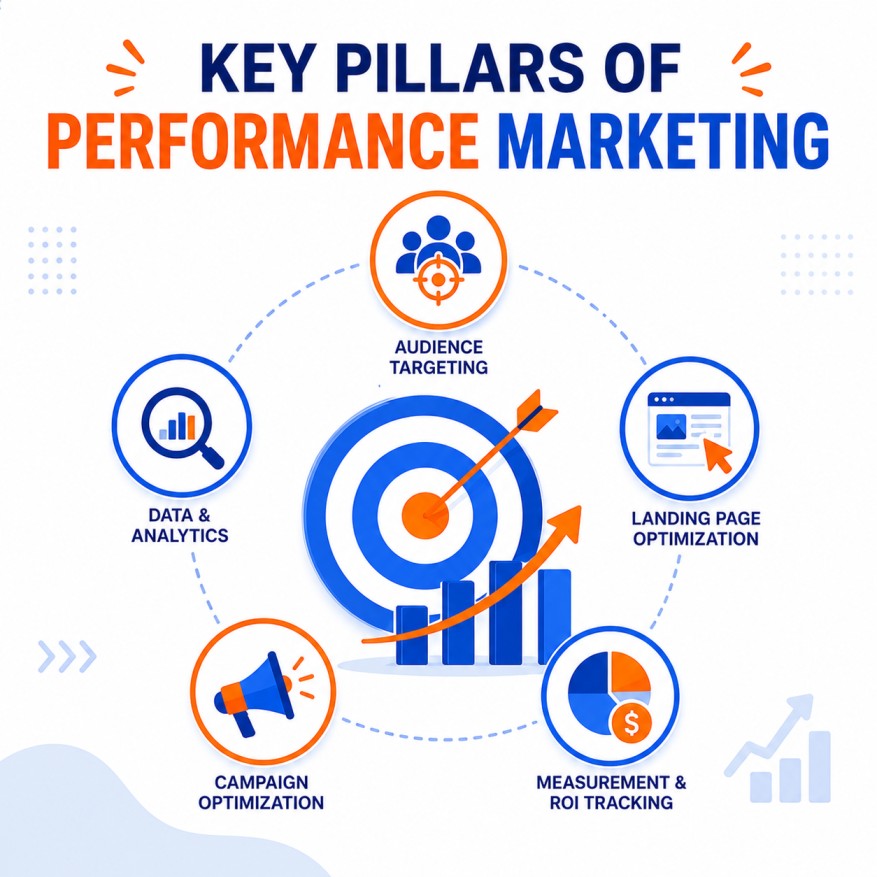
Performance marketing has evolved from a tactical approach into the dominant philosophy of modern digital advertising. Unlike traditional branding campaigns that focus on impressions and awareness, performance marketing is defined by its obsession with measurable results — paying only for specific, trackable outcomes such as leads, sales, sign-ups, or app installs. At its core, success in performance marketing rests on three interconnected pillars: Targeting, Measurement, and Optimization. These pillars form the foundation upon which every high-performing campaign is built.
This exhaustive guide explores each pillar in exceptional depth. We will examine definitions, strategies, tools, real-world applications across industries, advanced techniques for 2026, integration between the pillars, common challenges, and future trends. By the end, you will have a complete strategic framework to build, scale, and sustain profitable performance marketing efforts.
Introduction: Why These Three Pillars Matter
Performance marketing is fundamentally about efficiency and accountability. Every dollar spent must be justified by measurable return. The three pillars work as a continuous cycle:
- Targeting decides who sees your message.
- Measurement tells you what happened and why.
- Optimization improves results over time.
When these pillars are strong and synchronized, campaigns achieve superior ROAS (Return on Ad Spend), lower CPAs (Cost Per Acquisition), and sustainable scalability. In 2026, with rising advertising costs, stricter privacy regulations, and AI-driven platforms, mastering these pillars is no longer optional — it is the difference between profitable growth and wasted budgets.
Pillar 1: Targeting — Reaching the Right Audience at the Right Time
Targeting is the art and science of identifying and reaching individuals most likely to convert. Poor targeting wastes budget on unqualified traffic, while precise targeting dramatically improves efficiency.
Key Components of Effective Targeting
1. Audience Research & Segmentation
- Demographic segmentation (age, gender, location, income)
- Psychographic segmentation (interests, values, lifestyle)
- Behavioral segmentation (past purchases, website activity, engagement level)
- Contextual targeting (content they consume, intent signals)
2. First-Party Data Strategy In the post-cookie era, first-party data has become king. Collect data through:
- Website interactions
- Email sign-ups and CRM
- Loyalty programs
- On-site quizzes and preference centers
3. Advanced Targeting Methods in 2026
- Lookalike Audiences: Expand from high-value customers.
- Custom Audiences: Upload customer lists for retargeting.
- Interest & Intent Audiences: Platforms like Google and Meta use AI to identify in-market users.
- Predictive Audiences: AI models forecast future conversion likelihood.
- Account-Based Targeting (B2B): Target entire companies using firmographics and technographics.
4. Platform-Specific Targeting
- Google Ads: Performance Max uses broad signals + AI optimization.
- Meta Ads: Advantage+ audiences with detailed interest layering.
- Microsoft Ads: Strong LinkedIn-style professional targeting.
- TikTok & Emerging Platforms: Interest-based + behavioral video engagement.
5. Privacy-Compliant Targeting With regulations like GDPR, CCPA, and platform changes (iOS ATT), focus on:
- Consent-based marketing
- Contextual targeting
- Server-side tracking
- Zero-party data (direct feedback from users)
Best Practices for Targeting:
- Start narrow, then expand using lookalikes.
- Layer multiple signals (demographics + behavior + context).
- Use exclusion lists aggressively.
- Test audience segments regularly.
- Align targeting with customer journey stage (awareness vs. conversion).
Pillar 2: Measurement — Knowing Exactly What’s Working
Measurement provides the truth behind every campaign. Without accurate measurement, optimization is guesswork.
Core Measurement Concepts
1. Key Performance Indicators (KPIs)
- Primary: ROAS, CPA, Conversion Rate, Revenue
- Secondary: CTR, View-Through Rate, Engagement Rate
- Advanced: Customer Lifetime Value (CLV), Incremental Lift, Attribution Contribution
2. Attribution Models
- Last-Click (simplest but flawed)
- Multi-Touch Attribution (Linear, Time Decay, Position-Based)
- Data-Driven Attribution (AI-powered)
- Incrementality Testing (geo-lift, PSA tests)
3. Tracking Technologies in 2026
- Server-Side Tracking & Conversions API (Meta, Google)
- Enhanced Conversions
- First-Party Data Hubs
- Unified Measurement Platforms (e.g., Northbeam, Triple Whale)
- Privacy-Safe Modeling (aggregated reporting)
4. Tools & Platforms
- Google Analytics 4 (GA4) + BigQuery
- Platform-native dashboards (Meta Ads Manager, Google Ads)
- Attribution tools: AppsFlyer, Adjust, Branch
- Business Intelligence: Looker, Tableau, Power BI
5. Advanced Measurement Techniques
- Incrementality Testing: Measures true causal impact.
- Media Mix Modeling (MMM): Statistical approach for budget allocation.
- Multi-Touch + Offline Conversion Uploads: Closes the loop for B2B and high-consideration purchases.
- Unified Customer Views: Connecting online and offline journeys.
Challenges in Measurement:
- Cross-device tracking difficulties
- Privacy-induced signal loss
- Platform attribution bias
- Long sales cycles in B2B
Best Practices:
- Implement proper tracking from day one.
- Use multiple attribution models for perspective.
- Run regular incrementality tests.
- Focus on business outcomes, not vanity metrics.
Pillar 3: Optimization — Turning Data into Better Results
Optimization is the continuous process of improving performance based on measurement insights.
Key Areas of Optimization
1. Creative Optimization
- Test multiple ad variations (A/B testing at scale)
- Refresh creatives regularly to combat fatigue
- Use dynamic creative optimization (DCO)
2. Bidding & Budget Optimization
- Smart bidding strategies (Target ROAS, Maximize Conversion Value)
- Dayparting and scheduling
- Budget allocation across campaigns and platforms
3. Audience Optimization
- Refine segments based on performance
- Scale winning audiences
- Suppress low-performers
4. Landing Page & User Experience Optimization
- Message match between ad and landing page
- Speed optimization
- A/B testing of headlines, CTAs, and layouts
- Heatmap and session replay analysis
5. Automation & AI Optimization
- Leverage platform AI (Advantage+, Performance Max)
- Custom rules and scripts
- Predictive optimization tools
Optimization Cadence:
- Daily: Monitor spend and basic metrics
- Weekly: Creative and audience tests
- Monthly: Strategy and budget reallocation
- Quarterly: Full audit and incrementality tests
Scaling Framework:
- Prove product-market fit at small budgets
- Expand winning audiences and creatives
- Diversify platforms and channels
- Build internal optimization playbooks
How the Three Pillars Work Together
The pillars create a virtuous cycle:
- Precise Targeting delivers qualified traffic.
- Accurate Measurement reveals what works.
- Continuous Optimization improves targeting and creative.
- Better results feed back into richer data for stronger targeting.
This flywheel effect compounds over time, creating sustainable competitive advantage.
Industry-Specific Applications
- E-commerce: Heavy focus on dynamic product ads, cart recovery, and ROAS optimization.
- SaaS: Long-cycle nurturing with lead scoring and multi-touch measurement.
- B2B Services: Account-based targeting + offline conversion tracking.
- Local Businesses: Geo-targeting + call tracking optimization.
Tools Ecosystem in 2026
- Ad Platforms: Google Ads, Meta, Microsoft Ads, TikTok Ads
- Analytics: GA4, Mixpanel, Amplitude
- Optimization: Optimizely, VWO, Google Optimize successors
- Attribution: Northbeam, Rockerbox
- Creative: AdCreative.ai, Pencil
Common Challenges & Solutions
- Data Fragmentation: Solution — Unified measurement platforms.
- Rising Costs: Solution — Strong optimization and audience refinement.
- Privacy Constraints: Solution — First-party data focus and modeled conversions.
- Algorithm Changes: Solution — Diversify platforms and maintain manual control options.
Future Trends (2026–2030)
- Agentic AI managing entire campaigns autonomously.
- Real-time optimization at individual user level.
- Greater emphasis on creative intelligence and emotional targeting.
- Privacy-first measurement standards.
- Integration of performance marketing with community and creator economies.
Conclusion: Master the Pillars for Sustainable Success
The three pillars — Targeting, Measurement, and Optimization — are not separate activities but interdependent elements of a high-performance system. Brands that invest in strengthening all three consistently outperform those that focus on only one or two.
Action Plan to Strengthen Your Performance Marketing:
- Audit your current targeting precision.
- Evaluate measurement accuracy and attribution setup.
- Establish a regular optimization cadence.
- Build cross-functional teams that own the full cycle.
- Test, learn, and scale relentlessly.
In 2026 and beyond, performance marketing is no longer just about running ads — it is about building intelligent, data-driven growth engines. Master Targeting to reach the right people, Measurement to understand reality, and Optimization to continuously improve. Do this well, and you will achieve not just better campaigns, but a more efficient, scalable, and profitable business

Author