Lookalike Audiences (also known as Similar Audiences or Custom Lookalikes) are one of the most powerful targeting tools in digital advertising. They allow marketers to expand their reach by finding new users who behave similarly to their existing high-value customers, website visitors, email subscribers, or app users. When created and scaled correctly, Lookalike Audiences can dramatically improve campaign efficiency, lower acquisition costs, and drive sustainable growth.
This exhaustive, highly detailed guide covers everything you need to master Lookalike Audiences. It includes creation methods, platform-specific strategies, scaling frameworks, advanced techniques, measurement approaches, common pitfalls, real-world examples, and optimization playbooks — all structured with extensive bullet points for maximum clarity and actionability.
1. Understanding Lookalike Audiences: The Foundation
What Are Lookalike Audiences?
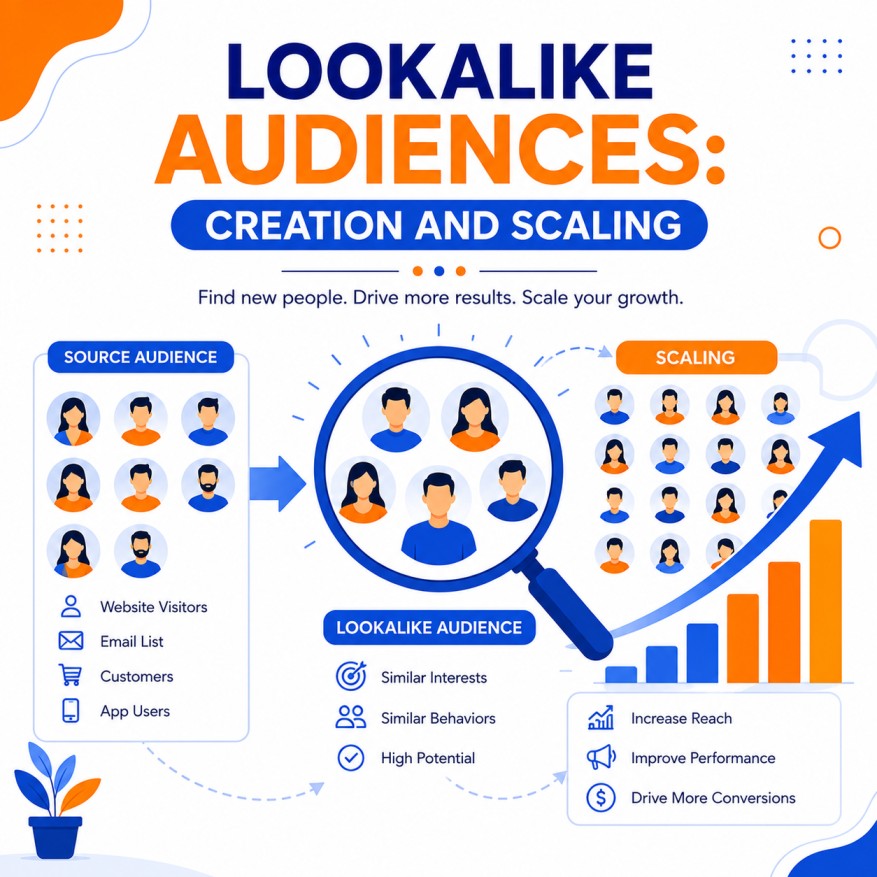
- Algorithmically generated audiences that share characteristics with your “seed” or source audience.
- Platforms use machine learning to find statistical similarities in behavior, demographics, interests, and online activity.
- They bridge the gap between precise but small custom audiences and broad but inefficient targeting.
Why Lookalikes Are Powerful:
- Expand reach while maintaining relevance and quality.
- Often deliver better ROAS than broad or interest-based targeting.
- Enable efficient scaling without proportionally increasing costs.
- Work exceptionally well across Meta, Google, TikTok, and other major platforms.
- Leverage first-party data in a privacy-conscious way.
Key Benefits of look-a-like Audience:
- Combat rising ad costs and audience fragmentation.
- Support full-funnel strategies (awareness to conversion).
- Provide a strong foundation for AI-driven campaign optimization.
- Enable testing and scaling of new offers or products.
2. Choosing the Right Seed Audience for Lookalikes
Best Seed Audiences (Ranked by Performance):
- High-value customers (e.g., repeat buyers, high LTV).
- Recent purchasers (strong intent signal).
- Website visitors who completed key actions (add to cart, started checkout).
- Email subscribers or CRM lists (especially engaged or converted users).
- Video viewers or landing page engagers.
- App users with specific in-app behaviors.
Seed Audience Best Practices:
- Use audiences with at least 100–500 high-quality members (larger is better).
- Choose audiences with clear positive outcomes (purchases, sign-ups, high engagement).
- Exclude low-quality segments (one-time buyers who churned, spam accounts).
- Create multiple seed audiences for different Lookalike tests.
- Refresh seed audiences regularly for best results.
3. Creating Lookalike Audiences: Platform-Specific Guides
Meta (Facebook/Instagram) Lookalikes:
- Go to Ads Manager → Audiences → Create Audience → Lookalike Audience.
- Select source audience (custom or value-based).
- Choose percentage (1% is most similar, 10% is broader).
- Select country or region for expansion.
- Name clearly and save.
Google Ads Similar Audiences:
- Use Customer Match lists or website remarketing lists as seeds.
- Google automatically creates Similar Audiences.
- Combine with in-market and affinity audiences for layering.
TikTok Lookalike Audiences:
- Upload customer lists or use engagement-based seeds.
- Adjust similarity percentage and targeting settings.
Other Platforms:
- Microsoft Ads, Pinterest, Snapchat, and LinkedIn all offer similar features with slight variations.
General Creation Tips:
- Start with 1% Lookalikes for highest similarity.
- Test multiple percentages (1%, 2%, 5%, 10%) in parallel.
- Use value-based Lookalikes when possible (Meta’s Value optimization).
- Name Lookalikes clearly (e.g., “LAL-1% High LTV Customers US”).
4. Scaling Lookalike Audiences: From Testing to High-Volume Growth
The Scaling Framework:
- Phase 1 (Testing): Small budget on 1% Lookalikes with strong creatives.
- Phase 2 (Validation): Increase budget gradually while monitoring ROAS.
- Phase 3 (Expansion): Add higher percentage Lookalikes and layer with other targeting.
- Phase 4 (Optimization): Combine multiple Lookalikes and automate distribution.
Budget Scaling Tactics:
- Increase budget by 20–30% every 3–7 days on winning Lookalikes.
- Duplicate successful ad sets and gradually shift spend.
- Use Campaign Budget Optimization (CBO) for efficient distribution.
- Set separate budgets for different Lookalike percentages.
Audience Expansion Strategies:
- Layer Lookalikes with interest or behavior targeting.
- Create Lookalikes from different seed sources and combine them.
- Use exclusion audiences to protect core profitable segments.
- Expand geographically once domestic Lookalikes are optimized.
Creative Scaling:
- Test multiple creative variations with Lookalikes.
- Refresh creatives regularly to combat fatigue.
- Use dynamic creative optimization where available.
5. Advanced Lookalike Audience Techniques
Value-Based Lookalikes:
- Upload customer lifetime value data to create revenue-optimized audiences.
- Particularly powerful on Meta for e-commerce and subscription businesses.
Multi-Platform Lookalike Strategies:
- Create similar audiences across Meta, Google, TikTok, and Microsoft.
- Use cross-platform data for more robust seed audiences.
Lookalike Layering:
- Combine 1% Lookalikes with broad targeting or interest signals.
- Use sequential layering (move users from cold Lookalikes to warmer retargeting).
Seasonal and Event-Based Lookalikes:
- Create temporary Lookalikes around peak seasons or events.
- Refresh seed audiences during high-conversion periods.
6. Measurement and Optimization of Lookalike Audiences
Key Metrics to Track:
- ROAS and CPA compared to other audiences.
- Scale efficiency (how much spend maintains target ROAS).
- Audience overlap and cannibalization.
- Creative fatigue indicators.
- Conversion quality (LTV of acquired customers).
Optimization Playbook:
- Pause underperforming Lookalikes quickly.
- Double down on top performers with increased budget.
- Regularly refresh seed audiences.
- Test different similarity percentages.
- Monitor frequency and ad fatigue.
7. Common Pitfalls and How to Avoid Them
- Using poor-quality seed audiences → Solution: Choose only high-value sources.
- Scaling too aggressively → Solution: Gradual budget increases.
- Ignoring creative refresh → Solution: Regular testing and rotation.
- Not monitoring overlap → Solution: Use exclusion lists.
- Over-reliance on one platform → Solution: Diversify Lookalike strategies.
8. Tools and Platforms for Lookalike Management
- Meta Ads Manager (native Lookalikes).
- Google Ads (Similar Audiences).
- TikTok Ads, Microsoft Ads, and others.
- Third-party tools like Revealbot or Madgicx for automation.
- CRM systems for better seed audience creation.
9. Future Trends in Lookalike Audiences
- Deeper AI personalization and predictive lookalikes.
- Greater use of first-party and zero-party data.
- Cross-platform unified lookalike systems.
- Privacy-compliant modeling for audience expansion.
- Integration with conversational commerce and community signals.
10. Your 90-Day Lookalike Audience Action Plan
Month 1: Build high-quality seed audiences and create initial 1% Lookalikes. Month 2: Test performance, optimize creatives, and begin controlled scaling. Month 3: Expand to multiple percentages and platforms while refining based on data.
Conclusion: Lookalike Audiences as a Growth Superpower
Lookalike Audiences remain one of the most effective ways to scale advertising efficiently while maintaining relevance and performance. By focusing on quality seed audiences, methodical testing, gradual scaling, and continuous optimization, you can build a powerful acquisition engine that delivers sustainable growth.
Master the creation and scaling of Lookalike Audiences, and you’ll unlock one of the highest-leverage tools in performance marketing. Start today by auditing your seed audiences and launching your first set of Lookalikes. The results will compound over time.