
In the dynamic landscape of Google Ads, two powerful campaign types stand out for performance marketers: Performance Max (PMax) and Demand Gen. Both leverage Google’s vast inventory and advanced AI, yet they serve fundamentally different purposes in the customer journey. Misunderstanding their differences can lead to wasted budgets, poor ROAS, or suboptimal funnel performance. Performance Max excels at capturing and converting existing or high-intent demand across all Google channels, while Demand Gen focuses on creating new demand through visually engaging, awareness-driven ads primarily on discovery-oriented surfaces.
This exhaustive guide provides a deep, detailed comparison. We’ll define each campaign type, trace their evolution, break down key differences across goals, placements, targeting, automation, creatives, reporting, and more. We’ll explore real-world use cases across industries, integration strategies with other channels (such as SEO, remarketing, heatmaps, newsletters, and influencer content), optimization tactics for 2026, common pitfalls, case study patterns, and future trends. By the end, you’ll have a complete playbook to choose the right campaign — or combine both — for maximum growth.
Defining Performance Max and Demand Gen
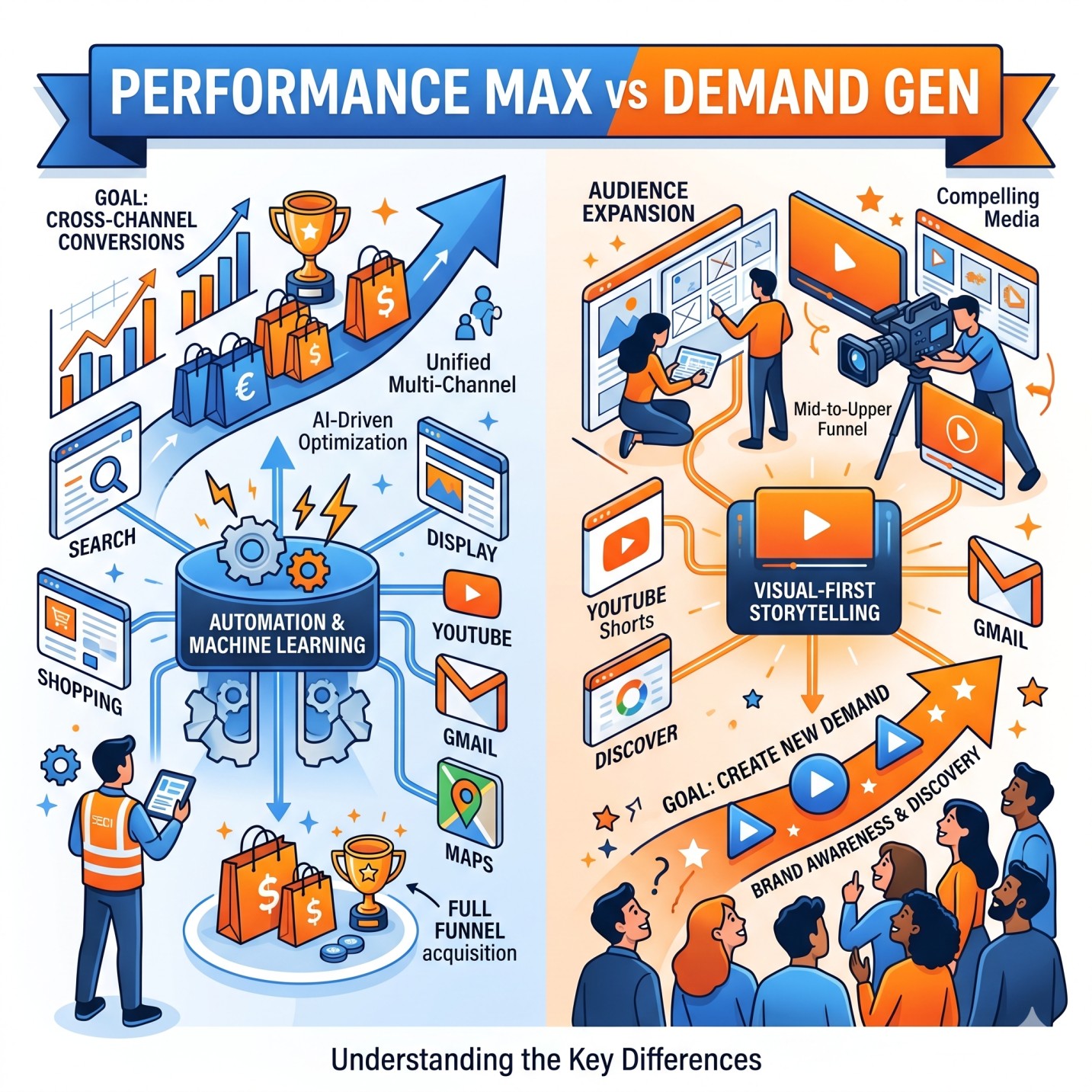
What Is Performance Max (PMax)? Performance Max is Google’s fully automated, goal-based campaign type that uses machine learning to optimize across all Google advertising channels simultaneously. Advertisers provide creative assets (headlines, images, videos, logos), set conversion goals (purchases, leads, revenue), and supply audience signals or data feeds (e.g., product feeds for e-commerce). Google’s AI then decides the best placements, bidding, audience targeting, and even creative combinations to maximize results. It spans Search, Shopping, Display, YouTube, Gmail, Discover, Maps, and more. PMax is designed for efficiency and scale, especially when you have strong conversion data.
What Is Demand Gen? Demand Gen (evolved from Discovery campaigns) is a campaign type focused on generating demand through immersive, visual advertising. It primarily targets YouTube (including Shorts), Discover, Gmail, and select video partners. It emphasizes brand awareness, consideration, and sparking interest among new or broader audiences. While it can drive some conversions, its strength lies in top- and mid-funnel engagement with high-impact creatives like videos, carousels, and single images. Demand Gen offers more manual controls over targeting and placements compared to PMax.
In simple terms:
- PMax = Capture and convert demand efficiently across the full funnel using maximum automation.
- Demand Gen = Create and nurture new demand with visual storytelling and greater advertiser control.
The Evolution of Both Campaign Types
Performance Max launched in 2021 as a successor to Smart Shopping and Local campaigns, quickly becoming a cornerstone for e-commerce and lead-gen advertisers due to its broad reach and AI power. By 2026, it has matured with enhanced asset groups, better video support (up to 15 videos per group in some updates), New Customer Acquisition goals, and tighter integration with first-party data and server-side tracking.
Demand Gen evolved from the older Discovery Ads format around 2022–2023. It was refined to compete with social platforms like Meta by offering scroll-stopping, feed-style experiences. In 2026, it includes improved New Customer Acquisition goals, better creative previews, and stronger reporting on view-through conversions (VTC). Both have adapted to privacy changes, relying more on first-party data, enhanced conversions, and modeled attribution.
Today, they are not direct replacements but complementary tools. Many sophisticated advertisers run Demand Gen to fill the top of the funnel and PMax to convert at the bottom.
Key Differences: A Detailed Side-by-Side Comparison
Here is a comprehensive breakdown:
- Primary Goal and Funnel Stage
- Performance Max: Full-funnel optimization with a strong emphasis on bottom-funnel conversions (purchases, leads, revenue). It targets every stage but excels at finding ready-to-buy users.
- Demand Gen: Top- and mid-funnel focus — awareness, interest, and consideration. It sparks curiosity and builds demand, especially for new audiences or brand storytelling.
- Placements and Reach
- Performance Max: All Google channels — Search, Shopping, YouTube, Display, Gmail, Discover, Maps, and more. This gives massive scale and inventory coverage.
- Demand Gen: Primarily YouTube (including Shorts), Discover, Gmail, and Google video partners. More focused on discovery and feed-style surfaces, avoiding direct Search/Shopping dominance.
- Level of Automation vs. Control
- Performance Max: Highly automated. Google’s AI handles bidding, placements, audience selection, and creative mixing with minimal manual intervention. You provide signals (not strict targeting).
- Demand Gen: More manual control. Advertisers can set precise audience targeting, exclusions, placements, and creative strategies. Less “black box” than PMax.
- Targeting Approach
- Performance Max: Audience signals (hints for AI), customer lists, lookalikes, and first-party data. No strict audience targeting — the algorithm finds optimal users.
- Demand Gen: Granular audience targeting options, including custom segments, lookalikes, and manual selections/exclusions. Better for intentional reach.
- Ad Formats and Creatives
- Performance Max: Mix of text, images, videos, and shopping assets. AI can combine them dynamically. Strong for product-focused or conversion-oriented creatives.
- Demand Gen: Visually rich formats — single images, carousels, videos, and immersive storytelling. Optimized for engagement on YouTube and Discover feeds.
- Bidding and Optimization
- Both support conversions and conversion value bidding.
- Performance Max: Heavily optimized for your chosen goal (e.g., Target ROAS). Requires solid conversion tracking to perform well.
- Demand Gen: Can use upper-funnel signals or view-through metrics. More flexible for awareness goals but may need conversion points to optimize fully.
- Reporting and Insights
- Performance Max: Less granular reporting. Insights are aggregated; placement-level or audience-level details are limited.
- Demand Gen: More detailed reporting on placements, audience performance, and creative engagement. Better for analysis and iteration.
- Conversion Requirements
- Performance Max: Needs strong conversion data to learn and scale effectively. Without it, performance can suffer.
- Demand Gen: Can run with weaker or upper-funnel conversions but benefits from eventual conversion tracking.
Use Cases Across Industries
E-commerce and D2C Brands
- PMax: Drive direct sales, promote product catalogs via Shopping integration, recover cart abandoners, and scale revenue with dynamic creatives.
- Demand Gen: Launch new collections, build brand awareness through lifestyle videos, or introduce products to new audiences via YouTube Shorts and Discover.
SaaS and Lead Generation
- PMax: Maximize demo bookings, sign-ups, or free trials with full-funnel optimization.
- Demand Gen: Educate and nurture with thought-leadership videos or webinars promotions to fill the top of the funnel.
Fashion, Beauty, and Lifestyle
- Demand Gen shines with high-visual creatives (try-on videos, influencer-style content).
- PMax handles retargeting and direct sales across channels.
Local Businesses or Services
- PMax for appointment bookings or store visits via Maps integration.
- Demand Gen for community awareness or event promotions.
B2B
- Demand Gen for long-cycle nurturing; PMax for capturing bottom-funnel intent.
How Performance Max and Demand Gen Work Together
The smartest strategies combine both:
- Use Demand Gen to create awareness and move users into mid-funnel (build audiences, improve brand recall).
- Feed that intent into PMax for efficient conversion capture.
This full-funnel approach reduces overlap waste, improves lead quality, and leverages attribution more accurately. Sync audiences (e.g., Demand Gen engagers into PMax signals) and use unified measurement tools.
Integration with Other Marketing Channels
- With SEO and Heatmaps: Use Demand Gen insights on engagement to inform on-page optimizations (e.g., content that resonates in videos). PMax benefits from better site experiences revealed by heatmaps.
- With Remarketing: Layer both for retargeting — Demand Gen for warm re-engagement with visuals, PMax for high-intent recovery.
- With Newsletters and Email Campaigns: Promote newsletter sign-ups via Demand Gen for awareness, then use PMax to drive conversions from engaged subscribers.
- With Influencer Content: Amplify influencer videos in Demand Gen for authentic reach, then drive traffic to optimized landing pages tracked in PMax.
- With Cart Abandonment Strategies: PMax excels at recovering abandonments across channels.
Optimization Strategies for 2026
For Performance Max:
- Provide high-quality, diverse assets (including more videos).
- Use strong first-party data and enhanced conversions.
- Set clear goals and value tracking.
- Monitor asset performance and exclude underperformers.
- Combine with New Customer Acquisition goals.
For Demand Gen:
- Focus on scroll-stopping, high-production creatives.
- Leverage granular targeting and A/B test placements.
- Optimize for view-through and engagement metrics.
- Use creative previews to ensure quality.
General Tips: Test both in parallel with proper budget allocation. Use incrementality testing. Maintain privacy-compliant tracking. Rotate creatives frequently to combat fatigue.
Real-World Case Study Patterns
Advertisers commonly report:
- Demand Gen delivering stronger brand lift and lower-funnel influence when used for awareness.
- PMax providing higher direct ROAS and volume when conversion data is mature.
- Combined campaigns yielding better overall efficiency — Demand Gen warms audiences, PMax converts them at lower CPA.
- Visual-heavy brands (fashion, beauty) seeing Demand Gen outperform for engagement, while transaction-focused e-commerce favors PMax for scale.
Here is a clear, detailed, and side-by-side comparison table highlighting the key differences between Google Ads Performance Max (PMax) and Demand Gen campaigns. This table is designed for quick reference while remaining comprehensive for performance marketers, e-commerce teams, and digital advertisers.
| Aspect | Performance Max (PMax) | Demand Gen |
|---|---|---|
| Primary Goal | Capture and convert existing/high-intent demand across the full funnel. Focus on conversions and revenue. | Create and generate new demand. Focus on awareness, interest, and consideration (top and mid-funnel). |
| Funnel Stage | Full-funnel optimization with strongest performance at bottom-funnel (purchases, leads, sign-ups). | Primarily top and mid-funnel (awareness & consideration). Can support some conversions. |
| Main Placements | All Google channels: Search, Shopping, Display, YouTube, Gmail, Discover, Maps, and more. | Focused on discovery surfaces: YouTube (including Shorts), Discover, Gmail, and Google video partners. |
| Level of Automation | Extremely high. Google’s AI controls bidding, placements, audience selection, and creative mixing. | Moderate to high automation, but offers more manual control than PMax. |
| Advertiser Control | Low manual control. You provide assets and signals; AI decides most elements. | Higher control over targeting, placements, exclusions, and creative strategy. |
| Targeting Approach | Audience signals (hints only), customer lists, lookalikes, first-party data. No strict targeting. | Granular audience targeting: custom segments, lookalikes, interests, and precise exclusions. |
| Ad Formats & Creatives | Mix of text, images, videos, logos, and shopping assets. AI dynamically combines them. | Visually rich formats: single images, carousels, immersive videos, and storytelling creatives. |
| Creative Emphasis | Performance-oriented (product-focused, conversion-driven). Dynamic asset groups. | Engagement and brand storytelling. Scroll-stopping visual content optimized for feeds. |
| Bidding & Optimization | Heavily optimized for conversion value or conversions (Target ROAS, Maximize Conversions). Requires strong conversion data. | Supports conversions but also optimized for upper-funnel signals and view-through conversions. |
| Conversion Requirements | Needs robust conversion tracking and data for effective learning. Performs best with mature tracking. | Can run effectively with weaker conversion data; benefits from view-through and engagement metrics. |
| Reporting & Insights | Aggregated and limited granularity. Placement-level and audience details are restricted. | More detailed reporting on placements, audience performance, creative engagement, and VTC. |
| Best For | Scaling revenue, e-commerce sales, lead generation, cart recovery, and full-funnel efficiency. | Brand awareness, new product launches, visual storytelling, reaching new audiences, and building demand. |
| Audience Reach | Broadest possible reach across Google’s entire inventory using AI. | Targeted reach on discovery and video surfaces, ideal for intentional audience building. |
| New Customer Acquisition | Strong support with dedicated New Customer Acquisition goal and value rules. | Good support for acquiring new customers through visual discovery campaigns. |
| Typical ROAS Focus | High direct ROAS and conversion volume. | Often focuses on brand lift, engagement, and lower-funnel influence rather than immediate ROAS. |
| Creative Volume Needed | High volume and variety of assets (headlines, descriptions, images, videos). | Fewer but higher-quality, visually compelling creatives. |
| Ad Fatigue Risk | Moderate (AI rotates assets automatically). | Higher if creatives are not refreshed regularly due to visual feed nature. |
| Integration Strength | Excellent with Shopping feeds, remarketing, and CRM data. | Strong with influencer content, video assets, and visual campaigns. |
| Learning Phase Duration | Longer learning phase (needs sufficient data). | Relatively shorter learning phase. |
| Best Use Case Examples | E-commerce product sales, abandoned cart recovery, lead generation at scale, repeat purchases. | New collection launches, brand storytelling videos, awareness for SaaS tools, fashion/beauty campaigns. |
| Recommended Budget Split | Often 60-80% of Google Ads budget for conversion-focused advertisers. | 20-40% for top-funnel demand creation. |
| Privacy & Tracking | Relies heavily on enhanced conversions and first-party data. | Also benefits from first-party data but can use more view-based signals. |
Common Challenges and How to Overcome Them
- Lack of Transparency in PMax: Solution — Supplement with external analytics and incrementality tests.
- Demand Gen Not Converting Enough: Solution — Set appropriate upper-funnel goals and nurture paths.
- Budget Overlap/Waste: Solution — Use audience exclusions and clear role assignment (awareness vs. conversion).
- Creative Burnout: Solution — Regularly refresh assets, especially in visual-heavy Demand Gen.
- Learning Phase Issues: Solution — Start with sufficient budget and quality data.
The Future of Performance Max and Demand Gen (2026+)
In 2026 and beyond, expect deeper AI integration, better cross-campaign attribution, and tighter alignment with privacy tools. New Customer Acquisition features will expand. As video and immersive formats grow, Demand Gen may evolve further toward social-like experiences, while PMax becomes even more predictive. Brands that master the combination — creating demand intelligently and capturing it efficiently — will dominate.
Conclusion: Choose Wisely and Use Both Strategically
Performance Max and Demand Gen are not competitors but powerful allies in a modern Google Ads strategy. PMax offers unmatched scale, automation, and conversion power across the entire Google ecosystem. Demand Gen provides creative control, visual impact, and the ability to spark new demand at the top of the funnel.
Audit your current goals: If you need volume and conversions with minimal management, lean on PMax. If you want to build awareness, test visuals, or control targeting for brand storytelling, choose Demand Gen. For sustainable growth, integrate both into a full-funnel system.
Start today by reviewing your conversion tracking, creative assets, and audience data. Test small budgets on each type, measure holistically, and scale what delivers the best incremental results. In 2026’s AI-driven advertising world, the winners won’t rely on one campaign type — they’ll orchestrate Demand Gen to inspire and Performance Max to deliver.
Master the differences, align them with your business objectives, and watch your Google Ads performance reach new heights. The tools are here; the strategy is in your hands.

Author