
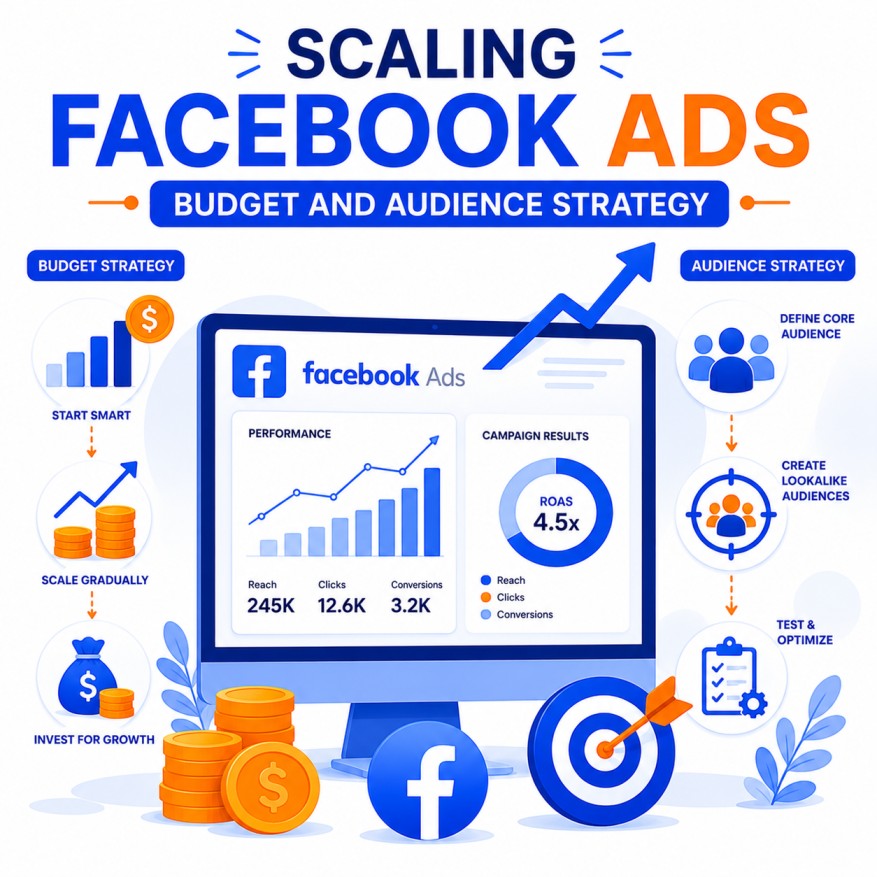
Scaling Facebook Ads (now Meta Ads) is one of the most critical and challenging phases in performance marketing. Moving from a small, profitable campaign to a high-volume, sustainable growth engine requires a sophisticated blend of budget scaling and audience scaling. Done incorrectly, scaling can destroy profitability, burn through budgets, and lead to account restrictions. Done correctly, it can multiply revenue 5–20x while maintaining or even improving ROAS.
This exhaustive, in-depth guide provides a complete playbook for scaling Facebook Ads. It focuses heavily on budget and audience strategies, with extensive bullet points, real-world tactics, frameworks, testing methodologies, tools, common pitfalls, and advanced techniques tailored for e-commerce, D2C, SaaS, lead generation, and service-based businesses.
1. Understanding Scaling in Facebook Ads
Scaling means systematically increasing ad spend while maintaining or improving efficiency (ROAS, CPA, conversion rate).
Types of Scaling:
- Horizontal Scaling: Expanding reach by adding new audiences, geographies, or products.
- Vertical Scaling: Increasing budget on already profitable campaigns/audiences.
- Hybrid Scaling: Combining both approaches.
Key Principles Before Scaling:
- Achieve consistent profitability at small budgets (minimum 7–14 days of stable data).
- Have clear KPIs (Target ROAS, CPA, MER — Marketing Efficiency Ratio).
- Strong creative fatigue management systems in place.
- Robust tracking (Conversions API + Enhanced Conversions).
- Clear offer and landing page optimization already validated.
2. Budget Scaling Strategies: How to Increase Spend Safely
Core Budget Scaling Rules:
- Never increase budget by more than 20–30% every 3–7 days.
- Scale only when ROAS is stable and above target for at least 3–5 days.
- Monitor Learning Phase — avoid major changes during it.
- Use Campaign Budget Optimization (CBO) or Advantage+ Campaign Budget wisely.
Detailed Budget Scaling Tactics:
- The 20% Rule: Increase daily budget by no more than 20% every 48–72 hours on winning ad sets.
- The Doubling Method: Once stable, duplicate the campaign/ad set and gradually shift budget to the new one.
- Seasonal Budget Pacing: Allocate more budget during high-conversion periods (evenings, weekends, holidays).
- Dayparting & Scheduling: Scale budget during peak performance hours and reduce during low periods.
- Portfolio Budget Approach: Set a high-level budget across multiple campaigns and let Meta’s AI distribute.
- New Customer Acquisition (NCA) Budgets: Separate budgets for cold traffic vs retargeting to protect profitability.
- Scaling by Creative: Duplicate ad sets with fresh creatives and gradually increase budget as they prove themselves.
- Geographic Budget Scaling: Test and scale into new countries or regions one at a time.
- Product-Line Scaling: Allocate separate budgets per product category or funnel stage.
Advanced Budget Techniques:
- Use Advantage+ Shopping Campaigns for automated budget distribution.
- Implement Value Optimization bidding with accurate purchase value tracking.
- Leverage Dynamic Budget Rules based on ROAS thresholds.
- Run Incrementality Tests (geo-holdouts, PSA tests) before large budget increases.
3. Audience Scaling Strategies: Expanding Without Losing Quality
Audience scaling is often more important than budget scaling. Poor audience expansion kills ROAS faster than anything else.
Core Audience Scaling Principles:
- Start with warm audiences (retargeting, customer lists).
- Expand to lookalikes and interest-based audiences gradually.
- Use layered targeting (demographics + interests + behaviors).
- Always maintain exclusions (recent purchasers, low-quality segments).
Detailed Audience Scaling Tactics:
- Retargeting Layering: Scale from 1% to 5% to 10% lookalikes of high-value customers.
- Interest Stacking: Combine multiple relevant interests while monitoring overlap.
- Broad Targeting with Advantage+: Let Meta’s AI find audiences using minimal signals (highly effective).
- Custom Audience Expansion: Upload CRM lists and create 1–10% lookalikes.
- Behavioral Scaling: Target “Engaged Shoppers”, “High Value”, or “Frequent Purchasers” segments.
- Competitor Audience Targeting: Use interest-based targeting around competitor brands or categories.
- Life Event & Demographic Scaling: Target recent life events (new parents, job changers) where relevant.
- Geographic Scaling: Expand city-by-city or country-by-country with localized creatives.
Advanced Audience Strategies:
- Create Audience Pools segmented by purchase history, LTV, or engagement level.
- Use Exclusion Audiences aggressively to protect core profitable segments.
- Implement Sequential Audiences: Move users from cold → warm → hot audiences automatically.
- Leverage Advantage+ Audience with suggested custom audiences for better AI performance.
- Test Interest vs Broad in parallel and let data decide winners.
4. Integrating Budget and Audience Scaling
The most successful scaling combines both pillars:
- Scale budget on proven audiences first.
- Once stable, introduce new audiences at lower budgets.
- Use a “Test → Scale → Stabilize → Expand” loop.
- Maintain a 60/30/10 split: 60% on proven audiences, 30% on expanding lookalikes, 10% on experimental audiences.
- Monitor Frequency — keep it under 3–4 for cold audiences to avoid fatigue.
- Balance Creative Refresh Rate with audience expansion.
5. Creative and Offer Strategy During Scaling
Scaling fails without strong creatives and offers:
- Maintain a creative testing budget (15–20% of total spend).
- Use Dynamic Creative Optimization (DCO) at scale.
- Refresh creatives every 7–14 days.
- Test UGC-style creatives heavily — they often scale better.
- Offer testing: Bundles, urgency, scarcity, guarantees, bonuses.
6. Measurement, Attribution & Safety Nets for Scaling
- Implement Conversions API + Enhanced Conversions religiously.
- Track Incremental ROAS through lift studies.
- Set up Automated Rules for pausing underperformers.
- Monitor Learning Limited status and avoid scaling during it.
- Use Triple Whale, Northbeam, or Elevar for unified attribution.
- Set clear Kill Criteria (e.g., if ROAS drops below X for 3 days, reduce budget 50%).
7. Common Scaling Pitfalls and How to Avoid Them
- Increasing budget too fast → Solution: Gradual 20–30% increases.
- Expanding audiences too broadly → Solution: Layered testing and exclusions.
- Ignoring creative fatigue → Solution: Regular refreshes and testing.
- Scaling during Learning Phase → Solution: Wait for stable data.
- Neglecting mobile experience → Solution: Test all creatives on mobile first.
- Poor landing page alignment → Solution: Perfect message match.
8. Advanced Scaling Frameworks
- The Tiered Scaling Model: Tier 1 (Proven), Tier 2 (Expansion), Tier 3 (Experimental).
- The 3x Rule: Only scale when you have 3x the data needed to feel confident.
- Portfolio Approach: Run multiple campaigns with different objectives and audiences.
- Seasonal Scaling Playbooks: Pre-planned budget ramps for Black Friday, holidays, etc.
- AI-Driven Scaling: Leverage Meta’s Advantage+ features with human oversight.
9. Tools and Automation for Scaling
- Meta Ads Manager + Advantage+ suite
- AdCreative.ai or Pencil for creative generation
- Revealbot or Madgicx for automation rules
- Triple Whale / Northbeam for unified analytics
- Zapier / Make for cross-platform workflows
10. Future Trends in Facebook Ads Scaling
- Greater reliance on AI automation (Advantage+ everything).
- Privacy-first scaling with first-party data and modeling.
- Video-first and UGC dominance.
- Deeper integration with commerce (Advantage+ Shopping).
- Cross-platform scaling (Meta + TikTok + YouTube).
Final Action Plan: Your Scaling Roadmap
Phase 1 (Foundation): Achieve stable profitability at current budget. Phase 2 (Testing): Test new audiences and creatives at 10–20% of budget. Phase 3 (Controlled Scaling): Gradually increase budget on winners. Phase 4 (Aggressive Scaling): Expand to new geographies, products, and creative formats. Ongoing: Weekly reviews, creative refreshes, and incrementality testing.
Scaling Facebook Ads successfully both an art and a science. Master the balance between aggressive growth and disciplined data-driven decisions. Focus on audience quality first, then scale budget intelligently while keeping creative fresh and offers compelling.
The brands winning at scale treat Facebook Ads as a sophisticated growth system — not a simple traffic source. Implement the strategies in this guide, stay patient during testing phases, and scale with confidence.

Author