
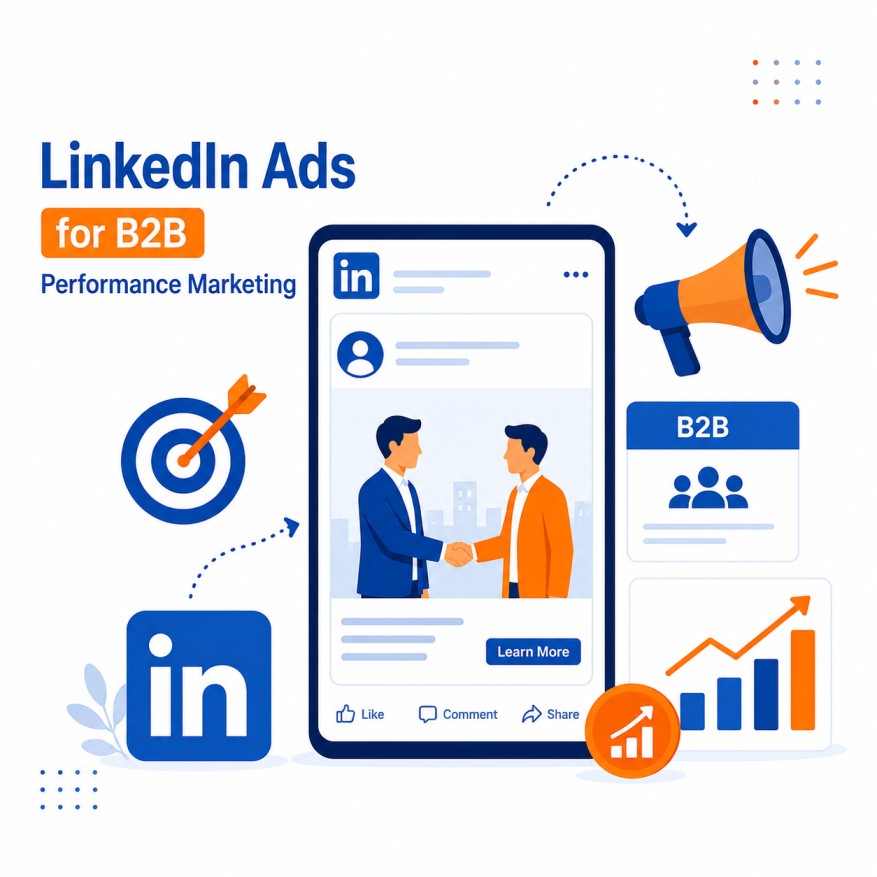
LinkedIn Ads remain one of the most powerful—and most expensive—channels for B2B performance marketing in 2026. No other major paid platform offers comparable precision in reaching professionals by job title, seniority, company size, industry, skills, and account lists. For companies selling to mid-market and enterprise buyers with meaningful deal sizes, LinkedIn frequently delivers higher-quality leads and stronger pipeline influence than broader consumer platforms, even when cost-per-lead appears higher on the surface.
Performance marketing on LinkedIn is not about chasing the lowest possible CPL. It is about efficiently generating sales-qualified pipeline, accelerating deal velocity, and influencing multi-stakeholder buying committees over long sales cycles (often 6–12+ months). Done well, LinkedIn campaigns can produce strong returns against closed-won revenue. Done poorly, they become expensive sources of low-intent form fills that sales teams ignore.
This in-depth guide covers the full modern playbook: platform strengths, campaign structure, ad formats, targeting, creative, bidding, Lead Gen Forms versus website conversions, benchmarks, full-funnel and ABM strategies, measurement, optimization, common pitfalls, and practical implementation.
Why LinkedIn Works for B2B Performance Marketing
LinkedIn’s unique value rests on three pillars:
- Professional identity data — Users maintain relatively accurate profiles with job titles, seniority, company, skills, and career history. This enables targeting that is difficult or impossible on Meta, Google Display, or programmatic networks.
- Buying-committee reach — Modern B2B purchases involve multiple stakeholders (often 6–10+). LinkedIn allows simultaneous reach to decision-makers, influencers, champions, and economic buyers within target accounts.
- Context and intent signals — Professionals are in a work mindset. Content about industry challenges, benchmarks, ROI, and peer solutions performs differently here than on entertainment-oriented platforms.
LinkedIn performs best when:
- Average contract value (ACV) or customer lifetime value is high enough to support elevated media costs (commonly $10k+ ACV, often much higher).
- The ideal customer profile (ICP) can be defined by firmographics and professional attributes.
- Sales cycles are consultative and multi-touch.
- Brand and demand generation need to work together rather than pure bottom-of-funnel capture.
It is generally less efficient for high-volume, low-ACV, or purely product-led growth motions where cheaper channels can fill the top of the funnel.
Campaign Objectives and Account Structure
LinkedIn organizes campaigns around objectives that determine available formats, bidding options, and optimization goals. Primary objectives relevant to B2B performance marketers include:
- Brand Awareness — Maximize reach and impressions.
- Website Visits — Drive traffic to landing pages or site sections.
- Engagement — Encourage likes, comments, shares, and follows.
- Video Views — Optimize for video consumption.
- Lead Generation — Collect leads via native Lead Gen Forms.
- Website Conversions — Optimize for on-site actions (demo requests, form fills, trials) tracked via the Insight Tag and conversion tracking.
- Job Applicants — Primarily for recruiting.
For performance marketing focused on pipeline, the most commonly used objectives are Lead Generation and Website Conversions, supported by Website Visits, Engagement, or Video Views for upper-funnel and retargeting layers.
Recommended structure:
- Campaign Groups organized by funnel stage (awareness / consideration / conversion), product line, region, or audience type.
- Clear naming conventions that include objective, audience, offer, and date.
- Separate campaigns for cold prospecting, retargeting, and high-intent account lists.
- Consistent creative testing within campaigns (typically 3–5 ads per ad set).
A full-funnel budget split used by many successful B2B teams allocates roughly 50–60% to awareness and education, 25–35% to consideration and retargeting, and 10–20% to high-intent conversion offers, adjusted by business maturity and sales cycle length.
Core Ad Formats for B2B Performance
LinkedIn offers multiple formats; the highest-performing for B2B in recent years include:
Sponsored Content (Single Image) The workhorse format. Appears in the feed. Strong for clear offers, proof points, and direct response. CTR benchmarks often fall in the 0.4–0.9% range depending on creative quality and audience warmth.
Document Ads Highly effective for B2B. Users can preview PDF pages (guides, checklists, frameworks, case studies) directly in the feed before downloading or completing a form. Frequently delivers above-average CTR and strong mid-funnel engagement.
Thought Leader Ads Amplify organic posts from executives or subject-matter experts as paid ads. These often generate significantly higher engagement and CTR than company-page creative because they feel more authentic and human. One of the highest-leverage formats in 2025–2026.
Video Ads Underused relative to potential. Short, captioned, problem-focused videos or demo teasers perform well for awareness and consideration. Hook in the first 3 seconds; keep most under 30–45 seconds for feed consumption.
Carousel Ads Useful for multi-step stories, feature comparisons, customer logos + outcomes, or sequential education. Can outperform single image when the narrative benefits from multiple cards.
Message Ads and Conversation Ads Direct messaging formats. Best reserved for highly targeted ABM or warm audiences. Higher cost but can drive strong response rates when personalized and permission-aligned. Conversation Ads allow branching paths.
Lead Gen Forms (available with several formats under the Lead Generation objective) Native forms pre-filled with LinkedIn profile data. Dramatically higher conversion rates than website forms (often 3–5× or more) but typically lower lead quality.
Other formats (Text Ads, Dynamic/Spotlight/Follower Ads, Event Ads) have more specialized or supporting roles.
Targeting Capabilities
LinkedIn’s targeting is its greatest strength and the easiest place to waste budget.
Key targeting layers:
- Job title, job function, and seniority
- Company name, industry, size, and growth rate
- Skills, groups, and interests
- Education and demographics
- Matched Audiences: company lists (ABM), contact lists, website retargeting (via Insight Tag), lookalikes/predictive audiences, and engagement retargeting
Best practices:
- Prefer tighter, higher-quality audiences over maximum scale. Broad targeting on LinkedIn usually increases waste rather than efficiency.
- Use company lists (Matched Audiences) whenever possible for ABM efficiency—this often reduces wasted spend significantly compared with pure title targeting.
- Layer seniority and function carefully; exclude irrelevant seniorities or company sizes.
- Build exclusion lists (existing customers, competitors, job seekers, previous converters).
- Aim for audience sizes that support learning and frequency (often 50k–300k+ for prospecting, smaller for high-intent or ABM).
- Retarget website visitors, video viewers, ad engagers, and company-page interactors with progressively stronger offers.
Predictive and lookalike audiences can expand reach once you have strong seed data (customers, high-intent engagers, or closed-won contacts).
Lead Gen Forms vs. Website Conversions
This is one of the most important strategic decisions.
Lead Gen Forms:
- Higher conversion rates (commonly 8–15%+ of clicks in good campaigns).
- Lower friction and lower CPL.
- Pre-filled data improves completion.
- Best for content offers, webinars, newsletters, and top/mid-funnel assets.
- Lead quality is often lower; many form fills are low-intent.
Website Conversions / Landing Pages:
- Lower conversion rates (often 2–5%).
- Higher intent signals and typically better SQL rates.
- Full control over experience, messaging, and progressive profiling.
- Enables richer behavioral tracking and retargeting.
- Preferred for demo requests, high-ACV offers, and when sales capacity is limited.
Many sophisticated teams run both: Lead Gen Forms for volume and education at the top/mid-funnel, and website conversion campaigns for high-intent bottom-funnel offers. Offline conversion tracking and CRM feedback loops are essential to optimize for quality rather than volume.
Creative and Messaging Best Practices
LinkedIn users respond to relevance, specificity, and proof more than hype.
Strong creative principles:
- Lead with the buyer’s problem or a quantified outcome in the first line or visual.
- Use clear, jargon-free language.
- Feature real people (customer faces, employee experts, founder perspectives) over generic stock.
- Quantify results wherever possible (“reduced onboarding time 40%,” “cut procurement costs 23%”).
- Social proof: logos, metrics, short testimonials, industry benchmarks.
- Strong, specific calls to action matched to funnel stage.
- Multiple creative variations (3–5+) per campaign for testing.
- Regular refresh cycles—creative fatigue occurs, especially with smaller audiences.
Thought Leader Ads and document-style educational content consistently outperform pure product promotion for cold and cooler audiences. Product-focused creative works better with warm or high-intent audiences.
Bidding, Budgeting, and Optimization
Common bidding approaches include Maximum Delivery (auto), Cost Cap, Manual CPC/CPM, and enhanced strategies once conversion data exists. New campaigns often start with Maximum Delivery or higher bids to exit learning, then tighten.
Minimum effective monthly budgets are frequently cited in the $5,000–$15,000+ range depending on audience competitiveness and goals; smaller spends struggle to generate enough data for reliable optimization. Frequency of 3–7 impressions per month per target buyer is a useful planning heuristic for meaningful presence.
Optimization cadence:
- Allow 7–14 days (or sufficient spend) before major changes.
- Pause clear underperformers.
- Scale winners gradually.
- Continuously test creative, offers, and audience refinements.
- Feed CRM stage data (MQL → SQL → Opportunity → Closed) back into optimization where possible (including Qualified Lead Optimization features when available).
Benchmarks (Indicative 2025–2026 Ranges)
Performance varies widely by industry, seniority, geography, offer, and creative quality. Approximate observed ranges for B2B:
- CPM: often $30–$90+ (higher for senior/enterprise audiences)
- CPC: commonly $5–$15+ (can exceed $20 for competitive C-level or niche targeting)
- CTR (Sponsored Content): 0.4–0.9% typical; Thought Leader and strong Document Ads can run higher
- CPL (Lead Gen Forms): $55–$300+ depending on industry and offer quality
- Form completion rates: frequently 10–25%+ on well-optimized Lead Gen Forms
- Downstream metrics matter more: cost per SQL, cost per opportunity, pipeline influence, and revenue ROAS
Company-level studies have shown LinkedIn contributing meaningfully to pipeline and, in some datasets, delivering positive ROAS when measured with proper multi-touch attribution across long cycles. Always benchmark against your own historical data and sales-accepted lead rates rather than platform averages alone.
Full-Funnel and Account-Based Strategies
High-performing programs rarely run only bottom-funnel conversion campaigns. Effective structures include:
- Cold/ICP prospecting with educational content and Thought Leader Ads.
- Engagement and website retargeting with case studies, demos, or stronger offers.
- High-intent conversion campaigns to engaged accounts or in-market signals.
- ABM layers using uploaded target account lists, often with personalized creative and coordinated sales outreach.
- Sequential messaging that moves audiences from problem awareness → solution education → proof → offer.
Coordinate paid LinkedIn with organic executive content, sales outreach, email, and other channels. LinkedIn influence often appears deeper in the funnel than pure last-touch attribution suggests.
Measurement, Attribution, and CRM Integration
Install the LinkedIn Insight Tag sitewide. Define meaningful conversions (not just page views). Push offline conversions and CRM stages back to LinkedIn when possible. Use multi-touch or data-driven attribution models that respect long B2B cycles rather than last-click only.
Key metrics beyond platform CPL:
- Lead-to-MQL and MQL-to-SQL rates by campaign/source
- Cost per SQL and cost per opportunity
- Pipeline generated and influenced
- Win rates and deal velocity for LinkedIn-touched opportunities
- Account-level engagement within target lists
Common Pitfalls
- Targeting too broadly and paying premium prices for low-fit impressions
- Optimizing solely for cheap leads instead of sales-qualified pipeline
- Weak or generic creative that fails to earn attention
- Insufficient budget or patience for learning and iteration
- Poor CRM handoff and slow follow-up (killing lead quality)
- Ignoring frequency and creative fatigue
- Treating LinkedIn as a standalone channel rather than part of a coordinated system
- Neglecting mobile experience and form usability
Advanced Tactics and 2026 Considerations
- Heavy use of Thought Leader Ads and employee amplification
- Document Ads for mid-funnel education
- Personalized creative by segment, geo, or industry
- Predictive audiences and refined Matched Audiences
- Tighter integration with sales for account prioritization and closed-loop reporting
- Testing short-form video more aggressively
- Combining LinkedIn with stronger content and organic programs for compounding results
Implementation Roadmap
- Define ICP, buyer committee roles, and primary offers by funnel stage.
- Build clean account structure and naming conventions.
- Install tracking and CRM integrations.
- Launch tightly targeted pilot campaigns with strong creative and clear hypotheses.
- Establish weekly/bi-weekly optimization and monthly strategic reviews.
- Scale what produces qualified pipeline; cut what does not.
- Layer in ABM, retargeting, and sequential plays.
- Continuously improve creative, offers, and feedback loops with sales.
Conclusion
LinkedIn Ads are a precision instrument for B2B performance marketing. They reward clear ICP definition, relevant creative, disciplined structure, full-funnel thinking, and measurement that extends beyond form fills to revenue outcomes. The platform is rarely the cheapest source of leads, but for many B2B organizations it is one of the highest-quality sources of pipeline when managed with rigor.
Success requires treating LinkedIn as a strategic demand and influence channel rather than a simple lead-gen vending machine. Teams that align media, creative, content, sales follow-up, and multi-touch measurement consistently outperform those chasing vanity metrics. In an environment of longer buying cycles and larger committees, the ability to reach and progressively engage the right professionals at the right accounts remains a durable competitive advantage—and LinkedIn continues to be one of the best places to do exactly that.

Author