
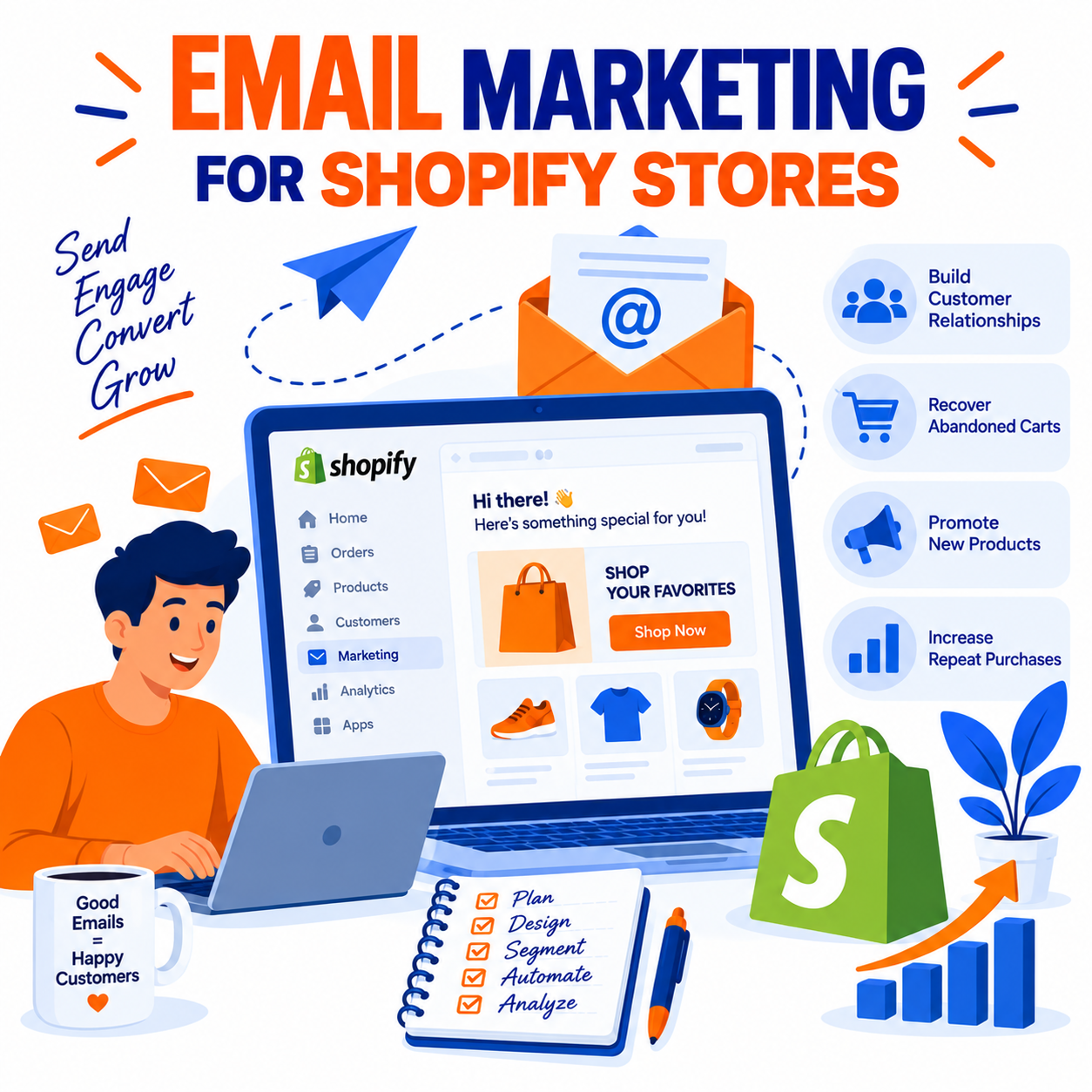
Email marketing remains the highest-ROI channel for most Shopify stores. Industry data consistently shows returns in the range of $36–$42 (or higher in well-optimized ecommerce programs) for every $1 spent. Mature Shopify brands frequently generate 20–40% of total revenue from email, with automated flows often responsible for the majority of that revenue despite representing a small share of total sends.
Unlike paid acquisition, email lets you own the relationship with customers and subscribers. You control the timing, messaging, and experience. When properly set up with Shopify’s rich customer and order data, email becomes a powerful engine for first-purchase conversion, cart recovery, repeat purchases, and lifetime value growth.
This guide covers everything from platform selection and technical foundations to essential flows, campaign strategy, segmentation, list growth, deliverability, measurement, and advanced optimization for Shopify stores in 2026.
Why Email Marketing Is Essential for Shopify Stores
- Highest ROI among digital channels for ecommerce.
- Direct ownership of the audience (unlike social algorithms or ad platforms).
- Strong performance across the full customer lifecycle: acquisition, conversion, retention, and reactivation.
- Deep integration with Shopify data (purchase history, browse behavior, cart contents, customer tags, and more) enables highly relevant messaging.
- Compounding returns: a growing, engaged list increases the impact of every future campaign and flow.
Stores that treat email as a core revenue channel rather than an afterthought consistently outperform those that rely primarily on paid traffic.
Choosing the Right Email Platform for Shopify
Shopify Email
Native solution with a generous free tier (commonly 10,000 emails per month). Ideal for early-stage stores, simple needs, and low volume. Limited advanced automation, segmentation, and analytics compared with dedicated platforms.
Klaviyo
The most popular choice for scaling Shopify brands. Excellent native integration, powerful flow builder, advanced segmentation (including predictive analytics and RFM-style insights), strong revenue attribution, and robust Shopify data sync. Best for stores serious about maximizing email revenue.
Omnisend
Strong all-in-one option that combines email, SMS, and push. Good visual builders and solid Shopify integration. Often more cost-effective for mid-market stores seeking multichannel capabilities.
Other options
Mailchimp, ActiveCampaign, Drip, and others work but generally offer less depth in Shopify-specific ecommerce features.
Recommendation framework
- Very early / low volume: Start with Shopify Email.
- Growing stores focused on maximum performance: Move to Klaviyo.
- Preference for bundled email + SMS at a predictable cost: Consider Omnisend.
Whatever you choose, prioritize clean data sync with Shopify and proper domain authentication.
Technical Foundations: Setup That Protects Deliverability
Deliverability is the foundation of all email results. Without inbox placement, nothing else matters.
Key steps:
- Authenticate a custom sending domain (not the default myshopify.com address) with SPF, DKIM, and DMARC records.
- Configure proper sender identity (from name and address that match your brand).
- Set up transactional emails (order confirmation, shipping updates, etc.) correctly in Shopify so they do not conflict with marketing sends.
- Disable Shopify’s native abandoned checkout emails if you will run a more sophisticated flow in your ESP.
- Implement proper list hygiene practices from day one.
- Monitor domain and IP reputation using tools such as Google Postmaster Tools.
Failing to authenticate or sending from a shared/generic domain is one of the most common reasons Shopify store emails land in spam.
Building Your Email List
List growth compounds every other effort. Primary capture methods for Shopify stores:
- On-site popups and embedded forms (exit-intent, timed, scroll-triggered, or gamified/spin-to-win). Offers of 10–15% off or free shipping typically perform well.
- Checkout opt-in (ensure compliance with local regulations).
- Footer and account creation forms.
- Post-purchase and thank-you page prompts.
- Contests, quizzes, or lead magnets relevant to your products.
- In-store or offline collection where applicable.
Best practices: Delay intrusive popups, make dismissal easy (especially on mobile), match brand aesthetics, and clearly communicate value. Quality matters more than pure volume—engaged subscribers outperform large but inactive lists.
The Essential Automated Flows Every Shopify Store Needs
Automated flows typically generate the majority of email revenue. Prioritize these:
1. Welcome Series
Triggered on signup. Usually 3–5 emails over 7–14 days.
Goals: Deliver the promised incentive, introduce the brand, build trust with social proof and storytelling, showcase bestsellers, and drive the first purchase. Highest open rates of any flow.
2. Abandoned Cart / Checkout Recovery
One of the highest-ROI flows.
Recommended structure (3 emails over 48–72 hours):
- Email 1 (1–4 hours): Simple reminder with cart contents, no discount.
- Email 2 (24 hours): Social proof, reviews, trust signals, address common objections.
- Email 3 (48–72 hours): Optional incentive (discount or free shipping) if margins allow.
Use both “Added to Cart” and “Started Checkout” triggers where available. Always exclude anyone who has already purchased. Dynamic product blocks are essential.
3. Browse Abandonment
Targets visitors who viewed products but did not add to cart. Softer and earlier in the funnel than cart abandonment.
4. Post-Purchase / Thank You + Cross-Sell / Upsell
Triggered after an order. Confirm the purchase, set expectations, request reviews, educate on product use, and recommend complementary items. Excellent for increasing AOV and encouraging second purchases.
5. Win-Back / Re-Engagement
Targets customers who have not purchased in a defined window (often 60–120 days, adjusted to your repurchase cycle). Progressive sequence that starts with value and may introduce an incentive later. Critical for list health and reactivation.
Additional high-value flows
- Browse or site abandonment variants
- Back-in-stock notifications
- Price-drop alerts
- Replenishment / consumable reminders
- VIP or loyalty flows
- Sunset / preference management for chronically inactive subscribers
Build flows first. Campaigns become more effective once the automated backbone is solid.
Campaign Strategy and Cadence
Campaigns (one-time sends) handle promotions, new product launches, seasonal events, content, and storytelling.
Guidelines:
- Consistent cadence (commonly 1–4 times per week depending on list size, engagement, and brand). Increase during peak seasons.
- Always segment rather than blasting the full list.
- Focus each email on one primary goal and clear call-to-action.
- Strong subject lines and preview text (curiosity, benefit, urgency, personalization).
- Mobile-first design with clear hierarchy and scannable content.
- Mix promotional and non-promotional value content to avoid fatigue.
Segmentation: The Biggest Performance Lever
Sending the same message to everyone is the most common and costly mistake. Segmented campaigns consistently generate significantly higher revenue per recipient.
Powerful Shopify-friendly segments include:
- Purchasers vs. non-purchasers
- Engagement level (opened/clicked in last 30/60/90 days)
- RFM-style groups (Recency, Frequency, Monetary value)
- Product category or collection affinity
- Average order value or lifetime value tiers
- Geographic or language segments
- Predicted next order date or churn risk (in advanced platforms)
- Discount sensitivity or VIP status
Start simple and expand as data and volume grow. Suppress chronically unengaged contacts to protect deliverability.
Design, Copy, and Creative Best Practices
- Clean, brand-consistent templates that load quickly.
- Prominent, single primary CTA.
- Dynamic product recommendations and personalized content where possible.
- Social proof (reviews, UGC, ratings).
- Clear hierarchy and ample white space.
- Accessible design and alt text.
- Test plain-text or lightly designed versions for certain flows (especially early welcome emails).
- Subject lines under ~50 characters when possible; A/B test regularly.
Deliverability and List Hygiene
Ongoing practices:
- Regular cleaning of hard bounces and chronic non-openers (sunset after defined inactivity).
- Easy unsubscribe and preference center.
- Consistent sending patterns and warm-up for new domains or significant volume increases.
- Monitor complaint rates (keep well under 0.1%), bounce rates, and inbox placement.
- Authenticate everything and maintain good sender reputation.
A smaller engaged list almost always outperforms a large disengaged one.
Measurement and Key Metrics
Track both engagement and revenue metrics:
- Open rate and click rate (contextualize with industry and list quality)
- Revenue per recipient (RPR) — one of the most important overall metrics
- Flow vs. campaign revenue contribution
- Conversion rate and attributed revenue
- List growth rate and churn/unsubscribe rate
- Deliverability indicators (inbox placement, complaints, bounces)
- Customer lifetime value impact of email-engaged cohorts
Understand attribution windows and the difference between platform-reported revenue and last-click models in Shopify. Focus on incremental impact and long-term list health alongside short-term revenue.
Advanced Tactics for Scaling Stores
- Predictive segments and AI-assisted content or send-time optimization
- Multichannel coordination (email + SMS with proper consent)
- Loyalty program integration
- Advanced post-purchase journeys and subscription flows
- Seasonal and promotional calendar aligned with inventory and marketing
- Continuous A/B testing of subject lines, offers, timing, and creative
- Zero-party data collection via preference centers and quizzes
Common Mistakes to Avoid
- Neglecting domain authentication and deliverability
- Relying only on campaigns while ignoring flows
- Blasting the entire list without segmentation
- Over-discounting too early in cart recovery
- Ignoring mobile experience
- Failing to clean the list
- Inconsistent or overly sales-heavy sending
- Poor data sync between Shopify and the ESP
Implementation Roadmap
Weeks 1–2: Choose platform, authenticate domain, connect Shopify, set up basic tracking.
Weeks 2–4: Build and launch core flows (welcome + abandoned cart at minimum).
Month 2: Add post-purchase and browse abandonment; begin basic segmentation and regular campaigns.
Ongoing: Expand flows, deepen segmentation, optimize creative and offers, monitor deliverability, and scale list growth.
Conclusion
Email marketing for Shopify stores is one of the highest-leverage activities available to merchants. When built on solid technical foundations, powered by the right automated flows, refined through segmentation, and protected by strong deliverability practices, it reliably drives a substantial share of revenue while strengthening customer relationships.
Start with the essentials—authentication, list capture, welcome series, and abandoned cart recovery—then systematically expand. Treat your email list as a core business asset, measure what matters (especially revenue and engagement quality), and continuously optimize. Stores that do this consistently turn email into a predictable, high-ROI growth engine that compounds over time.

Author