
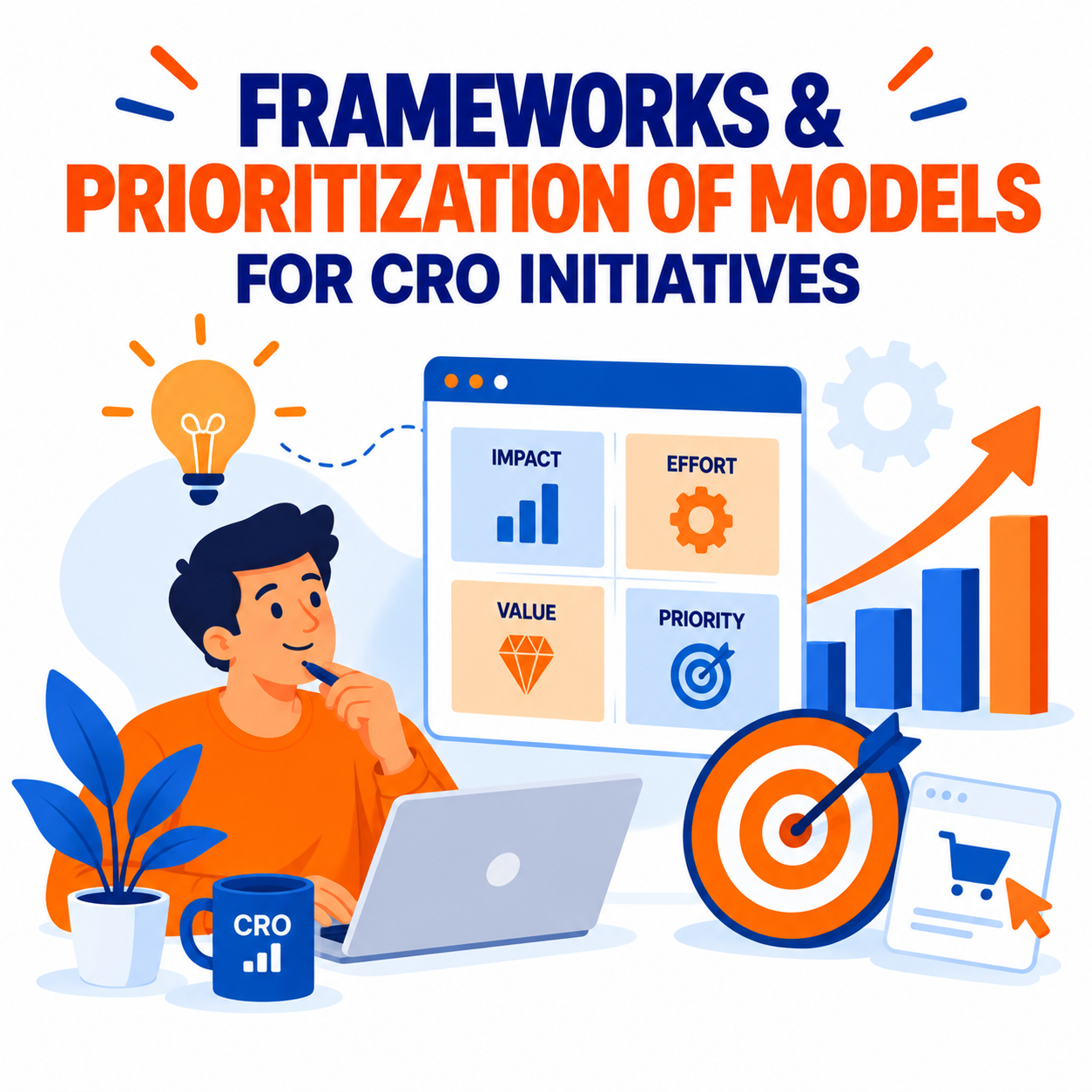
Conversion Rate Optimization (CRO) programs quickly accumulate more ideas than any team can test. Without a disciplined way to rank opportunities, teams default to the loudest stakeholder opinion, the easiest change, or the newest idea. The result is wasted traffic, slow learning, and suboptimal revenue impact.
Prioritization frameworks solve this by forcing structured evaluation of each idea against consistent criteria. The most widely used models in CRO—LIFT (primarily diagnostic), PIE, ICE, PXL, and related systems such as RICE—help teams decide what to test first, balance quick wins against bigger bets, reduce bias, and align cross-functional stakeholders.
This guide explains each major framework in depth, shows how to apply them to CRO initiatives, compares their strengths and limitations, and provides practical guidance for building a sustainable prioritization process.
Why Prioritization Matters in CRO
Every experiment consumes finite resources: traffic, design and development time, analyst attention, and opportunity cost. Running low-impact or poorly evidenced tests delays higher-value learning. Effective prioritization:
- Maximizes expected return on testing capacity
- Surfaces high-leverage opportunities that might otherwise be ignored
- Creates transparency and reduces political decision-making
- Encourages evidence-based hypothesis formation
- Helps maintain a healthy mix of quick wins and strategic tests
- Improves the quality of the experimentation backlog over time
The goal is not perfect ranking (which is impossible under uncertainty) but consistent, rational ranking that compounds learning and business results.
The LIFT Model: A Diagnostic Framework for Conversion
The LIFT Model (developed by WiderFunnel) is primarily a heuristic framework for evaluating and improving conversion experiences rather than a pure scoring system for ranking tests. It examines six factors that influence whether a visitor converts:
- Value Proposition — The core offer and benefits. Is the value clear and compelling?
- Relevance — Does the experience match the visitor’s intent, traffic source, and expectations?
- Clarity — Is the message, design, and next step easy to understand?
- Anxiety — What fears, doubts, or risks might prevent action (trust, privacy, complexity, cost)?
- Distraction — Are there competing elements, unnecessary links, or visual noise pulling attention away?
- Urgency — Is there a legitimate reason to act now?
How to use LIFT in CRO
Apply LIFT during page or funnel audits. Score or qualitatively assess each factor, gather supporting evidence (analytics, heatmaps, session recordings, user feedback), and generate hypotheses that address the weakest areas. LIFT is excellent for diagnosis and idea generation. Once hypotheses exist, feed them into a prioritization scoring model such as PIE or ICE.
LIFT pairs naturally with prioritization frameworks: it tells you what is likely broken; PIE/ICE/PXL help decide which fix to test first.
The PIE Framework (Potential, Importance, Ease)
Developed by Chris Goward / WiderFunnel specifically for conversion optimization, PIE is one of the most popular CRO prioritization models.
Scoring dimensions (typically 1–10):
- Potential — How much room for improvement exists? (Based on current conversion rate vs. benchmarks, severity of issues identified, qualitative research, or drop-off data.)
- Importance — How valuable is the traffic or page? (Traffic volume, revenue per visitor, cost of acquisition, strategic importance.)
- Ease — How easy is the test to design, develop, launch, and analyze? (Technical complexity, design effort, stakeholder dependencies, risk.)
Calculation
Most teams average the three scores:
PIE Score = (Potential + Importance + Ease) / 3
Some multiply them. Higher scores rank higher.
Strengths
- Purpose-built for CRO and page-level testing
- Explicitly factors in traffic value (Importance)
- Balances opportunity size with practicality
- Relatively simple to teach and apply
Limitations
- Still contains subjectivity, especially in Potential and Ease
- Does not explicitly score strength of evidence or confidence
- Can undervalue high-confidence, moderate-impact ideas if Potential is scored conservatively
Best for
CRO teams prioritizing tests on existing pages and funnels, especially when traffic data is available.
The ICE Framework (Impact, Confidence, Ease)
Popularized in growth and experimentation circles (often associated with Sean Ellis / GrowthHackers), ICE is widely used because of its simplicity and explicit treatment of uncertainty.
Scoring dimensions (1–10):
- Impact — If the test wins, how large will the effect be on the primary metric?
- Confidence — How confident are you that the hypothesis is correct and the test will produce a meaningful result? (Based on data quality, prior tests, research strength.)
- Ease — How easy is implementation and execution?
Calculation
Common approaches: average the three scores, or (Impact × Confidence) / Ease, or simple sum/average. Consistency within the team matters more than the exact formula.
Strengths
- Fast to apply
- Forces explicit discussion of confidence/evidence quality
- Works well for mixed growth and CRO backlogs
- Easy for cross-functional teams to understand
Limitations
- Highly subjective without calibration
- Impact can conflate effect size and reach
- Does not inherently weight page traffic volume as clearly as PIE’s Importance
Best for
Teams that want speed, early-stage programs, or broader growth experimentation backlogs.
The PXL Framework
Developed by CXL (Peep Laja and team), PXL aims to reduce the subjectivity inherent in ICE and PIE by using more binary (yes/no) criteria alongside scaled scores. It incorporates factors such as:
- Whether the change is above the fold / noticeable quickly
- Strength and type of supporting data (analytics, qualitative, heuristic)
- Traffic and conversion volume considerations
- Implementation complexity
- Potential impact indicators
PXL is more rigorous and time-consuming. It rewards ideas backed by stronger evidence and visible, high-traffic changes.
Strengths
- Lower subjectivity through binary scoring
- Encourages better research hygiene
- Better suited to mature experimentation programs
Limitations
- Higher scoring overhead
- Requires more data and process maturity
- Can feel heavy for small teams or rapid ideation
Best for
Established CRO or experimentation teams with rich data and a desire to minimize opinion-driven ranking.
RICE and Other Related Models
RICE (Reach, Impact, Confidence, Effort)
Originally from product prioritization (Intercom).
Score = (Reach × Impact × Confidence) / Effort
Reach quantifies how many users will be exposed in a given period. This makes RICE valuable when comparing ideas that affect very different audience sizes (homepage vs. a low-traffic checkout step). Effort is usually scored in person-time or story points.
Other approaches
- Value vs. Effort matrices (simple 2×2)
- MoSCoW (Must, Should, Could, Won’t) — more categorical than scored
- Custom hybrid models that combine elements of PIE/ICE with business-specific weights (revenue impact, strategic alignment, learning value)
Comparing the Frameworks
| Framework | Key Factors | Complexity | Subjectivity | Best Suited For | Notable Strength |
|---|---|---|---|---|---|
| LIFT | 6 conversion forces | Medium | Qualitative | Diagnosis & idea generation | Structured heuristic analysis |
| PIE | Potential, Importance, Ease | Low–Med | Medium | Classic CRO page testing | Explicit traffic/value weighting |
| ICE | Impact, Confidence, Ease | Low | Higher | Fast ranking, growth + CRO | Explicit confidence scoring |
| PXL | Multiple binary + scaled | Higher | Lower | Mature programs | Reduced opinion bias |
| RICE | Reach, Impact, Confidence, Effort | Medium | Medium | Ideas with varying audience size | Quantifies reach |
There is no universal “best” model. The right choice depends on team size, data maturity, speed requirements, and whether the backlog is primarily page-level CRO tests or broader growth experiments.
How to Apply Prioritization Frameworks in Practice
- Generate a backlog of hypotheses
Use analytics, heatmaps, session recordings, user testing, surveys, heuristic evaluation (including LIFT), and stakeholder input. Write each idea as a proper hypothesis: “Because [insight], we believe [change] will [effect] for [audience], measured by [metric].” - Choose and calibrate one primary framework
Agree on definitions and scoring anchors (what a “7” vs. “9” looks like) before scoring. Calibration workshops dramatically improve consistency. - Score collaboratively
Involve relevant roles (CRO, product, design, engineering, analytics). Ease scores especially benefit from engineering input. - Rank and select
Sort by score. Review the top items for strategic fit, traffic sufficiency, and portfolio balance (some quick wins, some higher-effort/higher-upside tests, some learning-focused experiments). - Revisit regularly
Re-score as new data arrives, business priorities shift, or previous test results change confidence levels. Monthly or sprint-based reviews work well. - Track outcomes
After tests conclude, compare actual results against original Impact/Potential and Confidence scores. This improves future calibration.
Best Practices for Effective Prioritization
- Separate idea generation from prioritization.
- Require minimum evidence before high Confidence or Potential scores.
- Weight Ease realistically—include design, development, QA, and analysis time.
- Consider secondary criteria when scores are close: strategic alignment, learning value, risk, dependencies.
- Maintain a visible, shared backlog.
- Avoid over-precision; frameworks are decision aids, not mathematical truth.
- Balance the portfolio: not every test should be a moonshot or a tiny copy tweak.
- Document scoring rationale for transparency and future learning.
- Combine diagnostic frameworks (LIFT) with scoring frameworks (PIE/ICE/PXL).
Common Pitfalls
- Treating scores as objective when they remain estimates
- Letting the easiest tests always win (neglecting high-Impact opportunities)
- Inflating Confidence without data
- Ignoring traffic volume and statistical power
- Changing frameworks too frequently, destroying comparability
- Using prioritization as a substitute for proper research
- Failing to re-prioritize after major wins, losses, or business changes
Building a Sustainable CRO Prioritization Process
Mature programs often evolve from simple ICE or PIE scoring toward more structured approaches (PXL or custom models) as data volume and process maturity increase. Many teams keep a lightweight model for rapid triage and apply deeper criteria only to the top candidates.
Regardless of the specific framework, the underlying discipline remains the same: generate evidence-backed hypotheses, evaluate them consistently against impact and feasibility, run the highest-priority tests, learn, and feed results back into the system.
Conclusion
LIFT, PIE, ICE, PXL, RICE, and related models give CRO teams a shared language and structured method for deciding what to optimize and test next. LIFT excels at diagnosing conversion barriers and generating ideas. PIE and ICE provide fast, practical scoring for ranking those ideas. PXL and RICE add rigor or reach considerations for more advanced needs.
The highest-performing experimentation programs treat prioritization as an ongoing capability rather than a one-time exercise. They calibrate scoring, involve the right people, balance the test portfolio, and continuously improve their judgment by comparing predicted versus actual outcomes.
When prioritization is done well, limited testing resources flow toward the opportunities most likely to improve customer experience and business results. That disciplined focus is one of the clearest separators between CRO programs that produce occasional wins and those that deliver compounding, measurable growth.

Author