
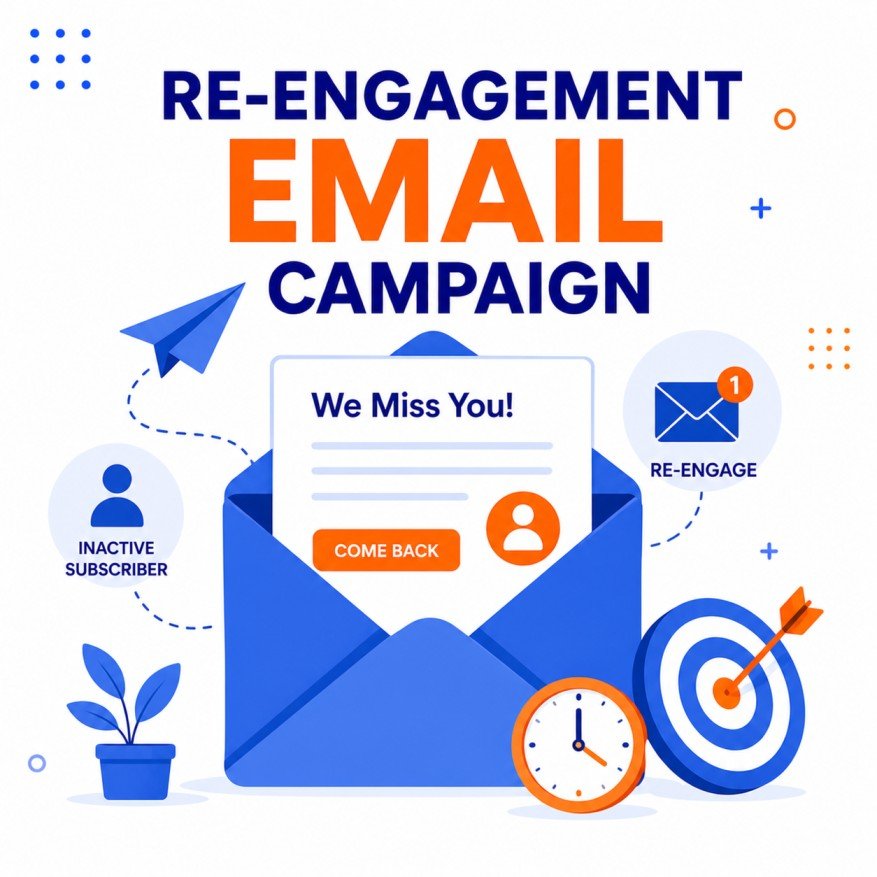
Re-engagement (also called win-back) email campaigns target subscribers who have stopped opening, clicking, or interacting with your emails. Over time, every list accumulates inactive contacts. These inactive subscribers hurt deliverability, inflate costs, distort metrics, and increase the risk of spam complaints and spam-trap hits. A well-designed re-engagement campaign gives them one last meaningful chance to return while protecting the health of your overall list.
This guide covers the full process: defining inactivity, segmentation, list hygiene, sequence design, content and subject lines, automation, timing, incentives, measurement, compliance, and ongoing best practices for 2026.
Why Re-Engagement Campaigns Matter
Inactive subscribers create multiple problems:
- Lower open and click rates damage sender reputation with inbox providers.
- Higher spam complaint rates and bounce rates further harm deliverability for the entire list.
- Distorted analytics make it harder to evaluate true campaign performance.
- Increased sending costs with little or no return.
A structured re-engagement program typically reactivates a portion of the inactive segment (often in the 8–20% range depending on list quality, niche, and sequence strength) and cleanly removes or suppresses the rest. The result is a smaller but healthier, more engaged list that performs better long-term.
Step 1: Define “Inactive” Correctly
There is no universal definition. Inactivity should be based on your normal sending frequency and business model.
General guidelines:
- Daily or near-daily senders: 30–60 days of no opens/clicks
- Several times per week: 60–90 days
- Weekly: 90–120 days
- Bi-weekly or monthly: 120–180 days or longer
Prefer clicks (and other strong engagement signals) over opens when possible, because privacy features such as Apple Mail Privacy Protection have reduced the reliability of open tracking. Combine email engagement with website activity, purchases, or app usage when data is available for a more accurate picture.
Also consider list tenure: a subscriber who signed up recently and never engaged is different from a long-term customer who went quiet.
Step 2: Segment the Inactive Audience
Not all inactive subscribers are equal. Segment before messaging:
- By recency of inactivity — e.g., 90–180 days vs. 180–365 days. Fresher inactives recover at higher rates.
- By past value — purchasers vs. non-purchasers; high-lifetime-value customers vs. low-value.
- By engagement history — previously highly engaged vs. never strongly engaged.
- By source or preference — signup source, content interests, or product categories.
High-value lapsed customers often deserve a stronger sequence or even multi-channel follow-up. Low-value or never-engaged contacts may warrant a shorter sequence or faster sunset.
Step 3: Clean and Verify the Segment First
Before any re-engagement send:
- Run the inactive segment through an email verification or validation service to remove invalid, disposable, role-based, or high-risk addresses.
- Suppress known hard bounces, previous complainers, and unsubscribes.
- Consider throttling volume so re-engagement sends do not dominate your daily sending volume (many experts recommend keeping inactive volume relatively low relative to engaged sends).
Sending to a dirty inactive segment is one of the fastest ways to damage domain and IP reputation.
Step 4: Design the Re-Engagement Sequence
Effective sequences are progressive and limited in length. Common high-performing structures use 3–5 emails over 2–4 weeks (often 14–21 days).
Typical progression:
- Soft check-in / value reminder (Day 0)
Acknowledge the gap lightly. Restate core value. Share what they’ve missed or a useful update. Low or no hard sell. Goal: reopen the relationship. - Value or relevance reinforcement (Day 5–10)
Highlight specific benefits, popular content, product updates, or personalized recommendations based on past behavior. Still focused on value. - Incentive or preference ask (optional, Day 10–16)
Offer a relevant incentive (discount, free resource, exclusive content) or ask them to update preferences. Time-limited offers can add urgency without desperation. - Final notice / sunset warning (Day 14–21)
Clearly state that this is one of the last emails. Invite them to stay (click, reply, or update preferences) or be removed. Transparency builds trust and often produces a final spike in engagement.
Some programs use a short confirmation email after the final notice for those who re-engage.
Key principles:
- Escalate urgency and clarity gradually.
- Give a clear, easy action in every email (click to stay, update preferences, claim offer, or unsubscribe).
- Keep the tone human and respectful rather than desperate.
- Make unsubscribing easy—better an unsubscribe than a spam complaint.
Step 5: Craft High-Performing Subject Lines and Content
Subject lines for inactive audiences must work harder. Patterns that frequently perform well include:
- Direct questions (“Still interested in [topic]?” or “Should we keep emailing you?”)
- Specific acknowledgment of time or missed value (“You haven’t opened us in a while” or “Here’s what you missed”)
- Permission/confirmation framing (“One click to stay on the list”)
- Light personalization with first name or past behavior
- Clear final-notice language in the last email (“Last email unless we hear from you”)
Avoid generic “We miss you!” lines that feel like mass marketing. Curiosity, specificity, and honesty tend to outperform pure nostalgia.
Email body best practices:
- Keep it relatively short and scannable.
- Lead with value or a clear reason to care.
- Use one primary call-to-action.
- Personalize where meaningful (past purchases, content interests, name).
- Include preference-center and unsubscribe links prominently.
- Test plain-text or lightly designed versions; heavy design is not always necessary for this audience.
Step 6: Set Up Automation and Triggers
The strongest programs run as ongoing automated flows rather than one-off blasts:
- Create a dynamic segment of contacts who meet the inactivity criteria.
- Enroll them automatically into the re-engagement series.
- Exit the series immediately on any engagement (click, reply, purchase, preference update).
- After the final email with no engagement, automatically suppress or move to a sunset/suppression list.
Most modern ESPs (Klaviyo, ActiveCampaign, HubSpot, Mailchimp, Iterable, etc.) support these behavioral triggers and dynamic segments.
Step 7: Timing, Frequency, and Deliverability Safeguards
- Space emails 5–7 days apart (adjust based on your normal cadence).
- Avoid sending the entire inactive segment at once if the volume is large—throttle or blend with engaged sends when possible.
- Monitor domain reputation (Google Postmaster Tools, Microsoft SNDS, etc.) before and during the campaign.
- Authenticate properly (SPF, DKIM, DMARC).
- Warm up or maintain good sending practices; do not let re-engagement volume spike dramatically.
Step 8: Decide What Happens After Non-Engagement (Sunset Policy)
Subscribers who do not engage with the full sequence should be removed from active marketing sends. Options include:
- Permanent suppression from marketing emails
- Moving to a long-term holdout or archival status
- Full deletion where compliance or data-minimization policies require it
Continuing to email non-responders after multiple clear attempts harms deliverability more than the loss of those addresses. A clean list almost always outperforms a large but disengaged one.
Step 9: Measure Success Properly
Primary metrics for re-engagement campaigns:
- Reactivation rate (% of the segment that clicks, replies, or converts during the sequence)
- Click rate (more reliable than opens)
- Unsubscribe and complaint rates
- Subsequent engagement of reactivated contacts (do they stay active?)
- Impact on overall list health (improved open/click rates, better deliverability signals after sunsetting)
- Revenue or conversion attributed to reactivated contacts (especially for e-commerce or high-value segments)
Benchmark expectations vary widely by industry and list quality. Reactivation rates commonly fall in the high single digits to low-to-mid teens; strong programs can do better with high-quality lists and relevant offers.
Advanced Tips and Variations
- Differentiate by value: Give high-LTV lapsed customers a richer sequence or multi-channel outreach (email + SMS or retargeting).
- Preference centers: Let people choose frequency or content types instead of a binary stay/leave.
- Survey the silent: Ask why they disengaged—useful product and content insight.
- Win-back offers: Use incentives strategically, especially for e-commerce, but lead with value first so you don’t train customers to wait for discounts.
- Post-reactivation nurture: Welcome re-engaged subscribers back with a short positive sequence so they don’t immediately go quiet again.
- Regular cadence: Run re-engagement as a continuous automated process rather than a sporadic manual campaign.
Compliance and Trust Considerations
- Honor all unsubscribe requests promptly.
- Maintain clear records of consent where required (GDPR, CCPA, and similar regulations).
- Be transparent in final-notice emails about removal.
- Avoid deceptive subject lines or misleading urgency.
- Ensure your privacy policy and data practices support the personalization you use.
Common Mistakes to Avoid
- Defining inactivity too aggressively and annoying still-somewhat-active subscribers
- Sending to unverified or very old inactive addresses
- Using only one email instead of a short sequence
- Leading with heavy discounts before reminding of value
- Failing to sunset non-responders
- Ignoring deliverability signals during the campaign
- Treating all inactives the same regardless of past value or behavior
Conclusion
A strong re-engagement email campaign is both a recovery tool and a list-hygiene system. It gives inactive subscribers a clear, respectful opportunity to return while protecting the long-term health and performance of your email program.
Define inactivity thoughtfully, segment by value and recency, clean the list first, run a short progressive automated sequence, measure reactivation and downstream engagement, and sunset those who do not respond. When executed with care, re-engagement campaigns improve deliverability, restore a portion of lost audience, and ensure your future emails reach people who actually want them.
Treat re-engagement as an ongoing automated process rather than a one-time cleanup. Healthy lists compound in value; neglected inactive segments quietly erode performance. With the right structure, timing, and respect for the subscriber, win-back campaigns become one of the highest-leverage maintenance activities in email marketing.

Author