
AI search visibility—whether in Google AI Overviews and AI Mode, ChatGPT, Perplexity, Gemini, Claude, or other generative systems—rests on a strong technical foundation. These systems primarily discover and ground answers in publicly crawlable, indexable web content. If search engines and AI crawlers cannot reliably access, render, understand, and trust your pages, your content cannot be cited or recommended, no matter how high-quality it is.
Google has stated that pages must meet standard Search technical requirements and be eligible for regular search results (including snippets) to appear in generative AI features. Traditional technical SEO therefore remains the non-negotiable base layer. On top of it sit AI-specific considerations: crawler access control, renderability for non-JavaScript bots, structured data that aids machine understanding, clear information architecture, and signals that help systems identify your entities accurately.
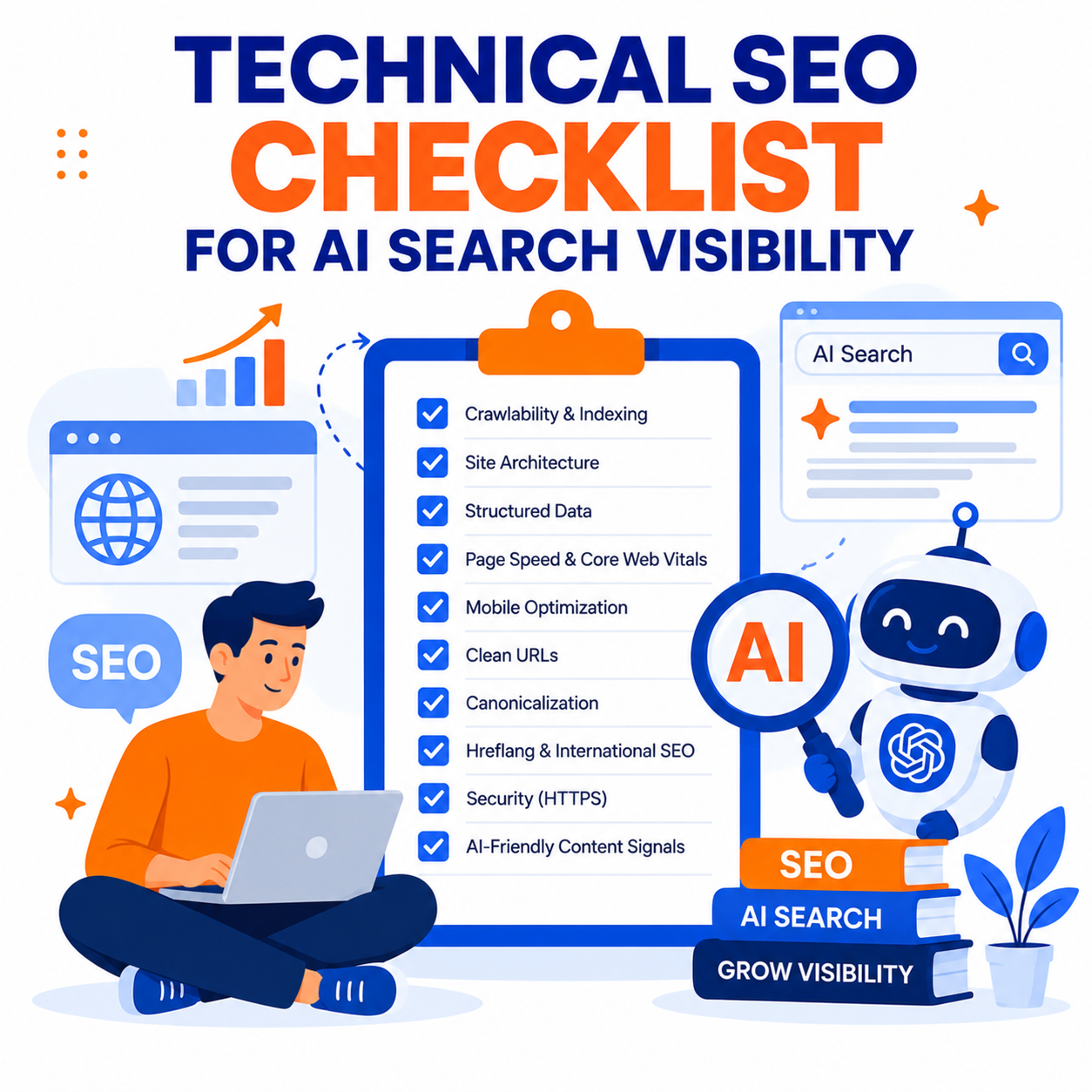
This comprehensive checklist organizes the essential technical work into practical categories. Use it for audits, prioritization, and ongoing maintenance. Focus first on crawl access and indexability—the rest becomes irrelevant if engines cannot reach your content.
1. Crawlability and AI Crawler Access
AI systems rely on crawlers (Googlebot and specialized bots such as GPTBot, OAI-SearchBot, PerplexityBot, ClaudeBot / Claude-SearchBot, Google-Extended, and others). Blocking them—intentionally or accidentally—removes you from consideration.
Checklist items:
- Audit robots.txt thoroughly. Ensure important pages, directories, and resources are not disallowed.
- Explicitly allow major AI-related user agents if you want visibility in their answers (examples commonly referenced: GPTBot, ChatGPT-User / OAI-SearchBot, PerplexityBot, ClaudeBot / related Anthropic bots, Google-Extended). Decide separately on training versus retrieval/search bots according to your policy.
- Check CDN, WAF, firewall, and bot-management rules (Cloudflare, AWS WAF, etc.). These often block AI crawlers even when robots.txt permits them.
- Verify actual crawler activity in server logs. Confirm the bots you care about are successfully requesting pages and receiving 200 responses.
- Test access with the relevant user-agent strings (via curl or similar tools) to confirm clean responses.
- Keep crawl budget healthy: fix soft 404s, redirect chains, infinite parameters, and low-value crawl traps.
- Maintain an up-to-date, accurate XML sitemap (or sitemap index) and reference it in robots.txt. Submit it in Google Search Console and Bing Webmaster Tools.
- Ensure critical content is not locked behind login walls, aggressive cookie gates, or paywalls that prevent crawling.
Note on emerging files: Some practitioners publish an llms.txt (and sometimes llms-full.txt) at the domain root as a curated Markdown map of key pages and summaries. Google has stated it does not require or specially use such files for Search or its generative features. Adoption and proven impact vary; treat it as optional supplementary guidance rather than a ranking factor.
2. Indexability and Canonicalization
Content that cannot be indexed cannot reliably appear in AI answers that draw from search indexes or crawled web data.
Checklist items:
- Confirm important pages return indexable status (no accidental noindex robots meta tags or X-Robots-Tag headers).
- Use consistent canonical tags pointing to the preferred version of each URL.
- Resolve duplicate content issues (HTTP/HTTPS, www/non-www, trailing slashes, parameter variants, printer-friendly versions, etc.).
- Implement clean, single-hop 301 redirects; eliminate long redirect chains.
- Monitor Google Search Console Coverage / Pages reports and Bing equivalents for indexing errors, exclusions, and discoverability issues.
- Ensure pagination, faceted navigation, and filtered views are handled correctly (canonicals, rel next/prev where appropriate, or noindex on pure filter pages).
- Avoid orphan pages; make sure high-value content is linked internally and discoverable via sitemaps or crawl paths.
3. Rendering and Content Accessibility for Machines
Many AI crawlers do not execute JavaScript the way modern Googlebot does. Content that appears only after client-side rendering may be invisible to them.
Checklist items:
- Verify that primary content, headings, and key text exist in the initial HTML response (view page source or fetch without JavaScript).
- Prefer server-side rendering (SSR), static generation, or prerendering for important pages, especially content-heavy or commercial pages.
- Ensure content inside tabs, accordions, or lazy-loaded sections that matters for answers is present in the initial DOM or reliably discoverable.
- Avoid depending on infinite scroll or pure client-side routing for core content discovery.
- Test that main textual content is readable without executing scripts.
- Maintain clean, semantic HTML. Use proper heading hierarchy (H1–H6), meaningful element types, and logical structure. Perfect validation is not required, but clear structure helps both humans and machines.
4. Structured Data and Schema Markup
Structured data is not strictly required for Google generative AI features according to Google’s guidance, yet it remains highly valuable. It reduces ambiguity, supports rich results eligibility, strengthens entity understanding, and can make content easier for various systems to parse and attribute.
Checklist items:
- Implement JSON-LD (preferred) for key types:
- Organization (sitewide) with name, url, logo, sameAs links to authoritative profiles.
- WebSite with potential SearchAction if relevant.
- Article or BlogPosting on editorial content (headline, author, dates, image, publisher).
- FAQPage on pages with clear question-and-answer sections.
- HowTo where procedural content exists.
- Product, Offer, Review, LocalBusiness, or other relevant types as applicable.
- BreadcrumbList on nested pages.
- Person schema for authors, linked to Organization where appropriate.
- Keep schema accurate, up-to-date, and consistent with visible page content.
- Validate with Google’s Rich Results Test and Schema Markup Validator.
- Serve schema in the initial HTML rather than injecting it only client-side when possible.
- Maintain entity consistency (name, address, organization details) across the site and external profiles.
5. Site Architecture, Internal Linking, and Information Hierarchy
Clear architecture helps both traditional crawlers and AI systems understand topical relationships and importance.
Checklist items:
- Design logical, shallow site architecture with important pages reachable in few clicks.
- Use descriptive, readable URLs.
- Strengthen internal linking with descriptive anchor text that reinforces topics and entities.
- Create clear topical clusters and hub-and-spoke structures where relevant.
- Ensure breadcrumb navigation is present and marked up.
- Avoid excessive click depth for key commercial or informational pages.
- Maintain a clean navigation system that does not hide important content.
6. Performance, Core Web Vitals, and Mobile Experience
While AI systems may weigh some performance signals differently from classic ranking, fast, stable, mobile-friendly pages remain important for crawl efficiency, user experience, and overall site quality signals.
Checklist items:
- Achieve “Good” Core Web Vitals (LCP, INP, CLS) on key templates, especially mobile.
- Optimize server response times (TTFB), image delivery, font loading, and JavaScript execution.
- Ensure mobile-first rendering and excellent mobile usability.
- Eliminate layout shifts and interaction delays that frustrate users and waste crawl resources.
- Use efficient caching, CDN, and modern image formats.
- Monitor performance in Search Console, PageSpeed Insights, and real-user monitoring.
7. Security, HTTPS, and Trust Signals
Checklist items:
- Serve the entire site over HTTPS with valid certificates and no mixed-content issues.
- Implement security best practices (HSTS where appropriate, secure headers).
- Maintain transparent authorship, organization information, contact details, and editorial policies that support E-E-A-T-style trust signals.
- Keep software, plugins, and dependencies updated to avoid security or crawl problems.
8. International, Multilingual, and Additional Technical Considerations
Checklist items:
- Correct hreflang implementation for multi-language or multi-region sites.
- Proper handling of geo-targeting and language declarations.
- Clean handling of AMP or other alternate versions if used (with correct canonicals).
- Log and monitor crawl stats, server errors, and bot traffic patterns over time.
- Ensure accessibility basics (alt text, semantic structure, keyboard navigability) that also aid machine parsing.
9. Monitoring, Validation, and Ongoing Maintenance
Technical SEO for AI visibility is not a one-time project.
Ongoing actions:
- Regularly review Search Console (including any generative AI-related reports) and Bing Webmaster Tools.
- Monitor server logs for AI crawler activity and errors.
- Re-validate schema and structured data after template or CMS changes.
- Re-test rendering and crawler access after major platform, CDN, or security updates.
- Track indexing status of priority pages.
- Combine technical health with content quality, freshness, entity strength, and external authority signals.
Priority Order for Most Sites
- Fix any crawl blocks (robots.txt, WAF/CDN, server configuration) and confirm AI crawlers can access key pages.
- Ensure indexability and clean canonicalization.
- Make primary content available in initial HTML.
- Strengthen Core Web Vitals and mobile experience on money pages.
- Implement and validate core schema (Organization, Article, FAQ where relevant).
- Improve architecture and internal linking.
- Add supplementary files or signals only after the foundation is solid.
Important Reality Check
Technical excellence makes your content eligible and easier to understand. It does not guarantee citations. AI systems also evaluate content quality, relevance, originality, authority, freshness, and how well a page answers the underlying query. Google has emphasized that generative AI features build on the existing Search foundation—strong traditional SEO and helpful content remain essential.
Avoid chasing unproven “AI-only” hacks. Focus on making your site reliably crawlable, clearly structured, fast, secure, and machine-readable while continuing to publish high-quality, people-first content.
Conclusion
A robust technical SEO foundation is the prerequisite for AI search visibility. By systematically addressing crawler access, indexability, renderability, structured data, architecture, performance, and trust signals, you remove the barriers that prevent AI systems from discovering, parsing, and confidently citing your pages.
Use this checklist as a living audit tool. Start with the highest-impact items (access and indexability), validate changes, monitor results, and iterate. When technical barriers are removed and content is genuinely useful, your site stands a far stronger chance of appearing in both classic search results and the generative answers that increasingly shape how people discover information.

Author