
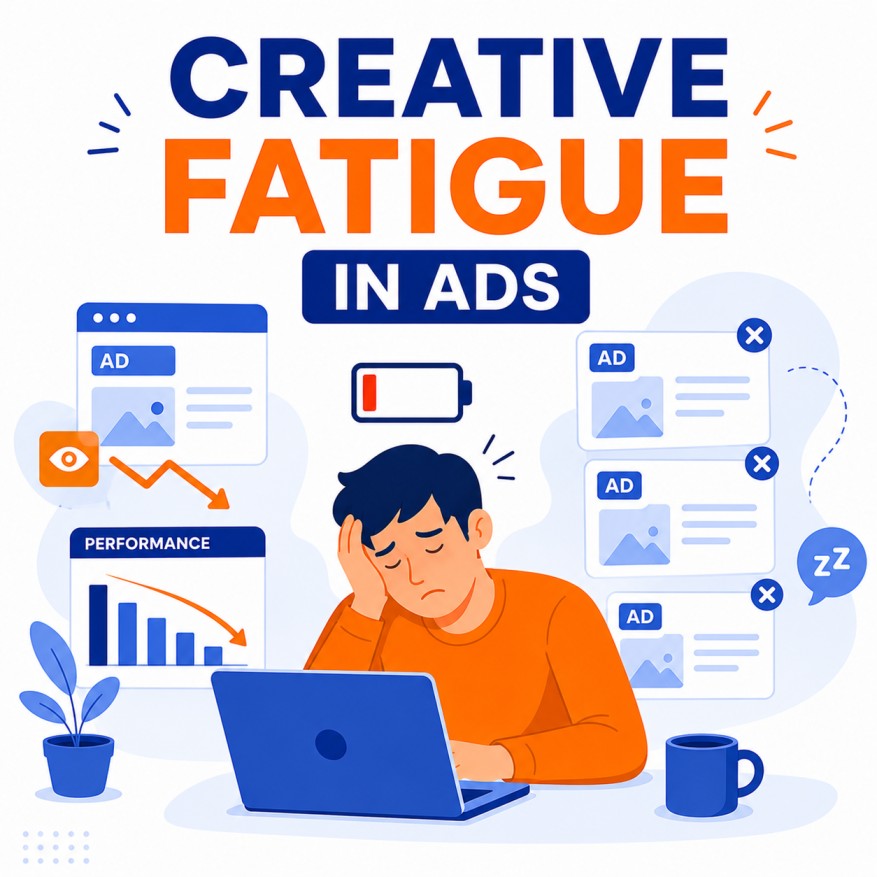
Creative fatigue is one of the most important performance levers in modern paid media. When the same creative is shown repeatedly to the same people, attention collapses, engagement falls, costs rise, and ROAS erodes—often silently until it becomes expensive to fix. This comprehensive guide covers definitions, diagnostics, platform differences, precise detection signals and thresholds, layered refresh tactics, proactive systems, and operational best practices.
What Creative Fatigue Actually Is
Creative fatigue occurs when an audience has been exposed to a specific ad asset (or highly similar assets) often enough that novelty disappears and response declines. People begin to ignore the ad, scroll past it, hide it, or engage less positively. Platform algorithms detect lower engagement and respond by charging higher CPMs, reducing delivery quality, or shifting impressions toward less ideal users.
It is distinct from related phenomena:
- Creative fatigue: The specific visual, hook, message, or format has worn out. New, meaningfully different creative in the same audience usually restores performance.
- Audience (saturation) fatigue: The reachable pool itself is exhausted. Even fresh creative underperforms until the audience is expanded or refreshed.
- Creative similarity / concept fatigue: An entire cluster of ads shares the same hook type, emotional angle, composition, or proof style, so the audience fatigues on the pattern rather than one asset.
- Downstream problems: Landing-page issues, offer weakness, measurement changes, or auction competition can mimic fatigue signals.
Research indicates that click likelihood decays roughly as (N+1)^-0.43, producing about a 45% drop by the fourth exposure. Average exposure in studied samples reached around 4.2 times over 30 days, with a meaningful share of impressions going to users who had already seen the creative five or more times.
Why Creative Fatigue Matters Economically
Fatigue is rarely a sudden cliff; it is a progressive efficiency leak. Early stages show declining CTR and rising frequency while conversion rate may still hold. Later stages produce higher CPC/CPM, lower conversion rates, rising CPA, and collapsing ROAS. By the time platforms surface native “Creative Fatigue” or “Creative Limited” status (often when cost-per-result reaches roughly 2× historical baseline), significant budget has frequently already been wasted.
High-spend accounts and small/retargeting audiences experience accelerated decay. Platforms that reward novelty (especially short-form video environments) amplify the problem. The cost of reactive management—waiting until ROAS tanks, then scrambling for new creative—is substantially higher than proactive detection and rotation.
Core Detection Signals and Thresholds
Monitor at the individual ad / asset level, not just campaign or ad-set level. Use rolling windows (3-day, 7-day) and compare against the creative’s own baseline rather than account averages. Leading indicators appear before CPA/ROAS fully deteriorate.
Primary signals (in approximate order of appearance):
- CTR decay: Most reliable early indicator. Sustained drops of 15%+ (some practitioners use 20–30%) from a 7-day rolling baseline, or consistent day-over-day declines for 3+ days, signal emerging fatigue.
- Hook rate / thumb-stop rate decline (video): 3-second views ÷ impressions. Drops of 20%+ or absolute rates falling below healthy benchmarks (often ~25%+) indicate the opening is no longer stopping the scroll. Hooks fatigue fastest.
- Frequency growth: Prospecting/cold audiences typically enter warning territory around 2.5–3.5 (7-day) and confirmed fatigue above ~3.5–4. Retargeting tolerates higher levels (often 5–10+ depending on goal), but individual creatives still fatigue.
- CPM creep: Rising 10%+ (or 15–20%+) versus baseline with no clear auction/seasonal explanation, especially when paired with CTR decline. Algorithms charge more for lower-engagement inventory.
- Spend-share shift within the ad set: A top ad’s share of ad-set spend declining sharply (e.g., >15 percentage points in a few days) indicates the algorithm is deprioritizing it.
- First-time impression ratio decline: Falling share of impressions that are new to the user signals the algorithm is increasingly re-serving saturated users.
- Lagging indicators: Rising CPA/CPR (20%+), declining conversion rate (15%+), falling ROAS, increasing negative feedback (“Hide ad,” “Seen this too much”), and shorter video retention.
Example diagnostic table (approximate ranges used by practitioners; calibrate to your vertical and historical data):
| Signal | Healthy | Warning | Confirmed Fatigue |
|---|---|---|---|
| CTR vs 7-day baseline | 0% to –5% | –6% to –14% | –15% or more |
| CPM vs 7-day baseline | 0% to +5% | +6% to +9% | +10% or more |
| Frequency (prospecting, 7-day) | Under ~2.5 | 2.5–3.4 | 3.5+ |
| Frequency (retargeting) | Under ~1.8–2.5 (varies) | Higher | 2.5–5+ depending on goal |
| Hook rate decline | 0% to –10% | –11% to –19% | –20% or more |
| Conversion rate vs baseline | 0% to –5% | –6% to –14% | –15% or more |
Two or more confirmed signals together strongly indicate creative fatigue. A single warning signal warrants investigation.
Diagnostic sequence:
- Check native platform flags and unique CTR / frequency trends.
- Isolate the specific ads that are declining versus those still performing.
- Test by introducing meaningfully different creative into the same audience. Recovery points to creative fatigue; continued underperformance points to audience saturation or other issues.
- Rule out downstream problems (landing page, offer, measurement).
Platform Differences in Fatigue Speed
- TikTok: Fastest. Often 3–7 days (sometimes shorter at high spend). High novelty expectation requires frequent hook and visual refreshes.
- Meta (Feed): Typically 14–28 days for many prospecting creatives; Reels can be faster (7–14 days). Frequency thresholds around 2.5–3.5 for cold audiences.
- Meta retargeting / smaller pools: Faster saturation; monitor more aggressively.
- YouTube / longer-form: Often longer lifespan (weeks to months).
- LinkedIn / B2B: Generally slower fatigue; higher frequency tolerance in some cases.
- Google Ads: More text- and offer-driven; CTR and conversion rate are key signals; visual fatigue is less dominant than on social.
Spend level and audience size matter more than calendar days. High daily spend accelerates frequency accumulation. Small retargeting pools (under ~100k) can fatigue in 7–10 days; large prospecting audiences (1M+) may sustain 21–30 days.
Refresh Strategy: Layered, Not Binary
Do not wait for full collapse and then replace everything. Use a tiered approach that protects what still works.
1. Hook / Opening Refresh (fastest, often highest ROI) Change the first 3 seconds of video or the headline/opening line of static ads while keeping the proven body, offer, and CTA. Hooks carry the attention burden and fatigue earliest. This can recover a large portion (often 50–80%) of lost performance quickly.
2. Angle / Messaging Shift Keep product and core offer but reframe the reason to care: problem-first vs. benefit-first, social proof, urgency, mechanism, identity, or outcome-focused. A new angle registers as a different ad even with similar visuals.
3. Format & Presentation Switch Static ↔ video, single image ↔ carousel, polished ↔ UGC, different aspect ratios or placements, new music/pacing/text overlays, or new creator faces. Format novelty resets attention.
4. Partial Element Refresh Swap proof elements (new testimonials, demos, data points), end cards/CTAs, or secondary text while protecting the winning core.
5. Full Concept Replacement New creative concepts when the underlying angle itself has saturated. Use only after multiple executions of the prior concept show decline.
Production and transition best practices:
- Always add new creative before pausing the fatigued asset. Run them in parallel briefly so the algorithm has continuity and learning is not fully reset.
- Maintain a pipeline: for every active winner, have 2–3 ready replacements or iterations.
- Modular creative systems (separate hook, body, proof, CTA layers) dramatically increase speed and volume.
- Diversify taxonomy: multiple hook types, emotional angles, compositions, and proof styles active simultaneously to slow concept-level fatigue.
Cadence guidelines (approximate; adjust by data):
- High daily spend (>$5k): every 3–5 days for critical elements.
- Medium spend: 5–10 days.
- Lower spend / large audiences: 14–21+ days.
- Retargeting / small pools: more frequent.
- Always data-triggered rather than purely calendar-based.
Building a Fatigue-Resistant System
Reactive fixes are expensive. The durable advantage comes from process:
- Continuous monitoring: Daily or near-real-time tracking of CTR, frequency, hook rate, CPM, and spend share per creative. Automate alerts at the thresholds above.
- Creative volume and diversity: Aim for enough active assets that no single creative dominates impressions. High-volume accounts slow individual fatigue dramatically.
- Always-be-testing structure: Allocate budget (example frameworks: 70% proven winners, 20% iterations/variations, 10% new concepts). Kill clear losers quickly; promote winners systematically.
- Spend- and audience-based rotation calendars rather than one-size-fits-all schedules.
- Taxonomy tracking: Tag creatives by hook type, angle, emotion, format, and composition so you can detect pattern-level fatigue early.
- AI-assisted production and detection: Tools that score fatigue risk, generate modular variants, or surface element-level insights accelerate the loop without sacrificing quality control.
- Weekly creative health reviews: Frequency vs. prior period, CTR trends, first-time impression ratios, and asset performance labels.
Common Mistakes That Prolong Damage
- Waiting for platform native “Creative Fatigue” flags or large ROAS drops.
- Changing only colors, fonts, or minor filters (insufficient differentiation).
- Pausing winners before replacements are ready, creating delivery gaps.
- Treating all audiences and platforms with the same cadence.
- Ignoring taxonomy similarity (many “new” ads that feel identical to the audience).
- Over-relying on frequency alone without pairing it with engagement metrics.
- Neglecting to diagnose audience saturation versus creative issues.
Operational Checklist for Teams
- Define baselines and alert thresholds per platform and audience type.
- Build a modular creative production pipeline with dedicated capacity for hooks and iterations.
- Maintain a ready queue of tested or near-tested replacements.
- Review creative performance at ad level at least weekly (daily at higher spend).
- Introduce new creative proactively; scale what works; retire what declines.
- Periodically audit overall creative diversity (hook types, angles, formats).
- Document fatigue curves for your top concepts so future planning is predictive rather than reactive.
Creative fatigue is inevitable at scale, but it is highly manageable. Teams that treat creative as a renewable, continuously tested asset—detecting decay early through layered metrics and refreshing with precision—protect efficiency and sustain growth far longer than those who treat ads as set-and-forget. The goal is not zero fatigue; it is a system that keeps the cost of novelty lower than the cost of decay. Implement disciplined detection, maintain a healthy creative pipeline, and prioritize high-leverage refreshes (especially hooks and angles), and creative fatigue becomes a controllable operational rhythm rather than a recurring crisis.

Author