
YouTube Shorts Ads represent one of the fastest-growing and most efficient advertising formats on the platform in 2026. These vertical, full-screen video ads appear between organic Shorts in the dedicated Shorts feed, blending into the rapid-scrolling, mobile-first experience that billions of users engage with daily. Unlike traditional in-stream ads that interrupt longer videos, Shorts ads live inside a continuous vertical feed where viewers swipe up or down to move on, making the creative demands, user mindset, and performance dynamics fundamentally different.
This in-depth guide explains exactly how YouTube Shorts ads work, from the technical delivery mechanics and charging models to creative requirements, campaign setup, targeting, measurement, optimization, and recent platform updates.
What Are YouTube Shorts Ads?
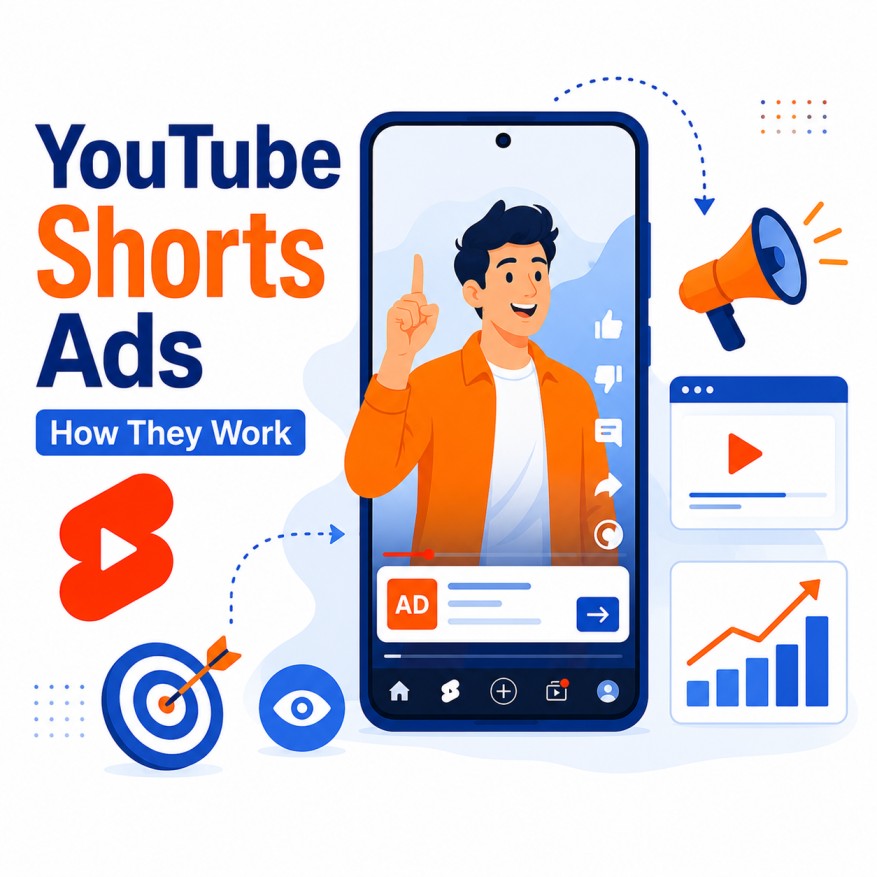
YouTube Shorts is the short-form vertical video experience on YouTube. Videos are typically under 60 seconds (the platform previously limited them more tightly), designed for full-screen mobile viewing with sound often on and rapid consumption. Ads in this environment are vertical (9:16) video units that insert themselves into the organic Shorts feed.
Key characteristics:
- Ads appear randomly between organic Shorts videos.
- Viewers can immediately skip by swiping up or down (no traditional “Skip Ad” button after a fixed number of seconds).
- The ad can be kept and reshown if the user scrolls back.
- Clicking the Call-to-Action (CTA) button takes the user to the advertiser’s landing page or destination.
- Ads serve across mobile apps, mobile web, desktop, tablets, and connected devices including Smart TVs, streaming devices, and gaming consoles.
Shorts ads are not a completely separate product you buy in isolation in most cases. They are a placement available inside several Google Ads campaign types. Advertisers upload vertical video assets and opt into (or exclusively target) the Shorts feed.
How the User Experience and Delivery Work
The Shorts feed is designed for continuous, low-friction scrolling. A viewer opens the Shorts tab or lands in the feed via recommendations and swipes through a stream of vertical videos. An ad is inserted into this stream in a way that feels similar to organic content.
When an ad appears:
- It plays full-screen in vertical orientation.
- The first frame and first 1–2 seconds carry almost the entire weight of attention. Viewers decide almost instantly whether to keep watching or swipe away.
- Sound is frequently on, but a meaningful portion of viewing still occurs with sound off, making text overlays and strong visual storytelling essential.
- Engagement actions available on organic Shorts (likes, comments, shares) are increasingly available on ads as well, depending on account linking and feature rollout.
- The ad loops if it is short enough and the viewer remains on it, but billing rules prevent double-charging in most view definitions.
This swipe-to-skip mechanic creates a much shorter effective attention window than skippable in-stream ads (where viewers must wait roughly 5 seconds before the skip button appears). On Shorts, the decision window is closer to 2 seconds.
Technical Specifications and Asset Requirements
Aspect ratio and resolution: Strictly vertical 9:16. Recommended resolution is 1080 × 1920 pixels. Horizontal or square assets perform poorly or may not serve optimally in the feed.
Length: Up to 60 seconds is supported, but only the first portion plays in the feed experience in practice for longer assets. Google recommends under 60 seconds overall. Performance sweet spots reported by advertisers are typically:
- 10–30 seconds for action/conversion-focused campaigns
- 15–45 seconds for many ecommerce use cases
- 30–60 seconds for view- or reach-oriented campaigns
Other creative elements:
- Strong visual hook in the first 1–2 seconds
- Text overlays for key messages (critical for sound-off viewing)
- Clear, prominent Call-to-Action button
- Native, social-first feel rather than polished traditional TV-style commercials
- Optional use of trending audio or voiceover (sound has been shown to lift conversions meaningfully)
Google recommends including multiple vertical assets (at least three in many campaign types) so the system can optimize delivery.
Campaign Types That Support YouTube Shorts Ads
Shorts inventory is accessible through several campaign types:
- Demand Gen campaigns (formerly related to Video Action / Discovery-style performance campaigns) — Strong for conversions, often the primary vehicle for performance-focused Shorts buying. Supports Shorts-only controls in many cases.
- Video View campaigns — Optimize for views; can include Shorts and now incorporate Shorts Ad Actions (likes, shares, comments) into budget optimization.
- Video Reach campaigns (especially with Efficient reach goal) — Focused on unique reach and brand awareness.
- Performance Max campaigns — Algorithmically allocates budget across Google inventory including Shorts; less direct control over exact Shorts share.
- App campaigns (install and re-engagement).
- YouTube reservation / Select campaigns — For premium guaranteed inventory in some cases.
Advertisers can often choose multi-format delivery or apply controls to emphasize or isolate Shorts placements. Mixing 16:9 and 9:16 assets in the same campaign can make clean placement-level analysis harder, so many advanced advertisers separate them.
Bidding, Pricing, and How You Are Charged
Charging models for Shorts ads include impressions, TrueView views, or engagements, depending on the campaign goal and bidding strategy.
TrueView view definitions on Shorts typically include:
- 10 seconds of autoplay, or
- A click on the CTA (loops count only once), or
- Full completion of an ad shorter than 10 seconds (when minimum length rules apply).
An impression is counted when playback starts; a viewable impression requires roughly 2 seconds. Engagements can include viewing a set duration (for example 5 seconds) or clicking the CTA.
Common bidding approaches:
- Target CPM (cost per thousand impressions) — You pay for impressions.
- Cost-per-view (CPV) or Maximize Views / Target CPV variants.
- Maximize Conversions or Target CPA / Target ROAS for performance campaigns.
Reported 2026 benchmarks from practitioner data frequently show Shorts CPMs among the lowest on YouTube (often around $4 or lower in many verticals, meaningfully below typical in-stream rates). Cost-per-view ranges commonly fall between roughly $0.10–$0.30 depending on targeting competitiveness, creative strength, and audience. CTR tends to be higher than many other YouTube formats (practitioner reports often cite figures around 1%+ as strong).
Actual costs vary widely by industry, geography, seasonality, audience competition, and creative quality.
Targeting Options
Shorts ads inherit the standard Google Ads / YouTube targeting toolkit:
- Demographics (age, gender, household income, parental status, etc.)
- Affinity audiences (long-term interests)
- In-market audiences (active research intent)
- Custom segments (including custom intent based on search terms or URLs, interests, and detailed demographics)
- Your data segments / remarketing (website visitors, customer lists, YouTube viewers and engagers — including expanded Shorts viewer segments)
- Life events
- Placement targeting (specific channels or videos in some contexts)
- Optimized targeting (can be used carefully)
Because the Shorts audience skews mobile and often younger, broad interest and custom intent combinations frequently work well for prospecting. Remarketing to previous engagers or site visitors is powerful for warmer audiences. Overly narrow targeting can limit delivery in the high-volume Shorts feed.
Creative Best Practices for High Performance
The creative requirements are the most distinctive aspect of Shorts ads:
- Hook in the first 1–2 seconds — Visual pattern interrupt, face, product in action, surprising result, or bold text. Traditional 5-second intros fail here.
- Native, creator-style production — UGC-style, authentic, fast-paced editing. Heavy branding or glossy commercial aesthetics often underperform.
- Text overlays and captions — Essential for sound-off viewing and message retention.
- Clear value proposition early — Product or offer should be understandable quickly.
- Single focused message — Avoid complex storytelling that requires longer attention.
- Strong, visible CTA — Make the next step obvious.
- Multiple variations — Test different hooks, openings, proof points, and CTAs.
- Sound strategy — Use voiceover, music, or both; sound-on viewing is common but not universal.
- Safe zones — Keep critical text and product visuals away from edges and UI overlays.
High-performing ecommerce Shorts ads often follow a compressed structure: visual hook (0–2s) → product/result reveal → proof or demo → offer + CTA.
Key Performance Metrics and Benchmarks
Important metrics include:
- Impressions and reach
- TrueView views / view rate
- Average view duration / percentage viewed
- Swipe-away rate (especially in the first few seconds)
- CTR (click-through rate on the CTA)
- Cost metrics (CPM, CPV, CPA, ROAS)
- Engagement actions (likes, comments, shares — increasingly trackable)
- Conversions and conversion rate (filtered to Shorts traffic when possible)
- Brand lift (awareness, consideration, favorability) and branded search lift
- Frequency
Practitioner benchmarks commonly cited:
- Strong CTR often above 1%
- View rates that are meaningfully lower than in-stream (different context — 5–12% range sometimes referenced as reasonable depending on definition)
- Emphasis on qualified views (meaningful duration) rather than raw view counts
- Brand search volume lift as a valuable upper-funnel signal
Note that view counting methodology evolved (views now count more liberally on start/replay in organic Shorts), but engaged views and monetization/revenue sharing continue to rely on quality signals. For ads, focus on the metrics that correlate with business outcomes.
Comparison with Other YouTube Ad Formats
| Aspect | Shorts Ads | Skippable In-Stream | In-Feed |
|---|---|---|---|
| Orientation | Vertical 9:16 | Primarily horizontal 16:9 | Thumbnail-driven |
| Placement | Between organic Shorts | Before/during longer videos | Homepage, search, related |
| Skip mechanic | Swipe anytime | Skip button after ~5 seconds | User-initiated click |
| Attention window | ~2 seconds | ~5 seconds | Thumbnail decision |
| Typical CPM | Often lowest | Higher | Varies |
| Best for | Mobile reach, discovery, quick impact | Storytelling, deeper engagement | Consideration, intent |
| Creative style | Native, fast, social-first | Can support more narrative | Strong thumbnail + title |
Shorts excel at efficient reach and top-of-funnel discovery, especially with younger and mobile audiences. In-stream remains stronger for longer-form persuasion and certain conversion journeys.
Recent Developments (2025–2026)
YouTube has continued expanding Shorts ad capabilities:
- Comments enabled on many Shorts ads (when the channel is linked to Google Ads or 360), creating two-way interaction.
- Creators can add clickable links to brand websites in branded Shorts content.
- Expanded inventory to mobile web and greater presence on Smart TVs / connected devices.
- Enhanced reporting for Shorts Ad Actions (likes, shares, comments) and better integration into budget optimization in Video View campaigns.
- Improved audience segment building from Shorts viewers.
- Greater controls for Shorts-only or format-specific buying in various campaign types.
- Stickers and interactive elements in some shopping-oriented experiences.
These changes make Shorts ads more measurable, interactive, and closer in engagement potential to organic content.
How to Set Up and Optimize Campaigns
- Choose the campaign type aligned with your goal (Demand Gen for performance, Video View/Reach for awareness and views).
- Upload multiple high-quality 9:16 vertical assets.
- Select or emphasize Shorts placements where controls allow.
- Start with appropriate bidding (Maximize Conversions or Maximize Views often work well at launch; move to Target CPA/ROAS after sufficient conversion data).
- Use layered targeting — start reasonably broad for learning, then refine.
- Set adequate daily budget for meaningful learning (practitioner guidance often suggests minimums that allow statistical reliability).
- Monitor swipe-away rates, early retention, CTR, and downstream conversions closely.
- Iterate creatives aggressively — test new hooks frequently.
- Separate Shorts performance reporting from other placements for clean insights.
- Layer brand lift studies or branded search tracking to capture upper-funnel value.
Benefits and Challenges
Benefits:
- Access to massive, engaged short-form inventory
- Often lower CPMs than traditional YouTube placements
- High CTR potential
- Strong mobile and younger demographic reach
- Native feel that can drive authentic engagement
- Expanding interactive and measurement features
- Complements longer-form YouTube strategies
Challenges:
- Extremely short attention window demands exceptional creative
- Lower view rates than in-stream (different context)
- Less room for complex storytelling
- Potential for creative fatigue if the same assets run too long in high-frequency feeds
- Attribution can be noisier for upper-funnel impact
- Requires dedicated vertical creative production
Conclusion
YouTube Shorts ads work by inserting vertical video advertisements into the high-velocity, swipe-driven Shorts feed, creating a native advertising experience that matches how hundreds of millions of people consume short-form content. Success depends far more on creative that stops the scroll in the first two seconds, feels authentic to the platform, and delivers a clear message quickly than on traditional long-form advertising techniques.
When executed well—with proper vertical assets, the right campaign structure, disciplined testing, and attention to early retention metrics—Shorts ads deliver efficient reach, strong engagement signals, and meaningful business results at competitive costs. They are not a simple replacement for in-stream ads but a powerful complementary format that rewards advertisers who adapt their creative and measurement approach to the unique psychology of the Shorts feed.

Author