
Storytelling is the most powerful tool available to brands on social media. In feeds saturated with promotions, polished ads, and AI-generated content, stories cut through because they are fundamentally human. They activate emotion, create memory, build trust, and drive action in ways that feature lists and discount codes rarely can. In 2026, the brands winning on Instagram, TikTok, LinkedIn, YouTube Shorts, and X are not the ones shouting the loudest—they are the ones telling the most resonant, authentic, and platform-native stories.
This comprehensive guide explores the science behind why storytelling works, core narrative frameworks adapted for social media, platform-specific strategies, types of stories that perform, practical creation techniques, measurement approaches, common pitfalls, and how to build a sustainable storytelling system.
Why Storytelling Works on Social Media
Human brains are wired for stories. When we encounter a narrative, multiple brain regions activate beyond language processing—including sensory, emotional, and motor areas. This creates “neural coupling,” where the listener’s brain activity begins to mirror the storyteller’s. Stories also trigger the release of oxytocin (linked to trust and empathy) and dopamine (linked to anticipation and reward), making the experience more memorable and persuasive than pure information.
On social media, these effects are amplified by platform mechanics:
- Algorithms favor content that generates meaningful engagement (comments, shares, saves, watch time).
- Stories create curiosity gaps that keep people watching or reading.
- Relatable narratives foster parasocial relationships and community.
- Emotional content is more likely to be shared, extending organic reach.
Research and practitioner data consistently show that narrative-driven content outperforms purely promotional posts in engagement, brand recall, share rates, and downstream conversion. Stories turn passive scrollers into active participants and, over time, into loyal customers and advocates.
Core Elements of Effective Social Media Stories
Every strong social story contains some version of these elements, even in 15-second videos:
- Character — Someone the audience can identify with (the customer, the founder, an employee, or a relatable persona). Importantly, the customer should usually be the hero; the brand is the guide or tool.
- Conflict or tension — A problem, obstacle, desire, or question that creates stakes.
- Stakes — Why it matters (emotional, practical, social, or identity-related).
- Turning point or discovery — The moment something changes.
- Resolution or transformation — The outcome, lesson, or new state.
- Emotional truth — Authenticity and specificity that make the story feel real.
- Relevance — A clear connection to the audience’s life or aspirations.
Specificity beats generality. “I struggled with marketing” is weak. “I spent $12,000 on ads in three months and got exactly four leads—all unqualified” is memorable.
Powerful Storytelling Frameworks for Social Media
Classic structures can be compressed for short-form platforms:
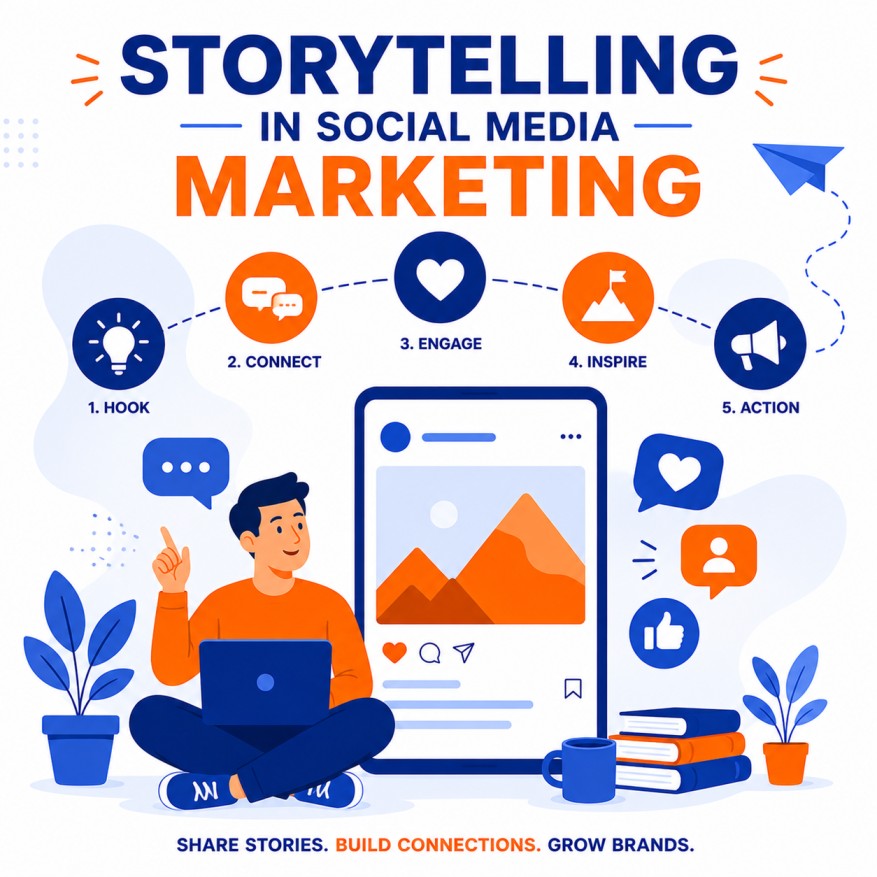
1. Hook – Compress – Invite Ideal for fast feeds. Open with an immediate hook (problem, surprising result, or tension), rapidly compress the story into its essential beats, and end with an invitation (comment, save, share, or next step).
2. Before – After – Bridge Show the painful “before” state, the desirable “after,” and position your brand/product/insight as the bridge. Extremely effective for transformation and product stories.
3. Problem – Agitation – Solution (PAS) Name the problem, intensify the emotional or practical cost of leaving it unsolved, then present the solution.
4. Simplified Hero’s Journey Ordinary world → Challenge → Struggle → Turning point → Transformation → Lesson. Works especially well for founder stories, customer case studies, and personal brands.
5. Curiosity Gap / Open Loop Start with a claim or situation that creates an information gap the audience wants closed. Deliver the payoff later in the post or video.
6. Micro-Story (Situation – Moment – Lesson) Perfect for very short content: set a quick scene, show a pivotal moment, extract a clear takeaway.
7. Episodic / Serialized Storytelling Tell one larger story across multiple posts, Reels, or carousel slides. This builds anticipation and habitual viewing.
Choose the framework based on goal: awareness and emotion favor Hero’s Journey or open loops; conversion favors Before-After-Bridge or PAS.
Platform-Specific Storytelling Strategies
TikTok and Instagram Reels / YouTube Shorts Speed and authenticity rule. Hook in the first 1–3 seconds with tension, a bold claim, or visual pattern interrupt. Keep narratives tight (15–60 seconds ideal for many stories). Use native trends, sounds, and editing styles without forcing them. Text overlays and captions are essential. Behind-the-scenes, “day in the life,” transformation, and micro-failure stories perform strongly. Duolingo’s character-driven, humorous, serialized approach remains a benchmark for brand personality.
Instagram (Feed, Carousels, Stories) Carousels excel at multi-act stories—each slide can represent a scene. Use strong cover slides as hooks. Stories (ephemeral) are ideal for sequential, behind-the-scenes, or interactive narratives (polls, questions, countdowns). Visual storytelling is paramount; pair images with concise, emotional captions.
LinkedIn Professional audiences respond to career arcs, lessons from failure, customer transformation stories, and industry insights framed as narrative. Longer text posts with clear structure (hook in the first two lines before “see more”) perform well. Founder and employee stories humanize companies. Document-style posts and carousels can support more detailed narratives.
X (Twitter) Threads are natural vehicles for micro-stories or sequential reveals. Lead with a strong hook tweet, develop the narrative across subsequent tweets, and close with a lesson or call to action. Real-time or observational storytelling also thrives here.
Facebook Community and longer-form emotional stories still resonate, particularly with certain demographics. Customer spotlights, local stories, and values-driven narratives often perform well.
Across all platforms, native execution beats cross-posted content. Adapt length, tone, visual style, and pacing to each environment.
Types of Stories That Drive Results
- Origin stories — Why the brand or product exists. Specificity and vulnerability increase impact.
- Customer transformation stories — Real people moving from struggle to success (with permission and authenticity).
- Founder and employee stories — Humanize the brand and build trust.
- Behind-the-scenes and process stories — Demystify the work and create intimacy.
- Micro-failure and lesson stories — Build relatability and authority through honesty.
- Values-in-action stories — Show (don’t just claim) what the brand stands for.
- User-generated and community stories — Amplify customer voices.
- Educational narratives — Teach through story rather than dry instruction.
- Serialized brand lore — Recurring characters, ongoing plots, or thematic series that reward followership.
How to Create Compelling Stories Consistently
- Build a story bank — Collect customer wins, internal moments, failures, insights, and observations. Interview customers and team members regularly.
- Start with the audience’s world — Center their desires, fears, and identity, not your product features.
- Write the hook first — If the opening does not stop the scroll, the rest rarely matters.
- Use concrete details — Names, numbers, sensory language, and specific moments beat abstractions.
- Show vulnerability selectively — Authentic struggle creates connection; constant negativity erodes trust.
- End with resonance or invitation — Leave the audience with a feeling, insight, or clear next step.
- Repurpose intelligently — A single core story can become a Reel, a carousel, a LinkedIn post, a thread, and Stories frames—each adapted natively.
- Involve real people — Customers, employees, and creators almost always outperform pure brand voice.
Measuring Storytelling Success
Move beyond vanity metrics. Track:
- Engagement rate and quality (comments that continue the story or share similar experiences)
- Watch time and completion rates for video
- Saves and shares (strong signals of value)
- Click-through and conversion rates on story-driven CTAs
- Sentiment and brand lift
- Follower growth quality and community health
- Downstream pipeline or sales influence where attributable
The best stories generate conversation and repeated exposure, not just one-time likes.
Common Mistakes to Avoid
- Making the brand the hero instead of the customer
- Being vague or overly polished (perfection reduces relatability)
- Forcing product mentions too early or too heavily
- Ignoring platform culture and formats
- Telling the same type of story repeatedly without variety
- Neglecting the hook
- Using storytelling as decoration rather than strategy
- Failing to listen and respond to the stories your audience tells back
Building a Sustainable Storytelling System
Treat storytelling as a core capability, not a campaign tactic. Develop:
- A clear brand narrative foundation (why you exist, who you serve, what you believe)
- Ongoing mechanisms for capturing stories (customer interviews, internal rituals, content audits)
- A content calendar that balances story types and funnel stages
- Creative guidelines that protect authenticity while maintaining brand coherence
- Feedback loops with performance data and audience responses
In 2026 and beyond, audiences increasingly reward participation, serial content, human voices, and genuine point of view over controlled, overly produced brand messaging. Brands that build with their communities—amplifying real stories rather than only broadcasting polished ones—create durable advantage.
Conclusion
Storytelling on social media is not about becoming a novelist or producing cinematic ads. It is about consistently finding and sharing specific, emotional, relevant human moments that help your audience see themselves, feel understood, and move closer to a better version of their story—with your brand as a meaningful part of that journey.
Master the fundamentals: put the customer at the center, create tension, deliver authentic resolution, and adapt ruthlessly to each platform. Build systems that surface stories regularly. Measure what matters. Over time, the accumulation of well-told stories becomes one of the strongest competitive moats a brand can have—because while products can be copied and ads can be outbid, a genuine connection built through narrative is far harder to replicate.
Start with one true story this week. Make the hook irresistible, keep the human element front and center, and invite your audience into it. That is how storytelling compounds on social media.

Author