Why Feedback Surveys are the Catalyst for Conversion Rate Optimization (CRO)
In the highly competitive landscape of digital marketing and eCommerce, driving traffic to a website is only half the battle. The true measure of success lies in converting those visitors into paying customers, subscribers, or leads. This is the domain of Conversion Rate Optimization (CRO).
Traditionally, CRO has been heavily reliant on quantitative data—heatmaps, click-through rates, bounce rates, and session durations. However, a massive paradigm shift is occurring. Marketers are realizing that while numbers tell you what is happening, they rarely tell you why.
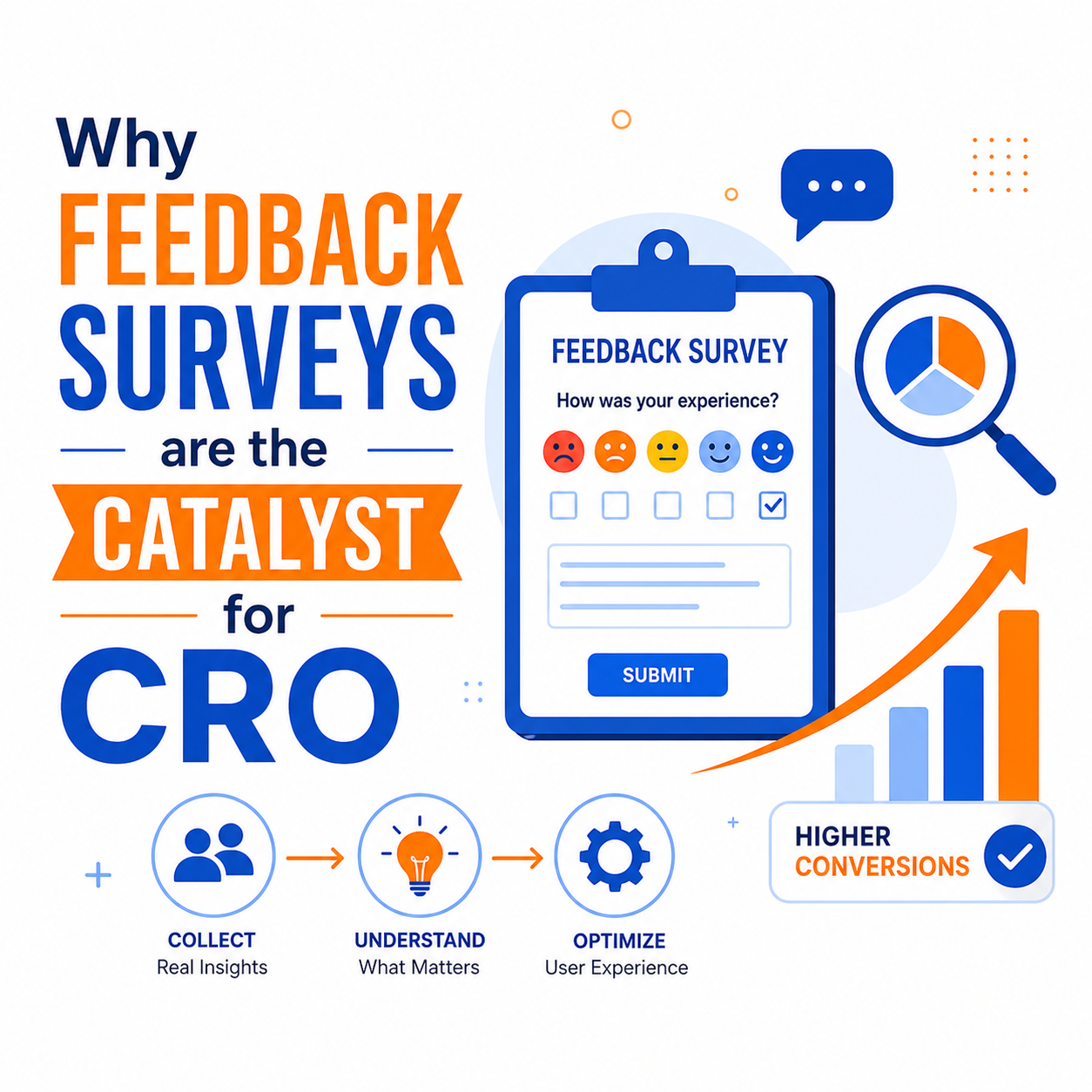
This is where the feedback survey becomes an indispensable tool. By capturing the authentic voice of the customer (VoC), feedback surveys bridge the gap between numerical data and human psychology.
The Blind Spot of Quantitative Analytics
Web analytics platforms like Google Analytics are incredibly powerful. They can show you that 75% of your users abandon their carts on the shipping page. They can highlight that visitors are spending less than ten seconds on your landing page.
However, looking purely at quantitative analytics is like watching a silent movie. You can see the actions, but you cannot hear the dialogue.
The Quantitative Limitation: Analytics will tell you that a user bounced from your checkout page. A feedback survey will tell you they bounced because the shipping costs were unexpectedly high, or because their preferred payment method wasn’t available.
Without qualitative feedback, CRO teams are forced to guess. Guessing leads to misguided A/B tests, wasted resources, and stagnant conversion rates. Surveys eliminate this guesswork by providing direct, actionable insights straight from the source: your users.
The Core Benefits of Feedback Surveys in CRO
Integrating feedback surveys into your CRO strategy yields several profound advantages that directly impact your bottom line.
1. Uncovering Friction Points and Usability Issues
Friction is the enemy of conversion. It encompasses anything that slows down, confuses, or frustrates a user. Often, these friction points are invisible to website owners who are too close to the product. A simple exit-intent survey asking, “What prevented you from completing your purchase today?” can unearth issues like broken links, confusing navigation, or unclear product descriptions.
2. Understanding User Motivation and Intent
Not all visitors come to your site with the same goal. Some are in the research phase, comparing features, while others are ready to buy. By asking questions like, “What is the main reason for your visit today?” you can segment your audience based on intent. This allows you to tailor your messaging, offers, and user pathways to match specific psychological drivers.
3. Discovering Missing Information
A common reason for non-conversion is a lack of crucial information. Users might have questions about warranties, sizing, integrations, or return policies that aren’t addressed on the page. A subtle slide-in survey asking, “Is there anything missing on this page?” can highlight exactly what content needs to be added to push a prospect over the line.
4. Validating Value Propositions
Your value proposition is the core promise you make to your customers. But does it resonate with them? Are you highlighting the benefits they actually care about? Post-purchase surveys can ask, “What was the main reason you decided to buy from us?” If the answers differ from your marketing copy, you have a massive opportunity to optimize your messaging to reflect the true value your customers perceive.
Types of CRO Feedback Surveys & When to Use Them
To extract the most value from feedback surveys, you must use the right format at the precise moment in the user journey.
| Survey Type |
Best Time to Trigger |
Primary CRO Goal |
| Exit-Intent Surveys |
When a user’s cursor moves to close the tab or browser. |
To uncover the specific reasons for cart abandonment or site bounce. |
| On-Page / Slide-In |
After a user scrolls a certain percentage or spends time on a page. |
To identify missing information, confusing copy, or usability bugs on specific pages. |
| Post-Purchase Surveys |
Immediately on the “Thank You” or order confirmation page. |
To understand what finally convinced them to buy and identify your strongest value propositions. |
| Net Promoter Score (NPS) |
Sent via email post-delivery or after a specific period of usage. |
To gauge overall brand loyalty and identify areas for long-term product/service improvement. |
| Customer Effort Score (CES) |
Immediately after a customer service interaction or complex task. |
To measure how easy or difficult it is to interact with your business, aiming to reduce future friction. |
Formulating the Right Questions for Maximum Insight
The quality of your data depends entirely on the quality of your questions. Bad questions lead to skewed data.
Best Practices for Question Design:
-
Keep it Open-Ended (When Possible): Multiple-choice questions limit the user to answers you have already thought of. Open-ended questions allow for unexpected, highly valuable insights.
-
Avoid Leading Questions: Don’t ask, “How much do you love our new feature?” Instead, ask, “How would you describe your experience with our new feature?”
-
Focus on the “Why”: Actionable CRO insights come from understanding motivations.
High-Converting Survey Questions:
-
For Landing Pages: “Were you able to find the information you were looking for today?”
-
For Pricing Pages: “What is your biggest concern about our pricing?”
-
For Checkout Pages: “Is there anything preventing you from completing your purchase right now?”
-
For Post-Purchase: “What was the single biggest challenge you faced when buying from us?”
-
For Churning Users: “What would it take for you to use our service again?”
Best Practices for High-Converting Surveys
Even the best-designed surveys are useless if no one fills them out. Implementing surveys requires a delicate balance; you want data, but you don’t want to annoy your visitors.
-
Keep it Micro: Respect your users’ time. The most effective on-site surveys ask only one or two questions. Long, paginated surveys should be reserved for email campaigns to highly engaged segments.
-
Incentivize (Strategically): Offering a discount code or entry into a giveaway can drastically increase response rates. However, be cautious: incentives can sometimes attract low-quality data from people just looking for the reward.
-
Target Meticulously: Don’t show the same survey to every visitor. Use targeting rules to show specific questions to specific users (e.g., only show the pricing survey to users who have visited the pricing page twice in one session).
-
Nail the Timing: A survey that pops up the second a user lands on the page is highly intrusive and will likely be dismissed. Trigger surveys based on behavior, such as time on page, scroll depth, or exit intent.
The Action Phase: Turning Feedback into A/B Tests
The ultimate importance of a feedback survey is not the data itself, but the action it inspires. Feedback is the raw material for your A/B testing roadmap.
The CRO Cycle: Analyze Analytics $\rightarrow$ Launch Survey $\rightarrow$ Identify Friction $\rightarrow$ Formulate Hypothesis $\rightarrow$ Run A/B Test $\rightarrow$ Implement Winner.
Example Scenario:
-
The Analytics: Google Analytics shows a 60% drop-off on your SaaS product’s pricing page.
-
The Survey: You implement a slide-in survey on the pricing page asking: “Is our pricing clear?”
-
The Feedback: Multiple users reply, “I don’t understand if the ‘Pro’ plan includes multiple user seats.”
-
The Hypothesis: “If we explicitly state ‘Up to 5 Users Included’ on the Pro tier pricing card, then conversions will increase because we are removing a specific point of confusion.”
-
The A/B Test: You test the original pricing card against the new one with the clarified text.
-
The Result: Conversions increase by 15%.
Conclusion
In the modern era of Conversion Rate Optimization, relying solely on quantitative data is an incomplete strategy. By neglecting the qualitative “why” behind user behavior, businesses leave money on the table. Feedback surveys are the most direct, cost-effective, and insightful method for understanding exactly what your customers need, what they fear, and what ultimately drives them to convert. When you stop guessing and start listening, your conversion rates will inevitably rise.