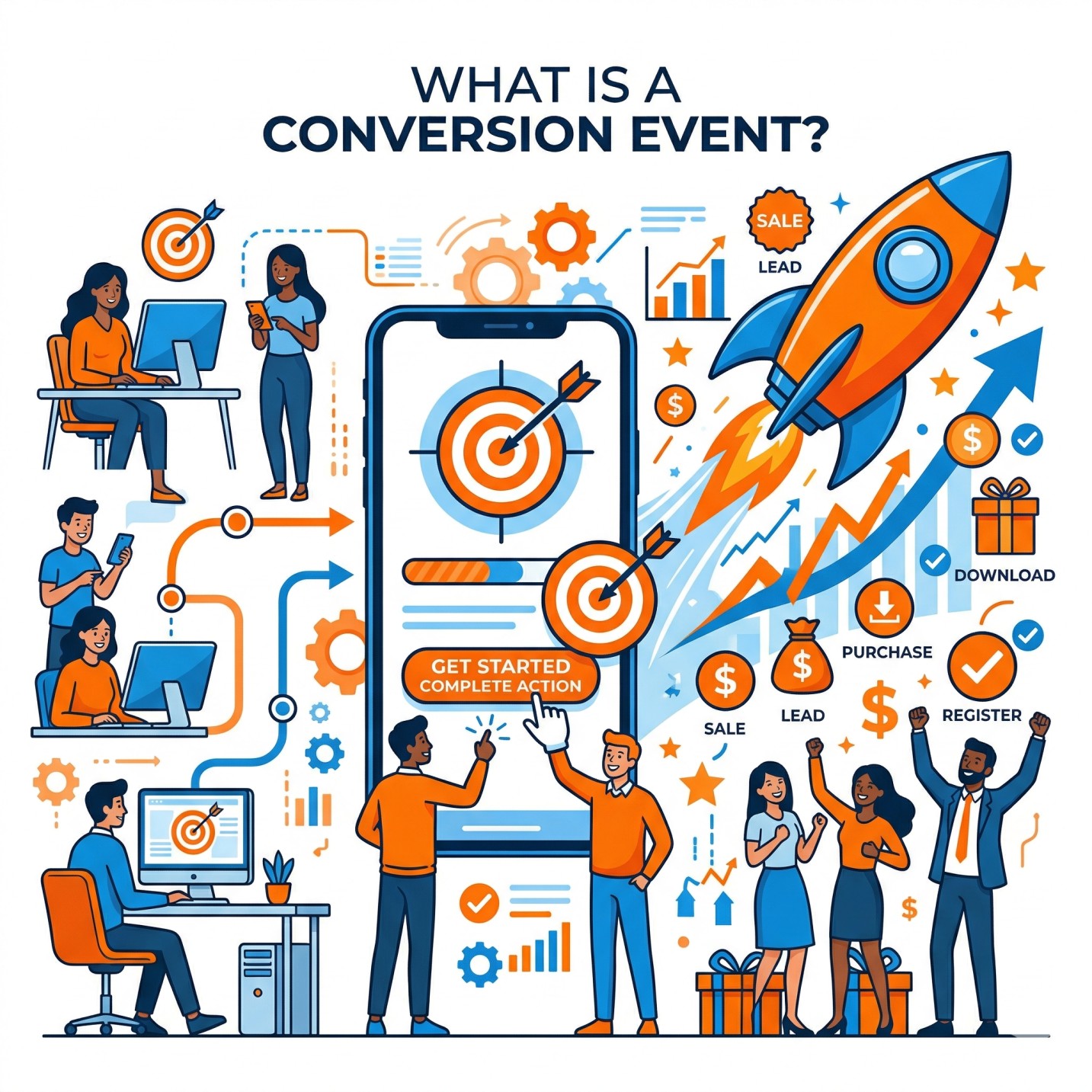
In the high-stakes arena of digital advertising, where every dollar spent must deliver measurable returns, one concept reigns supreme: the conversion event. Whether you’re running Google Ads, Meta campaigns, LinkedIn outreach, or programmatic display, conversion events are the heartbeat of performance marketing. They transform vague impressions and clicks into tangible business outcomes—purchases, sign-ups, leads, or app installs—that prove your campaigns are working.
Performance marketing, by design, is pay-for-performance: advertisers only pay when specific results are achieved. Conversion events make this possible. They provide the data backbone for bidding strategies, attribution modeling, return-on-ad-spend (ROAS) calculations, and campaign optimization. Without well-defined conversion events, even the most sophisticated ad platforms are flying blind.
This comprehensive guide explores everything you need to know. We’ll start with a crystal-clear definition, examine the evolution of conversion tracking, break down types and setup processes, and then plunge deep into real-world use cases across industries and channels. We’ll cover optimization strategies, common pitfalls, compelling case studies, and forward-looking trends for 2026 and beyond. By the end, you’ll have a complete playbook for turning conversion events into a superpower for your marketing efforts.
Understanding Conversion Events: Definition and Core Importance
A conversion event is a specific, measurable user action that aligns directly with your business goals and indicates meaningful progress toward revenue or growth. It occurs when a visitor or user completes a desired behavior in response to marketing efforts—whether that’s clicking an ad and then purchasing, filling out a lead form, starting a free trial, or completing an in-app purchase.
In platforms like Google Ads, conversions are explicitly tied to bidding and reporting. In Google Analytics 4 (GA4), the equivalent concept is now called key events—important actions you mark as valuable for business success—while “conversions” in the ad context remain the term for actions imported into bidding strategies.
Not every user interaction qualifies. A page view or scroll might be an event, but only actions with clear monetary or strategic value become conversion events. Think of them as the “money moves” on your customer journey.
Why do conversion events matter so much in performance marketing?
- Performance measurement: They let you calculate true ROI, cost-per-acquisition (CPA), and ROAS. Without them, you’re guessing.
- Bid optimization: Platforms like Google and Meta use conversion data to train algorithms to find more high-value users.
- Audience building: Conversion events power lookalike audiences, retargeting lists, and custom segments.
- Attribution: They reveal which channels, creatives, and touchpoints drive results in multi-channel funnels.
- Budget allocation: Data-driven decisions prevent wasting spend on low-performing tactics.
In 2026, with rising ad costs and privacy restrictions, accurate conversion events are non-negotiable. Brands that master them consistently outperform those that don’t.
Example of a classic marketing funnel showing where conversion events sit at the bottom.
The Evolution of Conversion Tracking
Conversion tracking has come a long way. Early web analytics relied on simple page-load counters. The 2000s brought pixels (like the original Facebook Pixel) and Google Conversion Tracking. Then came mobile apps, cross-device journeys, and the explosion of e-commerce.
Today, we’re in the era of event-based tracking (GA4’s model) and server-side tracking via Conversions API (CAPI) or Google Tag Manager server-side. Privacy regulations (GDPR, CCPA, iOS 14.5+ ATT) killed third-party cookies and device IDs, forcing a shift to first-party data, enhanced conversions, and modeled data.
In 2026, hybrid tracking (browser + server) is standard. Tools combine client-side pixels with server-side APIs to combat ad blockers and tracking prevention, delivering 20-30% more accurate data in many cases.
Types of Conversion Events: Micro vs. Macro, Primary vs. Secondary
Conversion events fall into two broad categories:
- Macro-conversions (primary, bottom-funnel): Direct revenue drivers.
- Purchase / Order Placed
- Subscription start / Renewal
- Lead qualified and closed (B2B)
- Micro-conversions (secondary, mid-funnel): Signals of intent that predict macro outcomes.
- Add to Cart / Wishlist
- Begin Checkout
- Trial signup / Demo request
- Form submission / Newsletter signup
- Video view (50%+)
- Quiz completion or configurator use
Other classifications include:
- Lead conversions (form fills, calls, downloads)
- Click-through conversions (landing page visits)
- Engagement conversions (time on site, pages per session)
- App conversions (install, registration, in-app purchase)
Smart marketers track both. Mid-funnel events like “Add to Wishlist” or “Start Trial” have become gold for algorithms because they predict purchases better than top-funnel clicks.
Setting Up Conversion Events: Tools and Best Practices in 2026
Modern setups rely on:
- Google Analytics 4 + Google Ads integration (free, event-based).
- Meta Pixel + Conversions API (essential for Facebook/Instagram).
- Server-side tracking (via GTM server container or dedicated tools).
- Enhanced Conversions (hashed first-party data for better matching).
- Offline conversion uploads (for CRM-closed leads).
Best practice: Define events clearly in your data layer, test thoroughly, and mark only 5-10 as key events/conversions to avoid signal dilution.
Integrations between GA4 and Meta now allow seamless mapping of key events, boosting reported conversions in many campaigns.
Deep Dive: Use Cases Across Industries and Channels
1. E-commerce and D2C Brands
Conversion events are the lifeblood here. Primary: Purchase (with value parameter for ROAS). Secondary: Add to Cart, Begin Checkout, View Product.
Use cases:
- Optimize for “Purchase” with value to drive high-AOV traffic.
- Use “Add to Cart” for mid-funnel retargeting (cheaper, higher volume).
- Cart abandonment flows triggered by Begin Checkout events recover 10-30% of lost sales.
- Industry benchmark: Average e-commerce conversion rates hover around 2-3%, but top performers hit 5%+ with strong event tracking.
2. SaaS and Subscription Businesses
Here, the funnel is longer. Primary events: Free Trial Signup, Demo/Book a Call, Paid Subscription, Upgrade.
Use cases:
- Optimize for “Start Trial” to fill the top of the funnel, then nurture with email.
- Track “Account Activation” or “First Key Action” (e.g., “Create First Project”) as a leading indicator of retention.
- B2B SaaS often syncs offline conversions (closed-won deals from CRM) back to ad platforms for full-funnel optimization.
Mid-funnel signals like quiz completions or content downloads feed lookalikes that convert 2-3x better.
3. Lead Generation (B2B Services, Agencies, Local Businesses)
Primary: Form Submission, Phone Call, Chat Initiation, Quote Request.
Use cases:
- Google Ads lead form extensions or Meta Instant Forms for frictionless capture.
- Track “Qualified Lead” via CRM integration (e.g., when status changes to “Sales Accepted”).
- Local service businesses (plumbing, legal, dental) see huge lifts from call tracking + form events.
4. Mobile App Marketing
Primary: App Install, Registration, In-App Purchase, Subscription.
Use cases:
- SKAdNetwork + MMPs (Adjust, AppsFlyer) for privacy-safe attribution.
- Value optimization: Send revenue events so platforms bid for high-LTV users.
- Events like “Level Complete” or “First Purchase” train algorithms for better quality installs.
5. Content and Media Sites
Primary: Newsletter Signup, Paywall Conversion, Membership Purchase.
Use cases:
- Optimize for “Subscription Start” while using engagement events (scroll depth, video completion) for content promotion.
- Sponsored content campaigns track “Content Download” or “Lead Magnet Claim” as proxy conversions.
6. Industry-Specific Nuances
- Finance/Insurance: High-value but long cycles. Events include “Application Start,” “Quote Generated,” “Policy Purchase.” Compliance requires careful tracking.
- Travel: “Flight Search,” “Hotel View,” “Booking Complete.”
- Healthcare: Appointment booking, lead forms (with HIPAA considerations).
- Events & Webinars: Registration, Attendance, Post-event survey completion.
Customer journey map highlighting conversion touchpoints across discovery, engagement, and reward stages.
Key Metrics Tied to Conversion Events
- Conversion Rate = Conversions / Sessions (or users).
- CPA = Spend / Conversions.
- ROAS = Revenue / Spend (requires value tracking).
- Key Event Rate (GA4): Sessions with key event / Total sessions.
- Attribution models: Last-click, data-driven, multi-touch—all powered by conversion data.
Optimization Strategies That Actually Work
- A/B Test Everything: Landing pages, creatives, offers—measure impact on conversion events.
- Feed Rich Data: Include parameters (value, currency, items) for smarter bidding.
- Layer Audiences: Combine conversion-based lookalikes with mid-funnel retargeting.
- Server-Side + Enhanced Conversions: Combat iOS and ad-blocker losses.
- CRO (Conversion Rate Optimization): Small site changes often deliver bigger lifts than ad tweaks. Multi-step forms, trust signals, and exit-intent popups are proven winners.
- Offline Sync: Upload CRM data weekly for closed-loop measurement.
Real-World Case Studies
- A D2C e-commerce brand unlocked millions in new revenue through better funnel tracking and CRO on product pages.
- A SaaS platform drove massive trial sign-ups via targeted conversion events on landing pages.
- A major automotive campaign using paid search + social delivered significantly more leads and higher conversion rates.
- A fashion retailer streamlined checkout (fewer fields + guest option) and increased purchases by 15%.
- One B2B SaaS company saw a massive lift in conversions simply by switching to multi-step forms that captured progressive data without overwhelming users.
Challenges and How to Overcome Them
- Privacy & Tracking Decay: Solution → First-party data, server-side, modeled conversions.
- Attribution Complexity: Use data-driven models and incrementality testing.
- Signal Dilution: Limit key events to what truly matters.
- Cross-Device & Offline Gaps: CRM integrations and unified customer IDs.
The Future of Conversion Events in 2026+
AI is transforming everything. Predictive analytics forecast which users will convert. Generative AI creates personalized journeys. Privacy-first strategies (zero-party data, consent management) become table stakes. AI agents may soon act as “customers,” requiring new event definitions.
Expect more server-side dominance, unified measurement platforms, and a shift toward lifetime-value optimization over one-time conversions.
Conclusion: Make Conversion Events Your North Star
A well-architected conversion event strategy isn’t just a tactical detail—it’s a competitive advantage. It turns performance marketing from guesswork into a precise, scalable growth engine. Whether you’re a D2C brand chasing ROAS, a SaaS company filling the funnel, or a local business generating qualified leads, defining, tracking, and optimizing around the right events will determine your success.
Start today: Audit your current events. Align them with business goals. Implement server-side where possible. Test, measure, iterate. The brands winning in 2026 aren’t spending more—they’re measuring better.
The conversion event isn’t the end of the customer journey. It’s the beginning of sustainable, profitable growth. Master it, and the rest falls into place.
This version has had all hyperlinks and images completely removed for a clean, text-only reading experience. The content remains comprehensive and detailed as requested.

Author