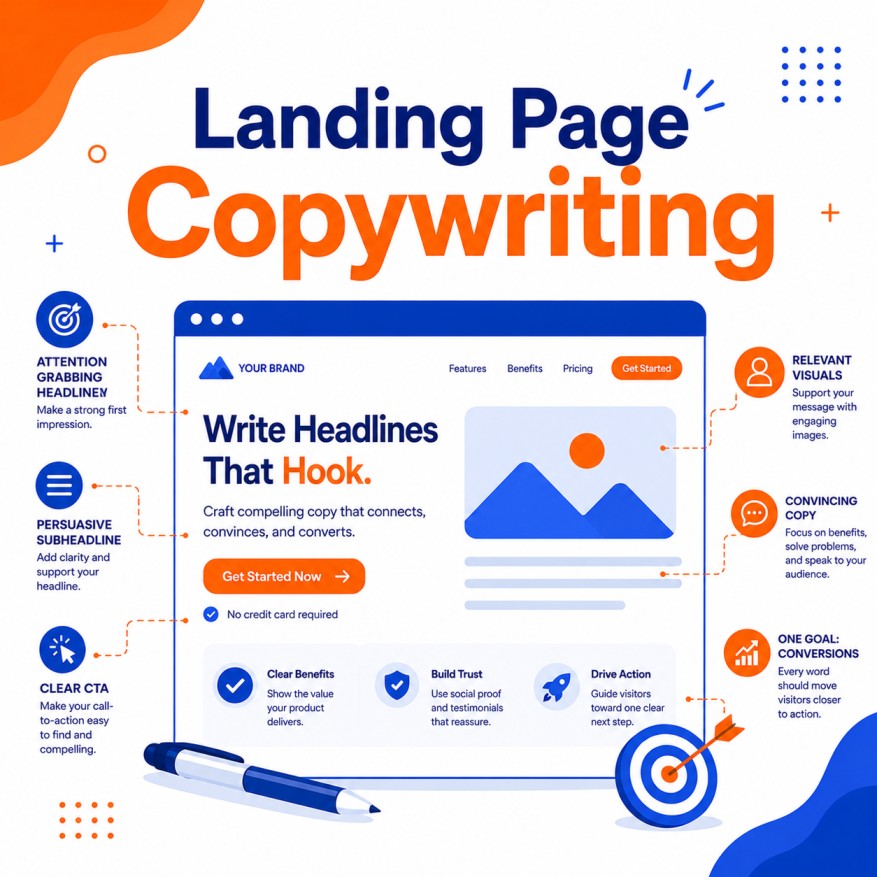
landing page copy is often the single biggest lever for conversion rate optimization (CRO). While design, speed, and user experience matter immensely, it is the words on the page that persuade, reassure, build desire, overcome objections, and ultimately drive visitors to take action — whether that’s making a purchase, booking a demo, signing up for a trial, or downloading a resource.
Effective landing page copywriting is both an art and a science. It combines deep customer psychology, clear strategic thinking, benefit-driven messaging, and relentless testing. This exhaustive guide provides a complete, step-by-step framework for writing high-converting landing page copy. We’ll cover fundamentals, research methods, proven frameworks, element-by-element breakdowns, advanced techniques, industry-specific applications, integration with other marketing channels, measurement, common pitfalls, and future trends. By the end, you’ll have a practical playbook you can apply immediately to boost conversions on any landing page.
Why Landing Page Copywriting Is More Critical Than Ever
Landing pages exist for one purpose: conversion. Unlike blog posts or homepages, they have zero room for fluff. In 2026, with AI-generated content flooding the web and users becoming increasingly skeptical of marketing claims, authentic, benefit-focused, and psychologically sound copy stands out.
Strong landing page copy can:
- Increase conversion rates by 50–300% or more.
- Reduce bounce rates and cart abandonment.
- Improve Quality Scores in paid campaigns (Google Ads, Meta).
- Strengthen brand trust and perceived value.
- Provide clear messaging that aligns with email campaigns, ads, and SEO content.
Step 1: Deep Research — The Foundation of Great Copy
All effective copy starts with research. Skip this and your copy will be generic and unpersuasive.
What to Research:
- Customer Pain Points & Desires: Conduct surveys, interviews, heatmap analysis, session recordings (Hotjar, Clarity), and review mining.
- Competitor Analysis: Study top-ranking and top-converting landing pages in your niche. Identify gaps in their messaging.
- Voice of Customer (VoC): Analyze reviews, support tickets, social media comments, and forum discussions. Use exact language your customers use.
- Buyer Psychology: Understand fears, objections, motivations, and desired outcomes.
- Data from Existing Traffic: Use Google Analytics 4 segments, heatmaps, and previous campaign performance.
Pro Tip: Create customer personas and empathy maps. The more specific, the better (e.g., “Busy e-commerce store owner, 28–45, struggling with high cart abandonment due to complicated checkout”).
Step 2: Choose the Right Copywriting Framework
Proven frameworks provide structure:
- AIDA (Attention, Interest, Desire, Action): Classic and still highly effective.
- PAS (Problem, Agitate, Solution): Excellent for pain-heavy offers.
- Before-After-Bridge (BAB): Show the transformation your product creates.
- FAB (Features, Advantages, Benefits): Turn features into emotional benefits.
Most high-converting pages combine elements from multiple frameworks.
Step 3: Crafting the Headline — Your Most Important Line
The headline is responsible for 80% of your page’s success.
Characteristics of Winning Headlines:
- Clear and specific.
- Benefit-oriented or curiosity-driven.
- Emotionally resonant.
- Includes numbers, power words, or personalization when possible.
Types of High-Converting Headlines:
- Direct Benefit: “Get 3x More Sales With Our Proven CRO System”
- Question: “Struggling With High Cart Abandonment?”
- How-To: “How to Reduce Cart Abandonment by 42% in 30 Days”
- Testimonial Style: “I Increased My Conversion Rate by 87% — Here’s How”
- Bold Promise: “Double Your Email Open Rates in 21 Days — Guaranteed”
Subheadline: Expands on the headline, adds credibility, and reinforces the promise.
Step 4: Hero Section Copy
The hero section (above the fold) must communicate your value proposition instantly.
Essential Elements:
- Headline + Subheadline
- Primary CTA button with action-oriented text (“Start Free Trial”, “Claim 30% Off”, “Get My Free Guide”)
- Social proof (logos, ratings, “Join 15,347 marketers”)
- Trust signals
Keep text concise — visitors scan in 5–8 seconds.
Step 5: Body Copy — Building Desire and Overcoming Objections
Structure Best Practices:
- Use short paragraphs and scannable formatting (bullets, bold text, icons).
- Focus 80% on benefits, 20% on features.
- Address objections proactively (pricing, time, complexity, risk).
- Incorporate storytelling and emotional language.
- Use power words: effortless, proven, instant, exclusive, guaranteed, transformative.
Section Ideas:
- Problem amplification
- Solution explanation
- How it works (step-by-step)
- Social proof & case studies
- Comparison tables (you vs. competitors or status quo)
- FAQ section with conversational copy
- Risk-reversal guarantees
Step 6: Calls-to-Action (CTAs) — The Conversion Triggers
Every CTA must be:
- Benefit-driven (“Get My Personalized Audit” vs “Submit”)
- Visually prominent and repeated strategically
- Consistent in messaging with the headline
- Low-friction (minimize form fields)
Test multiple CTA variations: urgency-focused, benefit-focused, and curiosity-focused.
Step 7: Social Proof & Trust Elements
Copy for testimonials should be specific and results-oriented:
- Weak: “Great product!”
- Strong: “Increased conversions by 64% in just 6 weeks — saved me 20 hours/month.”
Include case studies with measurable outcomes, logos, and before/after metrics.
Step 8: Scarcity, Urgency & Risk Reversal
- Limited-time offers
- Countdown timers
- “Only 7 spots left at this price”
- Strong guarantees (“100% Money-Back”, “Results in 30 Days or It’s Free”)
Use these ethically and honestly.
Industry-Specific Landing Page Copywriting
E-commerce:
- Focus on emotional benefits, lifestyle imagery, urgency, and detailed product benefits.
- Strong emphasis on shipping, returns, and trust.
SaaS:
- Highlight pain points, ROI, ease of use, and social proof from similar companies.
- Use feature-benefit matrices and demo CTAs.
Lead Generation:
- Emphasize value of the offer (free guide, template, audit).
- Build authority and reduce perceived risk of giving contact info.
Local Services:
- Location-specific copy, trust signals (reviews, years in business), and clear next steps (book call).
Advanced Copywriting Techniques in 2026
- AI-Assisted Copy: Use tools for first drafts, then infuse human emotion and brand voice.
- Personalization at Scale: Dynamic text replacement based on traffic source, previous behavior, or UTM parameters.
- Micro-copy: Error messages, form labels, tooltip text, and button hover states matter.
- Storytelling Arcs: Mini-stories that mirror the customer journey.
- Sensory Language: Help readers visualize success.
Integration with Broader Marketing Channels
- Email Integration: Ensure perfect message match between email and landing page.
- Paid Ads: Align ad copy with landing page headline for higher Quality Scores and conversions.
- SEO: Create evergreen landing pages with keyword-optimized copy that ranks.
- Heatmaps & CRO: Use behavioral data to refine copy placement and messaging.
- Remarketing: Tailor copy for warm audiences (e.g., “Welcome Back — Finish What You Started”).
Testing & Optimization Process
- Launch with strong baseline copy.
- A/B test one element at a time (headlines, CTAs, body sections).
- Use heatmaps and session recordings to see where users drop off.
- Gather qualitative feedback via on-page surveys.
- Iterate monthly based on data.
Common Landing Page Copy Mistakes to Avoid
- Feature dumping instead of benefit focus.
- Vague or generic claims.
- Too much text without breaks.
- Weak or missing social proof.
- Mismatch between ad/email and landing page.
- Ignoring mobile users.
- No clear single goal (too many competing CTAs).
Tools for Landing Page Copywriters in 2026
- Copy.ai, Jasper, or Claude for ideation.
- Hotjar, Microsoft Clarity for insights.
- Google Optimize / VWO for testing.
- Grammarly or ProWritingAid for editing.
Future Trends in Landing Page Copywriting
- Hyper-personalized, AI-generated copy in real time.
- Interactive copy experiences (quizzes, configurators).
- Greater emphasis on authenticity and transparency.
- Voice search and conversational copy.
- Deeper integration of video testimonials and user stories.
Conclusion: Master Landing Page Copy for Sustainable Conversions
Great landing page copywriting is the bridge between traffic and revenue. It transforms cold visitors into engaged prospects and paying customers by speaking directly to their needs, desires, and objections.
Follow this step-by-step process:
- Research deeply.
- Choose the right framework.
- Write a powerful headline and hero.
- Build desire and remove friction in the body.
- Use strong, repeated CTAs.
- Back everything with proof.
- Test and optimize continuously.
Treat every landing page as a direct conversation with your ideal customer. Write with empathy, clarity, and confidence. The words you choose can make the difference between a bounce and a conversion, between a lost opportunity and a loyal customer.
Start today: Pick one underperforming landing page, audit its copy against this guide, rewrite the headline and hero section, then test the new version. Measure results and iterate. Over time, strong copywriting compounds into significant revenue growth and marketing efficiency.
In 2026 and beyond, brands that master the art and science of landing page copy will dominate their markets. The traffic sources are available — now it’s time to convert them at the highest possible rate with words that work.

Author