Email marketing remains one of the most powerful, controllable, and highest-ROI channels in the entire digital marketing ecosystem. Even in 2026, with advanced AI tools, short-form video dominance, and evolving privacy regulations, a well-crafted marketing email can outperform most other tactics in driving direct revenue, customer loyalty, and long-term engagement.
However, not all emails are created equal. The difference between an email that gets opened, clicked, and converted versus one that lands in the promotions tab or gets deleted instantly lies in its anatomy — the strategic structure, design, psychology, and technical foundation that works together as a cohesive unit.
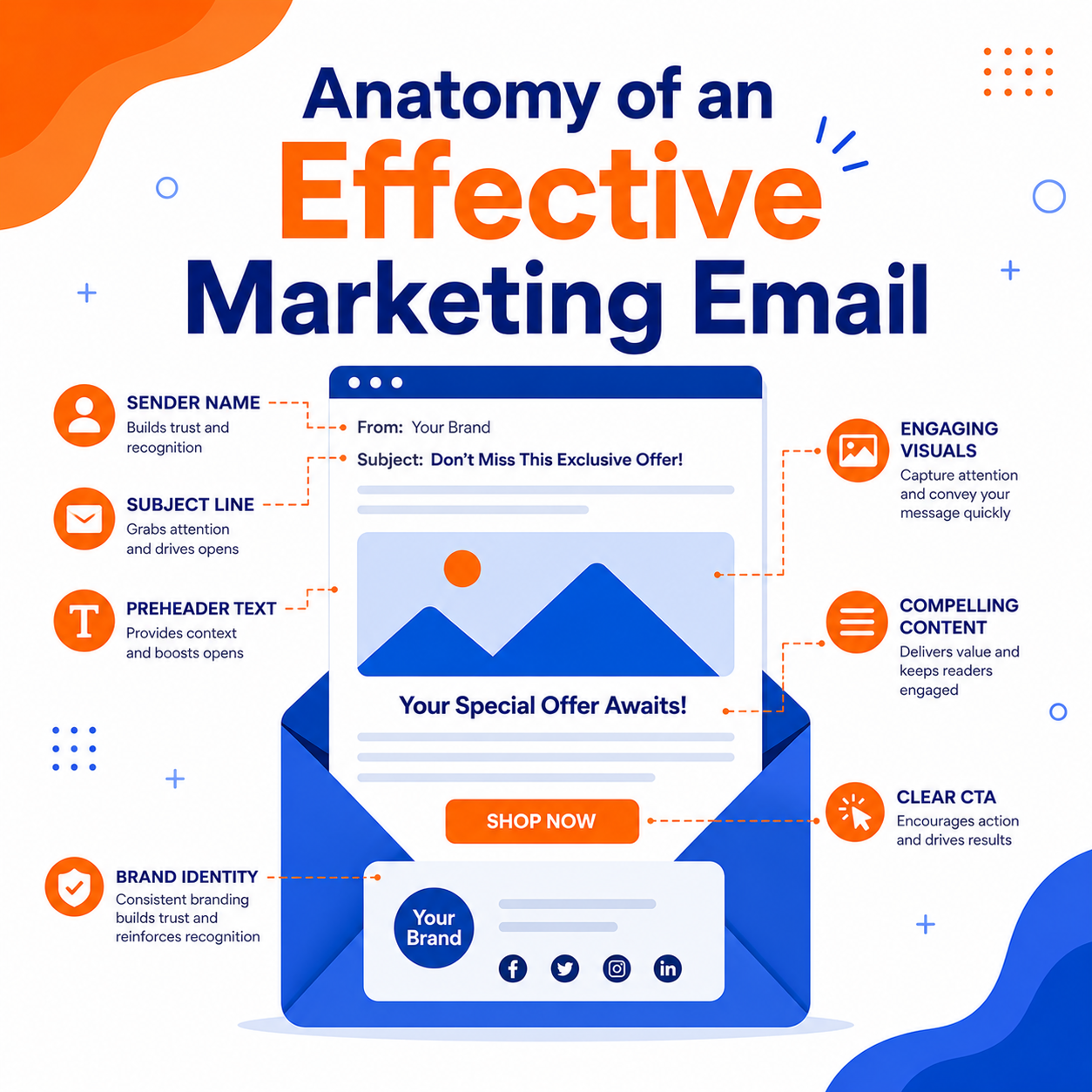
This exhaustive guide breaks down the complete anatomy of an effective marketing email. We’ll examine every single component in depth, explain why it matters, provide real-world examples and best practices for 2026, share data-backed insights, and show how to optimize each element for maximum open rates, click-through rates (CTR), and conversions. Whether you’re sending promotional campaigns, newsletters, automated flows, or transactional emails, this article will serve as your definitive playbook.
1. The Foundation: Strategy Before Structure
Before diving into the anatomy, remember that an effective email starts with strategy:
- Clear Objective: Every email should have one primary goal (e.g., drive sales, build engagement, reduce churn, onboard users).
- Audience Segmentation: The right message to the right person at the right time.
- Brand Voice Consistency: Maintain tone across all customer touchpoints.
- Compliance & Deliverability: GDPR, CCPA, CAN-SPAM, and inbox provider rules.
- Mobile-First Mindset: Over 50-70% of emails are opened on mobile devices.
With strategy aligned, let’s dissect the anatomy.
2. Subject Line: The Gatekeeper
The subject line is the most important element of your email. It determines whether your message gets opened or ignored.
Best Practices for 2026:
- Length: 35–50 characters (ideally under 60 to avoid truncation).
- Personalization: Use first names, location, or behavior-based triggers (e.g., “Nitin, your cart is waiting…”).
- Power Words: Free, New, Exclusive, Limited, Urgent, Secret, Proven.
- Numbers & Specificity: “Get 35% Off Today” performs better than “Big Sale.”
- Curiosity & Questions: “Are you making this common CRO mistake?”
- Emojis: Use sparingly and test — they can increase opens by 10-20% when relevant.
- Avoid Spam Triggers: All caps, excessive punctuation (!!!), or words like “Guarantee” in certain contexts.
Pro Tip: Test 3–5 subject line variations using A/B testing. Top performers often combine personalization + benefit + urgency.
Examples of High-Performing Subject Lines:
- “[First Name], Your Exclusive 25% Off Ends Tonight”
- “The 7 email mistakes costing you sales (fix #3 today)”
- “New arrivals just dropped – which one’s yours?”
3. Preheader Text: The Second Chance
The preheader (preview text) appears right after the subject line in most inboxes. It is often overlooked but can boost open rates by 10–15%.
Best Practices:
- Complement, don’t repeat, the subject line.
- Add extra value or context.
- Include a soft CTA or teaser.
- Keep it under 100 characters.
- Example: Subject: “Summer Sale Starts Now” → Preheader: “Up to 40% off + free shipping on orders over $50. Shop before it ends.”
4. Sender Name & From Address: Building Trust
- Sender Name: Use a recognizable, human name (e.g., “Nitin from GrowthBrand” or “Team at Shopify”) rather than just the company name.
- From Address: Use a branded domain (no-reply@yourbrand.com is acceptable but “hello@yourbrand.com” feels warmer).
Strong sender reputation directly impacts deliverability and open rates.
5. Header / Logo Area
- Include your logo with a link back to the homepage.
- Keep it clean and lightweight for fast loading.
- Add a subtle navigation menu (Home, Shop, Blog) for easy exploration.
6. Hero Section: The Attention Grabber
This is the first major visual block users see.
Key Elements of a Strong Hero:
- High-quality, relevant hero image or GIF.
- Compelling headline that matches the email’s promise.
- Subheadline that expands on the benefit.
- Prominent primary CTA button.
- Strong color contrast and hierarchy.
2026 Best Practices: Use subtle animations (if supported), personalized hero text, or dynamic content based on user segment.
7. Body Content: The Persuasion Engine
This is where value is delivered.
Structure Tips:
- Scannable layout: Short paragraphs, bullet points, bold text.
- Storytelling: Problem → Agitation → Solution (your offer/product).
- Benefit-focused copy rather than feature dumping.
- Visual hierarchy: Large images, icons, and whitespace.
- Social proof: Embedded testimonials or review snippets.
- Urgency/Scarcity: Limited stock, countdown timers, or expiring offers.
For newsletters, focus on educational value with multiple story blocks. For promotional emails, keep content focused on one main offer.
8. Calls-to-Action (CTAs): The Conversion Drivers
Effective emails usually have 1–3 CTAs, with one primary.
Best Practices:
- Use action-oriented, benefit-driven text: “Shop the Sale” → “Get My 30% Off Now”
- Make buttons large, high-contrast, and mobile-friendly.
- Repeat the CTA 2–3 times (top, middle, bottom).
- Use multiple button styles (text links + buttons) for accessibility.
- Track every CTA separately with UTM parameters.
9. Social Proof & Trust Elements
- Customer testimonials with photos.
- Review ratings (stars).
- Logos of trusted partners or media mentions.
- Security badges (for checkout-related emails).
- User-generated content (photos from real customers).
10. Footer: The Legal & Relationship Section
The footer should include:
- Unsubscribe link (clear and easy).
- Physical address (for compliance).
- Social media icons with links.
- Contact information.
- Preference center link (highly recommended in 2026).
- Copyright notice.
A well-designed footer builds trust and reduces spam complaints.
Design & Technical Best Practices
- Mobile Responsiveness: Test on multiple devices.
- Load Time: Keep total email size under 100KB when possible.
- Accessibility: Alt text for images, sufficient color contrast, semantic HTML.
- Dark Mode Compatibility: Design for both light and dark themes.
- Interactive Elements: AMP for email (where supported) for carousels, forms, or RSVPs.
Personalization & Dynamic Content
In 2026, basic personalization (first name) is table stakes. Advanced techniques include:
- Dynamic product recommendations.
- Behavior-triggered content blocks.
- Location-based offers.
- Purchase history customization.
Tools like Klaviyo, Braze, and ActiveCampaign excel at this.
Timing, Frequency & Send Strategy
- Best days: Tuesday–Thursday for B2B; weekends for consumer brands (test your audience).
- Optimal time: Early morning or late afternoon.
- Frequency: Quality over quantity. “Fewer, better emails” wins in 2026.
Metrics: How to Measure Success
Primary KPIs:
- Open Rate
- Click-Through Rate (CTR)
- Click-to-Open Rate (CTOR)
- Conversion Rate
- Revenue per Email Sent
- Unsubscribe & Spam Complaint Rate
- Forward/Share Rate
Aim for continuous improvement through rigorous A/B testing.
Different Email Types & Their Anatomy Variations
- Newsletters: More content-heavy, educational, multiple sections.
- Promotional: Strong hero, urgent CTAs, product grids.
- Abandoned Cart: Personalized, reminder-focused, strong urgency.
- Welcome Series: Progressive onboarding across multiple emails.
- Transactional: Functional, clear, trust-building.
Common Mistakes to Avoid
- Overloading with too many offers.
- Poor mobile experience.
- Generic, non-personalized content.
- Weak or missing CTAs.
- Ignoring deliverability fundamentals.
- Too much sales pressure with no value.
Future Trends in Email Design & Strategy
- AI-assisted copywriting and design.
- Greater interactivity (polls, quizzes, embedded forms).
- Privacy-first personalization using zero-party data.
- Video and cinematic emails.
- Deeper integration with landing pages and omnichannel journeys.
Conclusion: Master the Anatomy for Email Excellence
An effective marketing email is far more than copy and a button — it is a carefully engineered piece of communication where every element works in harmony to earn attention, build trust, deliver value, and drive action.
By mastering the full anatomy — from subject line to footer — you transform email from a broadcasting tool into a sophisticated relationship and revenue channel. The brands winning in 2026 treat every email as a product: thoughtfully designed, rigorously tested, and relentlessly optimized.
Action Plan to Improve Your Emails Today:
- Audit your last 10 campaigns against this anatomy checklist.
- Pick one weak element (e.g., subject lines or CTAs) and improve it this week.
- Implement A/B testing on every send.
- Map your emails to dedicated, message-matched landing pages.
- Build a reusable template system based on this structure.
When executed with strategy, creativity, and data-driven iteration, a single well-anatomized marketing email can generate thousands in revenue, hundreds of new relationships, and lasting brand affinity.
The inbox is still one of the most direct lines to your audience. Respect it, optimize every part of your email’s anatomy, and watch your marketing results compound month after month.
Start building better emails today — your subscribers (and your revenue) will thank you.

Author