
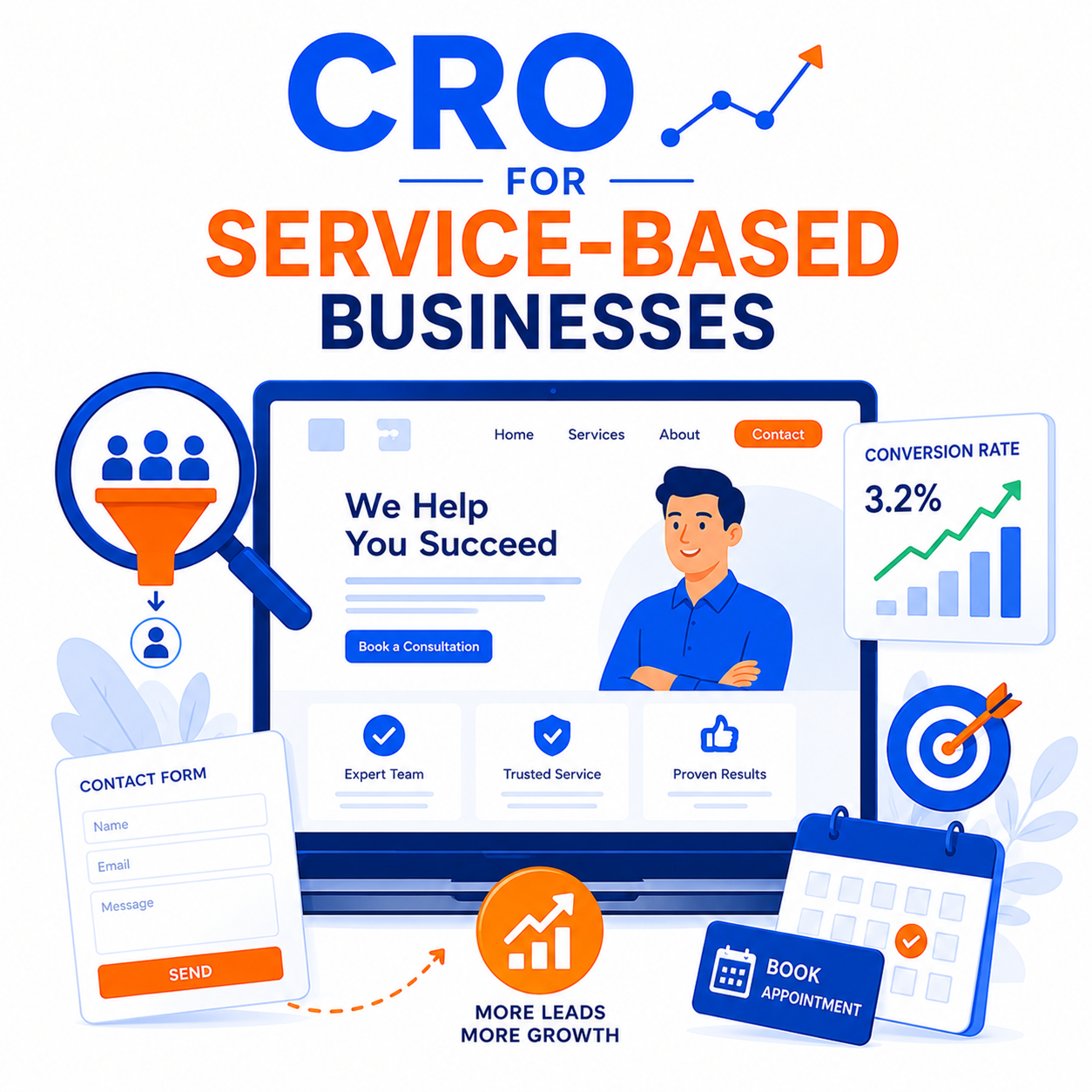
Conversion Rate Optimization (CRO) is the systematic process of improving the percentage of website visitors who take a desired action — whether booking a consultation, submitting a contact form, downloading a proposal, signing a contract, or starting a free audit. While CRO is often associated with e-commerce, service-based businesses (consulting firms, marketing agencies, law practices, accounting firms, coaching businesses, IT services, architecture firms, healthcare practices, and B2B SaaS service providers) face unique challenges and opportunities.
Unlike product businesses with instant purchases, service businesses typically have longer sales cycles, higher customer acquisition costs, and decisions based on trust, expertise, and perceived value. This makes CRO both more complex and potentially more rewarding — small improvements in conversion rates can lead to massive revenue gains because of high lifetime value per client.
This exhaustive guide provides a complete, step-by-step playbook for implementing CRO in service-based businesses. We’ll cover strategy, psychology, technical tactics, website element optimization, lead qualification, testing methodologies, tools, integration with other channels, real-world patterns, common pitfalls, and emerging trends for 2026 and beyond.
Why CRO Is Different (and Critical) for Service-Based Businesses
Service businesses differ from e-commerce in several key ways:
- Longer Decision Cycles: Buyers research extensively and need multiple touchpoints before committing.
- High-Stakes Purchases: Clients invest significant money and trust, making risk perception a major barrier.
- Intangible Value: You’re selling expertise, outcomes, and relationships rather than physical products.
- Relationship-Driven: CRO must focus on building trust and authority alongside direct conversions.
- Lead Quality Over Quantity: A lower volume of highly qualified leads often outperforms high-volume, low-quality traffic.
In 2026, with rising competition and ad costs, service businesses that master CRO enjoy:
- 20–100%+ increases in qualified leads
- Lower Cost Per Lead (CPL)
- Higher close rates
- Improved client retention and referrals
- Stronger brand positioning
The CRO Framework for Service Businesses
Effective CRO follows a continuous cycle: Research → Hypothesis → Test → Analyze → Implement → Repeat.
Phase 1: Deep Research & Audit
- Qualitative Research: Client interviews, win/loss analysis, heatmap & session recordings (Hotjar, Microsoft Clarity), on-page surveys.
- Quantitative Research: Google Analytics 4, heatmaps, form analytics, scroll depth analysis.
- Competitor Analysis: Study top-ranking service websites in your niche.
- User Journey Mapping: Map every stage from awareness to booking.
Phase 2: Identify High-Impact Pages
Priority pages for service businesses:
- Homepage
- Service/Offering pages
- About / Team pages
- Case Studies / Results pages
- Pricing / Packages pages
- Contact / Booking pages
- Blog / Resources pages
Phase 3: Core CRO Strategies for Service Businesses
1. Homepage Optimization
- Hero Section: Clear, benefit-driven headline focused on client outcomes (not features). Example: “We Help SaaS Companies Reduce Churn by 34% on Average” instead of “Digital Marketing Agency.”
- Social Proof: Prominent client logos, testimonials with measurable results, and trust badges.
- Clear Value Proposition: Answer “Why choose us?” in under 10 seconds.
- Strong CTA: Multiple prominent buttons leading to consultation booking or lead forms.
2. Service Pages Optimization
- Use problem-agitate-solution framework.
- Detailed benefit breakdowns with client outcomes.
- FAQ sections addressing common objections.
- Clear next-step CTAs (e.g., “Book Your Strategy Call”).
3. Trust & Authority Building
- Case studies with before/after metrics.
- Team bios with credentials and photos.
- Industry awards, certifications, and media mentions.
- Security and compliance badges (especially important for finance, legal, healthcare).
4. Lead Capture & Qualification
- Multi-step forms that qualify leads progressively.
- Smart lead magnets (free audits, templates, consultations).
- Exit-intent popups with compelling offers.
- Chatbots and scheduling tools (Calendly, Cal.com) integrated seamlessly.
5. Pricing Page Optimization
- Tiered pricing with clear value differentiation.
- Most popular plan highlighted.
- Risk-reversal guarantees (“Results in 90 Days or Your Money Back”).
- Transparent pricing or “Get Custom Quote” options.
6. Booking & Consultation Flow
- One-click or low-friction scheduling.
- Pre-qualification questions to ensure high-intent leads.
- Confirmation pages with next steps and calendar integration.
Advanced CRO Tactics for Service Businesses
- Personalization: Dynamic content based on traffic source, industry, or previous behavior.
- Micro-Commitments: Start with small asks (free resource) before big ones (paid consultation).
- Video Testimonials & Case Studies: Embedded client videos build massive trust.
- Content Upgrades: Turn blog posts into lead-generating experiences.
- Retargeting Sequences: Use website behavior to trigger personalized email or ad follow-ups.
- A/B Testing Roadmap: Prioritize high-traffic, high-impact pages first.
Tools Stack for Service Business CRO in 2026
- Analytics: Google Analytics 4 + BigQuery
- Heatmaps & Recordings: Microsoft Clarity (free & powerful), Hotjar
- Testing: VWO, Optimizely, Google Optimize alternatives
- Forms & Lead Management: Typeform, Tally, HubSpot
- Scheduling: Calendly, Cal.com with smart routing
- CRM: HubSpot, Salesforce, Pipedrive
- Heatmap-Driven Insights: FullStory or Contentsquare for enterprise
Measurement & KPIs for Service CRO
Primary Metrics:
- Lead Conversion Rate (visitors → qualified leads)
- Consultation Booking Rate
- Cost Per Qualified Lead (CPQL)
- Sales Close Rate from leads
- Return on Marketing Investment (ROMI)
Secondary Metrics:
- Time on Page, Scroll Depth, Form Abandonment Rate
- Bounce Rate on key pages
- Micro-conversions (PDF downloads, video plays)
Use attribution modeling to understand the full customer journey, especially for longer B2B cycles.
Integration with Broader Marketing Channels
- Landing Pages: Perfect message match from ads and emails.
- Email Marketing: Nurture sequences for leads who don’t book immediately.
- Performance Marketing: Align Google Ads, Microsoft Ads, and LinkedIn campaigns with optimized landing pages.
- Content Marketing & SEO: Use blog traffic to feed lead generation funnels.
- Social Media (Instagram Reels, LinkedIn, Bluesky): Drive qualified traffic to optimized service pages.
Common Challenges & Solutions for Service Businesses
- Long Sales Cycles: Solution — Focus on lead nurturing and multi-touch attribution.
- High Perceived Risk: Solution — Strong guarantees, case studies, and transparent processes.
- Generic Websites: Solution — Deep personalization and industry-specific messaging.
- Low Form Completion: Solution — Simplify forms, add progress indicators, and use smart conditional logic.
- Seasonality: Solution — Create evergreen CRO assets and campaign calendars.
Real-World Patterns from Successful Service Businesses
High-performing service companies in 2026 typically:
- Invest heavily in trust-building elements.
- Use data-driven personalization.
- Maintain consistent CRO testing programs.
- Focus on client outcomes in all messaging.
- Combine strong organic SEO with targeted paid campaigns.
Future Trends in Service Business CRO (2026+)
- AI-powered conversational lead qualification.
- Predictive lead scoring on websites.
- Greater use of video and interactive experiences.
- Privacy-first personalization using zero-party data.
- Deeper integration between website CRO and sales team workflows.
Your 90-Day CRO Action Plan for Service Businesses
Month 1: Comprehensive audit + heatmap analysis + competitor research. Month 2: Prioritize and redesign high-impact pages (homepage, key service pages, booking flow). Month 3: Launch A/B tests, implement lead nurturing, and measure initial results. Ongoing: Monthly testing cycles and quarterly strategy reviews.
Conclusion: CRO as a Growth Superpower for Service Businesses
Conversion Rate Optimization is one of the highest-leverage activities for service-based businesses. Unlike product companies, your success depends on building deep trust and demonstrating clear value — areas where thoughtful CRO shines brightest.
By systematically researching your audience, optimizing every touchpoint, testing rigorously, and focusing on qualified lead generation rather than vanity metrics, you can transform your website from a digital brochure into a powerful 24/7 sales engine.
Start today: Pick one critical page (most likely your homepage or primary service page), run a full audit using heatmaps and analytics, identify the biggest friction points, and create a hypothesis for improvement. Small, consistent changes compound into extraordinary results.
The businesses winning in 2026 are not necessarily the ones with the biggest marketing budgets — they are the ones that convert the highest percentage of their hard-earned traffic into loyal, high-value clients.

Author