
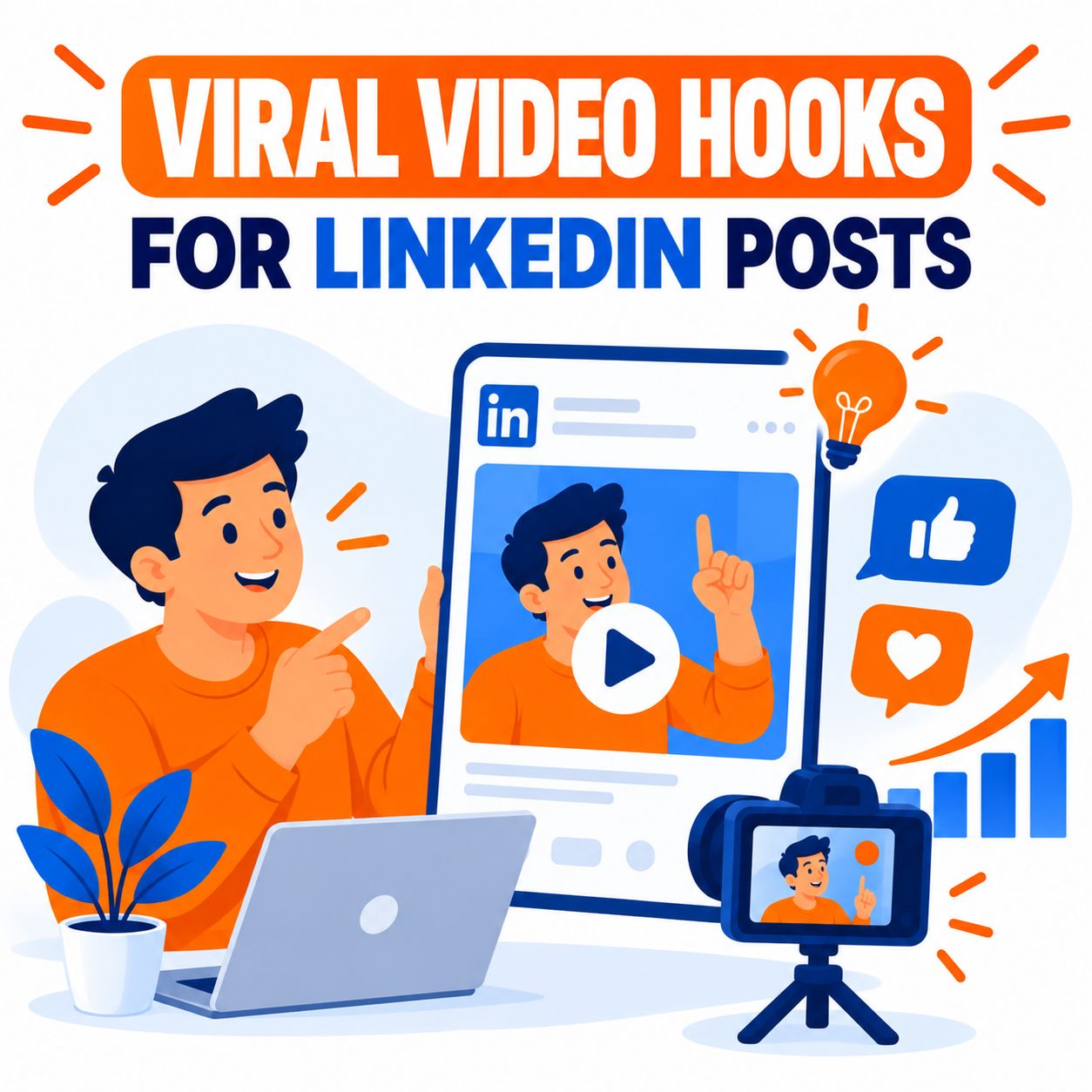
On LinkedIn, the first one to three seconds of a video (and the accompanying text hook that appears in the feed) decide whether someone stops scrolling or keeps moving. LinkedIn’s feed is professional, information-dense, and competitive. Users are often in a “work mode” mindset—scanning for insights, credibility, results, or relevant stories rather than pure entertainment. A weak opening means the algorithm receives weak early engagement signals, distribution stalls, and the rest of your content never gets a fair chance.
A strong video hook creates an immediate pattern interrupt, opens a curiosity gap, signals value or authority, and makes the viewer feel that continuing to watch will be worth their time. This guide breaks down the psychology, proven structures, video-specific techniques, dozens of adaptable examples, caption synergy, common mistakes, and a practical system for consistently creating hooks that drive views, watch time, comments, and shares on LinkedIn.
Why Hooks Matter More Than Ever on LinkedIn
- The majority of users decide within the first couple of seconds whether to engage.
- LinkedIn truncates post text, so the visible opening lines must work independently of the video.
- Early watch time, replays, comments, and saves heavily influence further distribution.
- Professional audiences respond strongly to specificity, credibility, results, and contrarian or story-driven openings.
- Video posts that hold attention past the opening seconds earn significantly more reach than those that lose viewers immediately.
Data from large post analyses consistently shows that story openings, specific claims with numbers, and well-crafted contrarian statements tend to outperform generic questions or slow introductory setups.
The Psychology of a Scroll-Stopping LinkedIn Video Hook
Effective hooks typically activate one or more of these triggers:
- Curiosity gap — The viewer needs the missing information.
- Specificity and proof — Concrete numbers, timeframes, or outcomes feel credible and scannable.
- Pattern interrupt — Something unexpected (visual, verbal, or conceptual) breaks the scrolling rhythm.
- Authority or lived experience — Signals that the speaker has relevant insight.
- Emotional or narrative pull — A scene, confession, or tension that invites the viewer into a story.
- Relevance and self-interest — The viewer quickly sees “this is about people like me / problems I have.”
- Contrarian tension — A claim that challenges a common belief, prompting agreement or disagreement.
The best hooks combine more than one trigger and deliver the core promise or tension in the first 1–3 seconds of both the spoken/visual content and the text caption.
Core Principles for LinkedIn Video Hooks
- Lead with value or tension, never with throat-clearing. Skip “Hey everyone,” “In today’s video,” or long context-setting.
- Be specific. Vague claims underperform. Numbers, timeframes, concrete outcomes, and named situations work better.
- Make it visual and verbal at the same time. On-screen text, facial expression, movement, or a clear demonstration should reinforce the spoken hook.
- Match the professional context. Overly hype-driven or purely entertainment-style hooks can feel out of place; credibility and usefulness matter.
- Create an open loop. The opening should make the viewer need the next few seconds or the full video to resolve the tension.
- Align caption and video. The text that appears before “see more” should reinforce or amplify the video’s opening, not repeat it weakly.
- Optimize for sound-off and sound-on. Many LinkedIn users watch without sound initially; strong on-screen text is essential.
High-Performing Hook Categories for LinkedIn Video (With Examples)
1. Specific Result / Number-Led Hooks
These consistently perform well because specificity triggers attention and credibility.
- “I added $47K in pipeline in 11 days with one LinkedIn change.”
- “This 14-second tweak doubled our reply rate.”
- “We tested 63 hooks. Three of them drove 80% of the results.”
- “One email sequence generated 19 meetings last month. Here’s the exact structure.”
2. Story / Cold-Open Narrative Hooks
Drop the viewer into a scene or pivotal moment.
- “I got the rejection email at 4:47 p.m. on a Tuesday.”
- “Three years ago I couldn’t get 10 likes. Last month one post did 2.1 million views.”
- “My hands were shaking when I hit publish.”
- “The client call that almost ended the company started with one sentence.”
3. Contrarian or Myth-Busting Hooks
Challenge a widely held belief in your industry.
- “Most LinkedIn advice about posting frequency is wrong.”
- “Stop writing ‘I’m excited to announce’ posts. Do this instead.”
- “The biggest lie in B2B content: ‘Just be consistent.’”
- “Cold outreach isn’t dead. Bad cold outreach is.”
4. Authority + Specific Insight Hooks
Establish credibility quickly while promising a concrete takeaway.
- “After reviewing 200 sales pages, the same three mistakes kept appearing.”
- “10 years of hiring engineers taught me this uncomfortable truth.”
- “I’ve scaled three companies past $10M. The lever that mattered most was…”
5. Problem-Agitation or “You’re Doing It Wrong” Hooks
Name a common struggle and imply a better way.
- “If your LinkedIn posts are getting views but no conversations, this is why.”
- “Most founders waste their best content in the first three seconds.”
- “You’re losing deals in the proposal stage for one invisible reason.”
6. Curiosity Gap / Open-Loop Hooks
Promise an answer but withhold the key detail.
- “The one line that changed how prospects replied to us…”
- “I found the real reason high-performing posts get buried.”
- “There’s a simple structure that consistently outperforms every other format I’ve tested.”
7. Demonstration-First or Visual Pattern-Interrupt Hooks
Show something unexpected or useful immediately on screen.
- Start with a screen recording of a striking result, a before/after, a quick process, or an unusual visual while the voiceover delivers the claim.
- Use bold on-screen text that states the hook in the first frame.
- Begin with a clear physical or digital action that demands attention.
8. Transformation / Before-After Hooks
Highlight a clear shift.
- “From invisible to 50 inbound leads a month. What actually changed.”
- “I used to post daily and get nothing. Then I changed one thing.”
Video-Specific Techniques That Amplify Hooks
- On-screen text in the first frame — Many viewers watch muted. Put the core claim or question on screen immediately.
- Facial expression and energy — A strong opening expression or slight lean-in can increase hold rates.
- Movement or visual change — A cut, zoom, gesture, or screen transition in the first second helps stop the scroll.
- Direct address — Looking into the camera and speaking as if to one person increases connection.
- Caption synergy — Write the LinkedIn post text so the first 1–2 lines create their own hook, then let the video deliver the payoff or deeper explanation. Longer, value-dense captions often support video performance.
- Pacing — Deliver the hook in the first 1–3 seconds, then expand. Avoid slow builds.
- Length awareness — Hooks must work for both short videos (under 60–90 seconds) and longer ones. The opening still determines whether people stay.
How to Write and Test Hooks Systematically
- Identify the single most interesting, specific, or surprising element of your content.
- Draft 5–10 different openings using different categories above.
- Read them out loud and time the first three seconds.
- Pair the strongest verbal hook with supporting on-screen text and a clear visual.
- Write the accompanying post caption so the visible text also hooks.
- Publish and review early retention (if available), comments, and overall engagement.
- Keep a personal swipe file of your highest-performing openings and patterns that work for your audience.
Common Mistakes That Kill Video Performance
- Starting with greetings, channel intros, or lengthy context.
- Using vague or generic claims (“This will change everything”).
- Relying only on questions without specificity or stakes.
- Weak or missing on-screen text for sound-off viewers.
- Misaligned caption and video (the text says one thing, the video opens differently).
- Overly salesy or hype-heavy language that feels inauthentic on LinkedIn.
- Ignoring the first three seconds while over-investing in the middle or end of the video.
- Failing to test variations and learn from retention and engagement data.
Putting It All Together: A Simple Hook Framework
Formula elements you can mix:
- Specific number or timeframe + result
- Unexpected claim or contrarian stance
- Scene or confession opener
- Clear promise of what the viewer will learn or see
- Visual proof or demonstration in the same moment
Example combined structure:
[Specific surprising result or scene] + [Implication or open loop] → then deliver the insight, story, or framework in the body of the video.
Final Recommendations
Treat the hook as the highest-leverage part of every LinkedIn video. Spend disproportionate time crafting and testing the opening. Favor specificity, story, credible claims, and clear visual reinforcement over generic curiosity or slow setups. Align the text caption with the video so both work hard in the feed. Study what already performs in your niche, adapt the underlying structures to your voice and expertise, and continuously refine based on real retention and engagement signals.
When the first three seconds consistently earn attention, the rest of your content—stories, frameworks, lessons, and calls to action—finally gets the audience it deserves. Master the hook, and you dramatically increase the probability that your LinkedIn videos will be watched, shared, and remembered.

Author